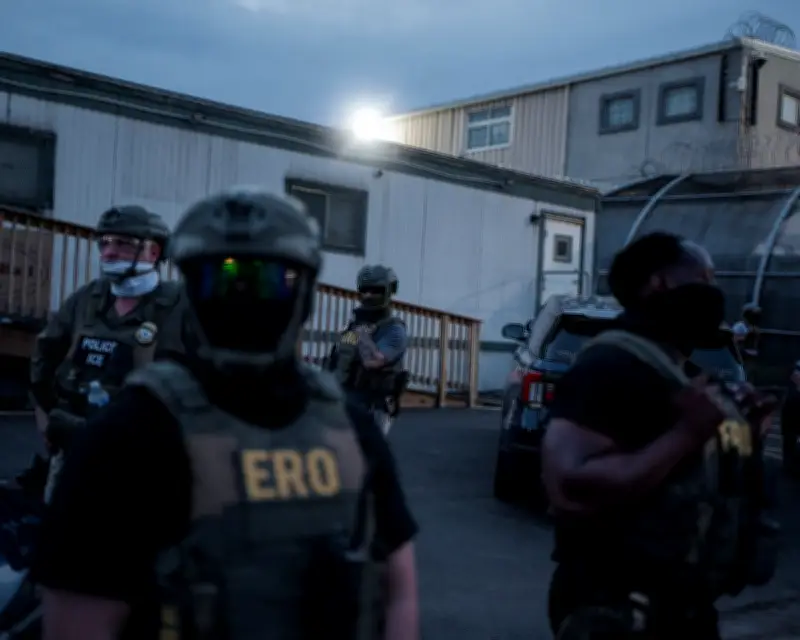
John Washington, a journalist who has reported on immigration enforcement for a decade, argues that facilities used by ICE to detain migrants should be called camps rather than detention centers. He says the word 'camp' best captures the political function of concentrating, immobilizing and excluding populations deemed unwanted.
Conditions inside ICE facilities
More than 65,000 people are currently confined in demeaning, often dangerous and increasingly deadly conditions not because they have committed a crime, but because of a civil infraction. They are ripped from their homes, families and jobs, shipped hundreds of miles away, and held in squalid, freezing conditions with limited access to lawyers, loved ones, food, sunlight or medical care. At least 52 people have died in ICE custody since the second Trump administration came into office. Tens of thousands have been held in solitary confinement.
Oversight has been gutted, members of Congress turned away, and ICE has stopped reporting basic data. A woman in Arizona detained for 16 months without proper care for her leukemia has reportedly lost more than 70lb and is regularly vomiting blood. People in a shuttered Florida camp were allegedly subjected to a two-by-two-foot outdoor punishment cage.
Historical context of the term 'camp'
Washington notes that calling such facilities 'detention centers' sanitizes their brutal reality, while using sensational nicknames like 'Alligator Alcatraz' trivializes them. He points to the historical use of concentration camps under the Third Reich, which began as holding centers for alleged subversives, and later models in Cuba, South Africa, and US Japanese American internment camps. He cites philosopher Giorgio Agamben on the 'progression' among camp variations.
A definitional aspect of detention camps is stripping legal personhood. Scholar Dan Stone writes that people in immigration camps are 'very close to falling into [Hannah] Arendt's category of the superfluous stateless person from whom the “right to have rights” has been removed.' Washington argues that US officials have used the term themselves: FDR called for concentration camps for Japanese Americans, and a 1981 immigration taskforce worried about 'the appearance of “concentration camps” which, at the present time, would be filled largely by blacks.'
Legal and physical consequences
Unlike prisons, where people are held due to alleged crimes, immigration camps lock people up for who they are or where they are from, an even more penetrating attack on personhood. The current administration is spending billions to expand the camp system and make it more painful. A Board of Immigration Appeals ruling last fall made detention indefinite without bond for many undocumented migrants. A recent fifth circuit ruling requires bond hearings within 90 days but does not guarantee release.
Despite some rollbacks, more immigrants than ever are being arrested. Recent reporting described 86 people held in a small room 'that smelled of sweat, urine and feces.' In one Texas camp, a person was told: 'You're only getting out deported or dead.' Washington concludes that the word 'camp' reveals the inhumanity rather than conceals it.