
Heba Abaid, 26, is living in a tent with her mother and two younger brothers on the spot where her family home in Khan Yunis once stood. She is one of hundreds of young Palestinian students who have been offered a place at a British university and dream of a life in the UK, away from the terrors of genocide.
Last month, the UK government confirmed it would continue helping exceptional young people leave Gaza if they were offered an unconditional place at a British university, as long as they have a full scholarship or can pay the tuition fees. Heba has very little money to her name.
Celebrities rally for Gaza students
Heba's story sparked a host of British celebrities to launch a fundraiser. Their aim was to raise enough money in an online auction to help exceptional students live their dream at a UK university. Former Match of the Day host Gary Lineker donated a signed Nagoya Grampus Eight football shirt from Japan, where he spent the final two years of his playing career. Scottish actor Brian Cox offered a signed copy of his memoir and original flyers from his productions.
Nicola Coughlan, Charlotte Church and Paloma Faith were among 18 other celebrities from sport, music and film who joined the Scholarships for Gaza online auction, organised by the charity Phoenix Space. The auction lasts until Thursday August 6, and Heba would receive a portion of any total funds raised.
She told the Mirror: "Seeing people I have admired for years, including Gary Lineker and others, stand behind my story means far more to me than I can put into words. It doesn't just make me happy... it gives me strength."
Throughout years of war and family tragedies, as well as hundreds of displacements, Heba believed her dream of continuing her education was over. But knowing people she had never met were supporting her changed her outlook on the future.
A dream of studying in the UK
Heba needs to raise a total of £32,129 to move to the UK and study for her Master's degree in Design Management at Lancaster University. She has so far raised a little more than £3,000 in a GoFundMe.
"It makes me hold on to my dream even more tightly. It has given me hope that my dream is not out of reach and it motivates me to keep fighting for it, no matter how difficult the journey is."
A home destroyed and a brother lost
Heba's home in Khan Yunis was completely destroyed in Israeli bombing, and her brother, Ahmed, was killed in the demolition. "It was a terrifying night," she said. "People were running through the streets with nowhere safe to go because the shelling surrounded us from every direction. Hundreds of people were injured in the streets and many were killed. That day, no one could move safely."
The five remaining members of the family escaped south to Rafah in January 2024. Within a few days, two-thirds of the entire Gazan population had been forcibly funnelled into the city by the Israeli Defence Forces (IDF).
Benjamin Netanyahu's government claimed the southern half of Gaza was a safe haven for civilians. But on February 9, he ordered the IDF to plan an offensive on Rafah. Just two days after Netanyahu's order, at least 44 Palestinians were killed by Israeli bombs inside the city in a single day.
Months of displacement
Heba and her mother, father and two younger brothers continued to move among refugee camps for the next four months. They lived in cramped conditions and struggled to sleep because of the destruction and fear around them. By December 2025, more than 70,000 people had died in Gaza during the war.
The family were allowed to move into the central area of Gaza by May 2024. They were closer to Khan Yunis but still displaced hundreds of times over the following 18 months.
"We moved from one place to another so many times that I've lost count," said Heba. "Each time, we had to start over from nothing, fleeing under bombardment with almost nothing. It was incredibly difficult and expensive to rebuild our lives every time... to put up a new tent, buy clothes, and find food. It truly felt like starting from zero again and again."
Her father's death
Heba's father was living with dementia and had been diagnosed with a brain tumour. During one chaotic displacement under bombardment, he was lost. The family searched for him everywhere and finally found him three weeks later, walking alone at night on one of the streets. At that moment, the area beside him was bombed.
Heba watched as her father was caught in the wreckage and left bleeding for more than two hours before anyone could reach him. "The situation was so dangerous that night," she said. "No-one could even drive their car, including the ambulances, so he had to wait more than two hours before he was finally taken for treatment."
The family could not go with him to hospital and did not know where he had been taken. He ended up in an overcrowded operating room filled with injured people, and died there after losing too much blood. "We didn't know that he had passed away," she said. "When he didn't return, we went from one hospital to another searching for him." They eventually found him in a morgue, registered as an unidentified person. Doctors told them he had died moments before they arrived.
Famine and the ICC
Shortly before Heba's father died, the IDF launched a total blockade on Gaza, banning essential supplies, aid and food from entering the strip. By August 22 2025, Gaza was officially in a famine. The blockade sparked extreme shortages of food, water and humanitarian aid, while stockpiles of relief were stored in warehouses outside Gaza.
Heba's mother became severely malnourished and, like the rest of the family, was forced to drink contaminated water. Her weight dropped to a little more than six stone. "The famine was an incredibly difficult period," said Heba. "After my father passed away, the famine became even worse. There was almost no food available and whatever food could be found was extremely expensive. My family became ill, especially my mother. She was in a very poor condition, and there was no safe drinking water available."
Nearly 450 people died inside Gaza from starvation by mid-August 2025, including 147 children, according to the Gaza Health Ministry. In November, the International Criminal Court issued arrest warrants for Benjamin Netanyahu and his former defence minister, Yoav Gallant. Judges said they had "intentionally and knowingly deprived the civilian population in Gaza of objects indespensible to their survival, including food, water, and medicine", and found reasonable grounds that they bore responsibility for the war crime of starvation.
Back to the ruins
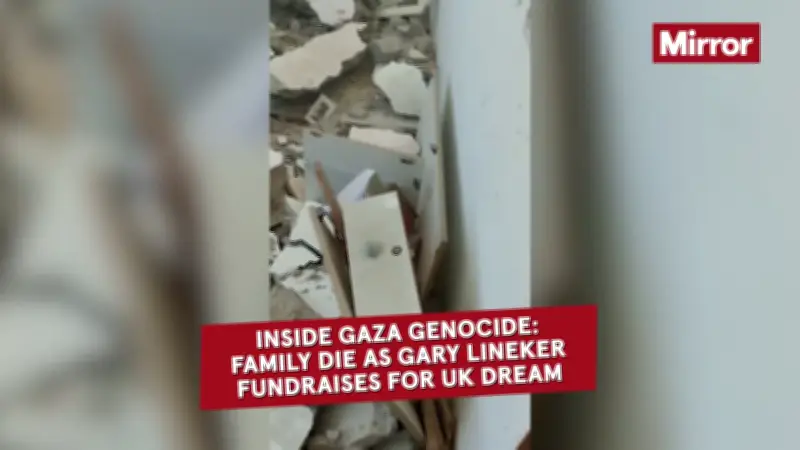
Heba's family has only recently been allowed back into their neighbourhood in Khan Yunis. They found their home reduced to rubble. A tattered old cupcake tin, the drawer from a bedside table and a lone dinner plate were strewn across the floor. They now live in a tent on top of the ashes, cooking whatever they can find on a makeshift stove.
"I refuse to give up," Heba said. "When I got my offer from Lancaster University, it felt like a dream come true. It showed me that dreams can survive, even in the middle of the war, even in the middle of genocide, even through all things we've lived through here in Gaza."
Heba raised about £3,000 on a GoFundMe before receiving her Master's offer, and hopes to combine that with funds from the celebrity auction to secure her education. "It reminds me that kindness can cross every border, and that even in the darkest moments, there are people willing to help someone they have never met, simply because they believe everyone deserves a chance." The auction remains open, and donations can also be made directly to Heba's Master's degree fund.




