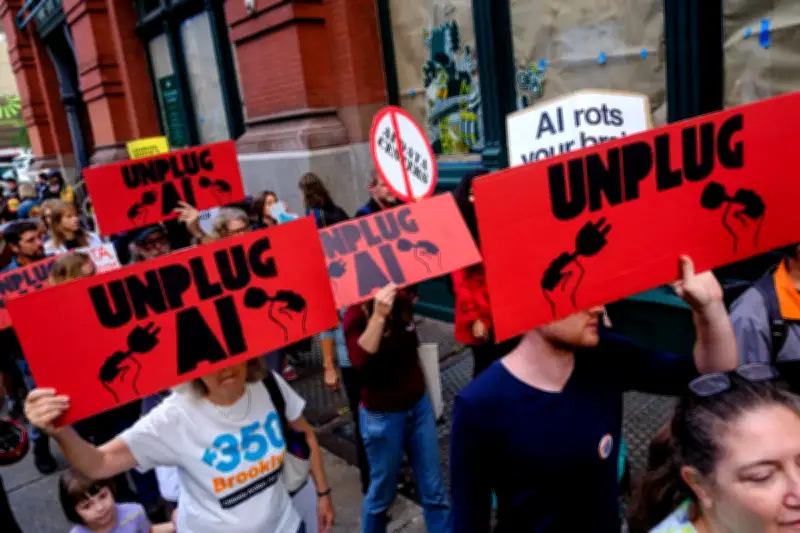
On Monday evening, protesters gathered outside the unmarked Manhattan offices of OpenAI, maker of ChatGPT, holding signs calling to “Eat the rich, save the planet”. Over the next two days, groups also picketed outside the offices of fellow tech giants Google and Amazon; other protesters, including clergy, were arrested while disrupting a closed-door AI health summit in the city. Tonight, protesters will target a Brooklyn gas power plant that was set to close – until it was purchased to power AI datacenters.
Growing AI panic and local resistance
The protests come on the heels of an Anthropic employee quitting his job with a warning that intensified an already-growing AI panic: “The people building AI earnestly believe that it could kill us all by the end of the decade.”
Though it was far from the first time an AI expert had issued a doomsday message about the threat the tech poses, this time it dominated public attention, arriving as trust in big tech has hit an all-time low and communities across the country are trying to stop the building of datacenters. From 2024 to 2026, at least $64bn in proposed datacenter buildout was blocked by local organizing. Today, bans have been passed in at least 18 states at the local or county level, and New York passed a statewide moratorium this summer.
Climate groups lead the charge
“They are claiming that they have the power to end humanity, but at the same time can’t get AI to do a lot of major things that they’re pushing for,” said Jonathan Westin of Climate Defenders and the Stop Funding Billionaires campaign, which organized the “unplug AI” week of action.
Like Westin, many of the protesters at the anti-AI protests this week were part of climate organizations, in town for New York’s climate week, a global gathering of elected officials, policy experts and advocates timed to the meeting of the United Nations general assembly. Datacenters require significant amounts of water to function and an immense amount of energy to power, often using fossil fuels, bringing pollution into communities. Organizers are calling for more datacenter moratoriums and stronger commitments to protect water access and to block fossil fuels. They say tech companies’ greed is the real threat to the environment.
Even Wall Street has warned the AI boom could cause another economic bubble to burst – one that, protesters say, will be carried on the backs of working Americans. “Regular people shouldn’t be left holding the bag for a bunch of billionaires and trillionaires to play Monopoly with our economy,” Westin said.
Broader concerns and local impacts
Other groups at this week’s protests, like the anti-war organization Code Pink, called attention to how many big tech corporations work with the US military: the US has used tech made by Palantir, xAI and Anthropic to establish targets and rain down bombs in the war in Iran – all with far-from-perfect accuracy.
Alex Hanna, director of research at the Dair Institute, an AI research organization centering communities facing environmental damage and extraction from AI, said the doomsday prophesying from tech companies and former employees are a distraction amid “the climate and ecological crisis, the rising fascism that is borne out of climate politics, the making of climate refugees, and the growing inability of people just to get by from day to day. It’s such a disconnect from what seems to be actually happening.”
Some protesters outside the OpenAI offices Monday had traveled from New Mexico, where a planned datacenter threatens the already-sapped Rio Grande and a community facing a 20-year drought. Oracle’s Project Jupiter, which is contracted to OpenAI, was pitched as a job creator for the community, but organizers say the companies aren’t talking about how it would drain the area’s limited water resources.
“There’s just so much misinformation that’s being sold, not only to the elected [officials], but to the community, and I think it’s really a disservice to the people of New Mexico for these companies to come in and just basically lie about what they’re going to do and how these projects are going to benefit communities,” said Daisy Maldonado, a resident of Doña Ana county, the planned site of the datacenter.
Arrests and political support
At an AI sustainability conference elsewhere in the city on Tuesday, five protesters were arrested for disrupting a keynote on using AI to solve the energy grid crisis. Activists called out the conference framing as “greenwashing”, or using misleading descriptions to brand something as eco-friendly or less harmful. “We do not want to greenwash these datacenters that are being built,” said Adrosto de Silva, who also traveled from New Mexico to the OpenAI protest. “There is no way that you can do harm reduction in any sort of datacenter whatsoever.”
At Monday’s protest, attendees – including the Tennessee state representative Justin Jones, who dropped in while in town for climate week – emphasized that many of these fights are happening in communities of color and poor communities, where the companies thought they wouldn’t face local backlash.
“This building behind me is a danger to humankind,” said Jones, gesturing at the OpenAI offices. “The confluence of this techno oligarchy is a threat to us all. I’m here because if they come for one of us, they’re coming for all of us.”