
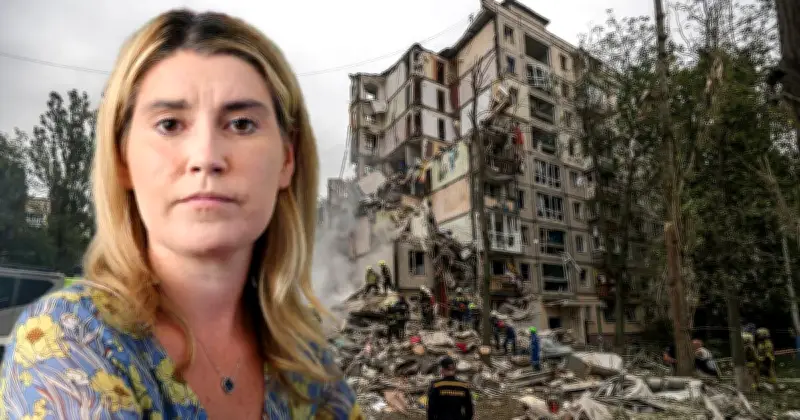
Imogen Payter, a 32-year-old British-Australian activist, has quietly worked to ensure British support for Ukraine does not falter, bringing nearly 100 elected officials and peers to the country since the Russian invasion.
From Girls' Trip to War Zone
Payter, who first met journalist David Williamson at the British Kebab Awards, went on a "girls' trip" to Kyiv in 2019 and "fell in love with Ukraine." She said, "We always said we were going to go back. I just didn't quite appreciate what circumstances it would be under."
When Russian forces invaded in February 2022, she contacted the Ukraine All-Party Parliamentary Group and helped organize an aid convoy. She has since made the journey nearly 30 times, helping to take around 100 elected officials and peers to show solidarity and see the conflict's cost. Her message is simple: "Ukraine wants their country back."
Leading UK Friends of Ukraine
Payter now heads UK Friends of Ukraine, arguing the nation can repel invaders with crucial support. She sees "desperation" in recent Russian attacks on cultural targets. "There's no real tactics anymore," she says. "It's just the destruction of Ukraine."
The humanitarian crisis forced her to choose between political ambitions and helping those under attack. She explains: "I chose not to stand [as a councillor] again because my Ukraine work was taking over, and something had to give." Her mother now shares her commitment, and they delivered water filtration kits to the Kherson frontline.
Witnessing Resilience and Devastation
Payter, born in Sydney, admits she had never been part of anything on this scale before: "Not even slightly. I'd never been to a war zone." She is impressed by the resolve of ordinary Ukrainians: "There's a real determination there. They've survived their harshest winter. They got through it."
She also sees the horrors: "You walk up and down the streets, even in Lviv, Kyiv, and you see young boys and girls with amputations. And it's just devastating. You see soldiers that have battle scars and they're meeting up with their wives or girlfriends." She adds: "I think you would struggle to find a single child in Ukraine that hasn't been personally affected by the loss of a loved one."
Sanctioned by Russia, Undeterred
Russia sanctioned her last year, barring her from entering the country. She saw it as proof of impact: "I remember my mom was like, 'Oh my goodness, what does this mean?' I was like, 'No, it's a good thing. It means I'm doing something right.'"
She notes Britons are welcomed "with open arms" in Ukraine due to early UK support. However, she fears support will dwindle and European states will not invest in defence. She says: "Ukraine's sort of holding the fort for the rest of Europe… This is a lesson on the importance of democracy and national sovereignty and the right to self-determination."
She would welcome Republicans to see the situation firsthand, and wants Ukraine to recover Crimea and Luhansk: "If Ukraine were given the adequate support in terms of air defence, and in terms of funding for their own manufacturing capabilities, I think they could very easily do that."
Long-Haul Commitment
Though she has shaken hands with Volodymyr Zelensky, she says she has not "felt the need for a sit-down with him" as he has "bigger priorities." She plans to continue her work, saying: "I'm definitely in it for the long haul, and that's where my heart lies." After the invasion, she says, there will be "years of reconstruction, years of rehabilitation, and years of really trying to fight for compensation that Ukraine deserves from Russia."




