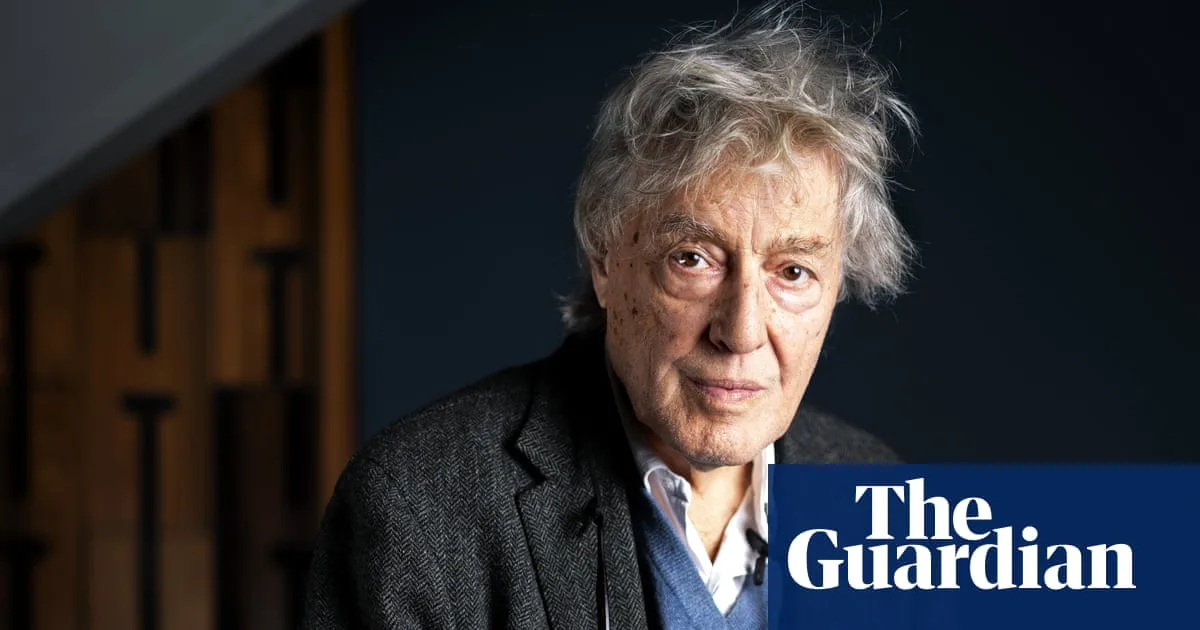
Tom Stoppard, the Czech-born British playwright whose work blended dazzling wit, playful erudition, and a restless imagination, has died at the age of 88. His breakthrough play, Rosencrantz and Guildenstern Are Dead (1966), opened on a bare stage with two minor characters from Hamlet tossing a coin, forever lost on a road to nowhere. This sense of displacement—of being far from home—echoed Stoppard’s own life: born Tomáš Straussler in Zlín, Czechoslovakia in 1937, he fled the Nazis as a toddler, later living in Singapore, India, and England.
Home in Stoppard’s work is a fitful notion, rarely found in the same place twice. While The Real Thing (1982) centres on a London playwright and is often seen as a shift toward emotional depth, his most engaging plays roam across time and space: pre-revolutionary Russia in The Coast of Utopia (2002), colonial India, and Georgian Britain. His early works, such as Jumpers (1972) and Travesties (1974), combined verbal acrobatics with a stab of distress, while later plays like Arcadia (1993) balanced lush historicism with wry romance.
Stoppard’s collaborations shaped his career. Director Peter Wood brought sparkle to early comedies; Trevor Nunn later framed his symphonic historicism. His actors included Diana Rigg’s sardonic quipsters and Felicity Kendal’s gruff yet gamine heroines, while male leads like John Wood, Bill Nighy, and Stephen Dillane embodied a quizzical, rueful tone. His adaptations of Chekhov—The Seagull, The Cherry Orchard, Ivanov—revealed a kinship with laughing-through-tears drama, where characters wrangle over domesticity as the present collapses.
Stoppard’s legacy is that of a cosmopolitan intellectual whose restless imagination created temporary homes on stage. From the lost-puppy bewilderment of Rosencrantz and Guildenstern to the affecting notions of home in Leopoldstadt, his work showed a mind on the move, always questing.