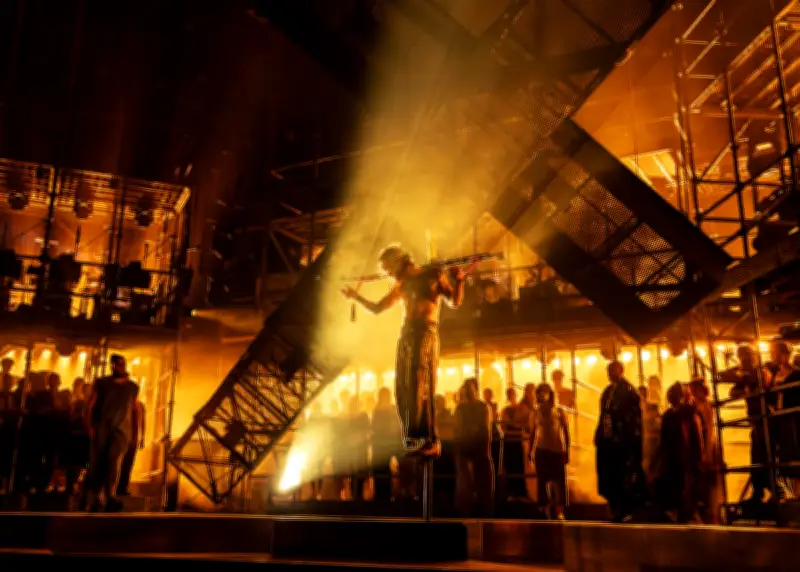
This amped-up version of Andrew Lloyd Webber and Tim Rice's rock opera is presented by the same triumvirate who near enough blew the critics – and crowds – to heaven with their 2016 revival. Tim Sheader is again director, designer Tom Scutt's set has a similar scaffold structure (but with some audience members standing around it this time) and Drew McOnie is once more the choreographer.
Production Returns to Hippy-Dom Roots
The production, in spirit, goes back not just to the first century when Jesus of Nazareth rises to become an inspiring preacher, radical tearaway and thorn in the side of the temple clerics, but also to the 1970s era of hippy-dom and flower power from which the original show arose.
Plenty of glitter is hurled around the stage but there is actual stardust in the cast as Sam Ryder plays the messiah (in man-bun and floaty shirt combo). Tyrone Huntley, who earned an Olivier award nomination for his 2016 Judas, reprises the role of a brooder who thinks Jesus has let fame go to his head.
Camped-Up Herod Adds Drag Race Aesthetic
The camped-up Herod (Jesse Tyler Ferguson) brings a Drag Race aesthetic, with trailing gold gown for King Herod's Song. The role will be played by a bevy of celebrities including Boy George, Layton Williams and Julian Clary over the course of the run. It's a stock crowd-pulling tactic for a West End show – if Ryder were not enough.
But the first thing that hits you here is the sound, which contains Greek levels of melodrama. It's a shame it stays at a single, fever-pitched high, flattening the emotional drama. Still, there is the glory of the signature song, Superstar, and the vocal blast of both Ryder and Huntley is a sound to behold. Rock and electric guitar crisscrosses choral church music and there are flecks of jazz and gospel. The voices really do raise the roof, especially Ryder's. He gets a standing ovation for Gethsemane, Jesus's confrontation with God.
Characterisation Lacks Depth
But the characterisation is far less satisfying and, just like the singer Self Esteem in David Hare's Teeth 'n' Smiles, Ryder's accomplishment is primarily vocal here. His Jesus does not seem like the dangerous revolutionary that temple High Priest Caiaphas (Bob Harms) regards him to be but rather a nice guy, verging on the bland.
Huntley emotes much better alongside the songs and brings an edge but it seems a little one-sided. The friction between these two central players does not take off dramatically. Ryder's portrayal is so woolly that you don't know what Jesus stands for. So it becomes difficult to pinpoint what, exactly, Judas dislikes: is it that Jesus has gone too far, as Judas repeats, or not far enough? He suggests that Jesus has lost sight of Judea's occupation by the Romans, and of the poverty around them. These are eternally unanswered questions around the figure of Judas but it still feels like a flaw in characterisation.
Volume Obscures Lyrics and Context
The volume makes it all the more unclear as lyrics cannot always be heard. Ryder tries to bring it down but his words then become a too-soft murmur. The stripped back nature of the set design renders some scenes very abstract, too, such as Jesus's attack on trade at the temple. The ensemble is choreographed into feverish delirium or devotion. They could represent members of the early church or those of American mega-churches today, yet the milieu never quite shakes off its nostalgic sense of hippy-dom. It is partly inspired by the 1973 film, which is full of psychedelia. Mary Magdalene (Desmonda Cathabel) stays reminiscent of a flower child, anodyne and there to soothe Jesus. Her songs are full of soupy romance, such as I Don't Know How to Love Him; what a missed opportunity for a transgressive biblical character.
The story is located in a non-specific time, without enough context to charge it. And the audience standing on the stage never feels integrated or implicated as the crowds that betray, or back, Jesus on his way to the cross. The violence of his end is certainly captured with an imaginative use of glitter but the focus is squarely spectacle and sound. Still, there's no doubt fans of Ryder will love it. At London Palladium until 5 September.