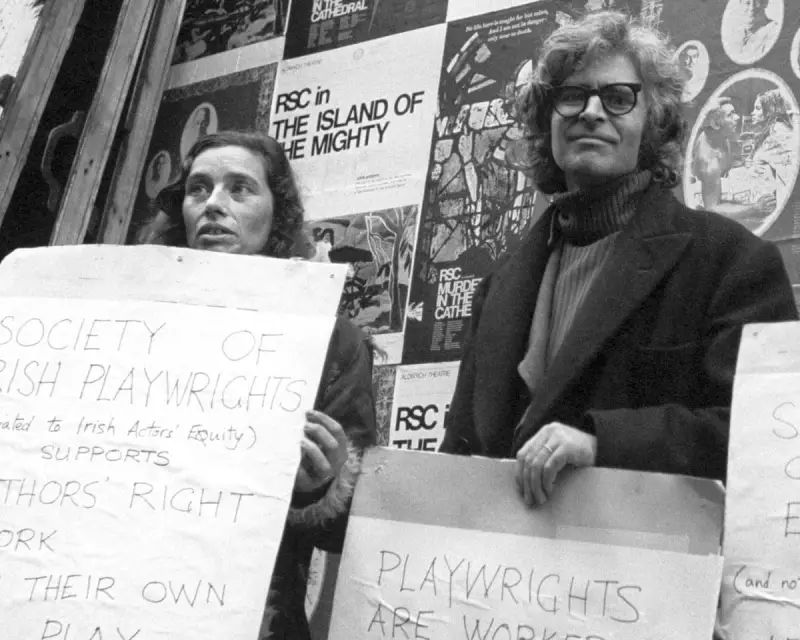
The world of theatre and political activism has lost one of its most uncompromising voices with the death of Margaretta D'Arcy at the age of 91. A playwright and campaigner whose life was defined by radical dissent, she was perhaps most famously pictured picketing the Aldwych Theatre in London in 1972 alongside her husband, John Arden, in protest against the Royal Shakespeare Company's staging of their own work.
A Life Forged in Political Theatre
Born in Whitechapel, London, on 14 June 1934, D'Arcy's commitment to political causes seemed innate. Her father, Joseph D'Arcy, was a Dublin-born civil servant and former IRA member, while her mother, Miriam, was a Jewish refugee from Odesa. This heritage of resistance and displacement shaped her worldview from the start.
After studying drama at Trinity College Dublin and working at the pioneering Pike Theatre, she moved to London. There, in 1955, she met the celebrated playwright John Arden, marrying him two years later. While Arden had already earned acclaim for works like Serjeant Musgrave's Dance, their creative partnership, beginning in 1960, produced a series of fiercely political co-authored plays.

Their notable collaborations included The Happy Haven (1960), a masked farce set in an old people's home; The Ballygombeen Bequest (1972), a satire on British actions in Northern Ireland; and their monumental, defining work, The Island of the Mighty (1972). This Arthurian trilogy, intended to parallel contemporary anti-colonial struggles, became the flashpoint for their ultimate break with the theatrical establishment.
The Picket Line as a Stage
The couple's dispute with the Royal Shakespeare Company over the editing of The Island of the Mighty during rehearsals led to an extraordinary act of protest. They publicly disowned the production and began picketing the stage door of the Aldwych Theatre, effectively going on strike against their own work. This was not their first such action; they had also picketed The Hero Rises Up at London's Roundhouse in 1969, with Arden reportedly passing a bucket around the audience to pay the cast.
This radical stance, though criticised by some as damaging to Arden's career, was a principled stand for authorial control and political integrity. Their protest directly contributed to the formation of the Theatre Writers' Union in 1976. For D'Arcy and Arden, politics invariably came before art, a belief that placed them at odds with the mainstream theatre world.
Activism Beyond the Footlights
D'Arcy's activism extended far beyond the theatre. She was an original signatory of Bertrand Russell's anti-war Committee of 100 in 1960. After moving to Galway with Arden in 1968, she immersed herself in the Irish civil rights movement, joining Sinn Féin (before being expelled in 1972) and the Society of Irish Playwrights.
Her commitment led to direct confrontation with the authorities. She was imprisoned twice in Armagh jail: for three days in 1978 and for three months in 1979 after protesting the conditions of female Republican prisoners. She chronicled this harrowing experience in her book, Tell Them Everything (1981). She also campaigned at Greenham Common against cruise missiles.
Her later collaborations with Arden included the mammoth 26-hour The Non-Stop Connolly Show (1975) about the Marxist Easter Rising leader, and a BBC radio epic, Whose Is the Kingdom? (1988). Arden died in 2012. D'Arcy was predeceased by two of their five sons, Gwalchmei and Jacob. She is survived by her three other sons, Finn, Adam, and Neuss, and six grandchildren.
Indomitable until the end, she spent her final days using a walker while brandishing pro-Palestinian placards and campaigning in Irish politics. Tributes have hailed her as "a woman of extraordinary conviction and radical honesty," a singular voice whose life was a continuous performance of principled dissent.