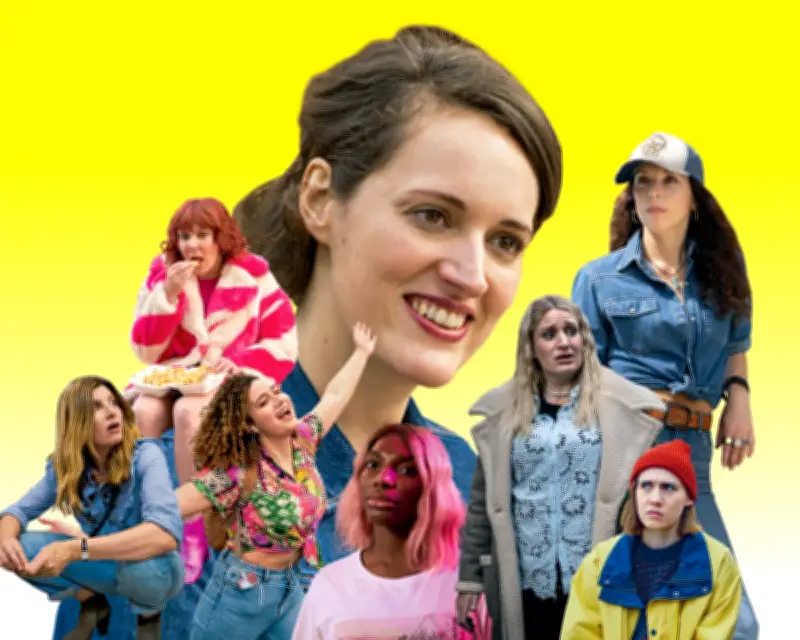
Fleabag's Legacy: A Decade of Change for Female-Led Television
Ten years ago, Phoebe Waller-Bridge locked eyes with the camera and asked her audience: "Do I have a massive arsehole?" That line from the half-hour comedy series Fleabag broke the fourth wall and the internet. Its second season was even bigger, spawning countless thinkpieces and a sold-out Topshop jumpsuit. The show secured Waller-Bridge an exclusive deal with Amazon worth a reported $20m (£16m) a year. But a decade on, as the British television industry has been reshaped by streamers, budget cuts, and dwindling opportunities for new talent, how did it change TV?
The Pre-Fleabag Landscape: A Gender Imbalance in Comedy
In the mid-2010s, pop feminism was everywhere—except on British TV. A report by the Writers' Guild of Great Britain revealed that from 2001 to 2016, just 14% of primetime TV was written by women, with an even more pitiful 11% in sitcoms. "We knew, even before we were making Fleabag, that the gender balance was horrific, and there was always a desire to change that," says Chris Sussman, a former BBC comedy commissioner who helped greenlight the show.
The Post-Girls Wave and Fleabag's Unique Cut-Through
Things had already started changing with Lena Dunham's Girls in the US, which created an appetite for female-authored comedy that was bawdy, awkward, vulnerable, and grotesque. Fleabag was part of a wave of semi-autobiographical half-hour comedies, including Catastrophe, Back to Life, and This Way Up. But Fleabag cut through in a way many contemporaries didn't. "Fleabag was very smoothly incorporated into that massive post-Girls cycle of unruly middle-class white women comedy and 'personal' stories," says Faye Woods, an associate professor at the University of Reading. She notes that shows like Alma's Not Normal or Chewing Gum didn't travel as widely.
Opening Doors for Diverse Voices
Television commissioning is famously risk-averse and trades on proven success stories. "Fleabag did probably give a lot of confidence to female comedy writers to go: 'Yes, I can go and own my show,'" as well as inspire commissioners to commission those shows, says Sussman. Another global success was Michaela Coel's I May Destroy You, which premiered in 2020. Co-produced by HBO, it was visually ambitious, with lush cinematography more often found in feature films. The standard British half-hour comedy was finding a new form: a hybrid of comedy and drama, increasingly bolstered by American money. Harry Williams, who executive produced Fleabag, notes, "We tried to make Fleabag look more like a drama and not a comedy."
The Spectre of Fleabag: Comparisons and Constraints
If Waller-Bridge became an undeniable reference point, she also became a spectre. Rose Matafeo, creator of Starstruck, recalls comparisons to Fleabag as "a compliment and a little lazy." She says her show's tone couldn't be more different, yet critics described the protagonist as "a millennial mess-up." Matafeo remarks, "That was my issue, where it became a way of describing a female character written with the amount of depth television had not been used to at that time."
Evolution Beyond the 'Messy Millennial' Trope
That has changed in the last decade. Audiences now see a broader range of female characters: funny, sexual, self-destructive, and still worthy of love. Shows like Bridget Christie's The Change (about a 50-year-old going through menopause), Am I Being Unreasonable?, and Such Brave Girls tackle issues like debt, abortion, and suicidal ideation with nuance.
The Changing Economics of TV Comedy
The circumstances that gave rise to Fleabag were specific. It began as a one-woman play and was developed as part of a BBC pilot scheme. "The money was tiny, but the pressure was tiny," says Lydia Hampson, one of Fleabag's producers. Now, with public service broadcasters spending less on nurturing talent, there's more pressure on writers to fit an existing mould. "I think there's some risk-averseness around original ideas," Hampson says. "Those big streamers are like: 'If we can point to IP, then we can point to subscriber numbers, then we can point to eyeballs.'" The irony is that the money Fleabag attracted into British comedy raised expectations—and financial stakes—unrealistically for shows following in its wake.
The Edinburgh Fringe Connection
It is no coincidence that the two biggest British TV exports of the decade—Fleabag and Baby Reindeer—both started at the Edinburgh festival fringe. Francesca Moody, who produced both theatre productions, says, "It's where artists have historically been given the space to try out ideas, take risks and express themselves in messy ways."
Waller-Bridge's Subsequent Projects and Industry Impact
Since Fleabag, Waller-Bridge has been more low key, creating Killing Eve, co-writing No Time to Die, and co-starring in Indiana Jones. Online jokes suggest she is collecting millions from her Amazon deal while seemingly doing nothing. But she has undeniably shaped British TV, even if she is no longer at its forefront.
When I think of Fleabag, I remember the poster: a striking closeup of Waller-Bridge's face, mascara running down her cheeks. One woman's experience and perspective suddenly had symbolic power. She was, despite all the clamour, no "everywoman"; just, in her own words, a "greedy, perverted, selfish, apathetic, cynical, depraved, morally bankrupt woman who can't even call herself a feminist." Now, she's not the only one on our screens.