Adrian Lester is magnificent as the big-nosed, big-hearted soldier-bard in this witty and unbearably moving Royal Shakespeare Company revival of Edmond Rostand’s 1897 verse play. Director Simon Evans and writer Debris Stevenson embrace the theatricality of the drama and warmly embrace the audience, a stark contrast to the National’s current self-consciously “meta” Misanthrope.
A Lyrical Adaptation with Poetic Metres
Their music-laced adaptation cleverly gives each major character a different poetic metre to speak. It also addresses and partially redresses the misogyny of the original, a story of two men deceiving a woman. Cyrano, believing himself ugly and unworthy of his childhood love Roxane, woos her on behalf of his handsome, tongue-tied comrade Christian.
Here Susannah Fielding’s Roxane is given agency and spirit: “Listen to MY story,” she says at one point, later accusing Cyrano of being “humiliating [and] controlling”. It becomes a tragedy for all of the central trio, not just Cyrano: even Levi Brown’s Christian can’t be loved for the simple, honest soul he is.
Pacing and Comic Sketches
The only serious flaw is a certain bagginess and stateliness of pace. As common to RSC shows originating in Stratford-upon-Avon, a three-hour running time is seen as part of the full experience. Here at least, the slowness allows a deeper relationship with the romantic central characters and gives space for memorable comic sketches of minor ones.
It opens in a theatre, actors scurrying around the stage, stalls and circle, anxious that the famous Cyrano is going to disrupt a performance. Lester’s showman-swordsman appears, attended by a sextet of minstrels he won in a bet, to vanquish both the actor and a count’s henchman who insults his enormous conk. Lester gets the audience to repeat the slur – “it’s f***ing huge” – and we are periodically enlisted as tavern denizens, army reservists or onlookers.
Roxane and Christian
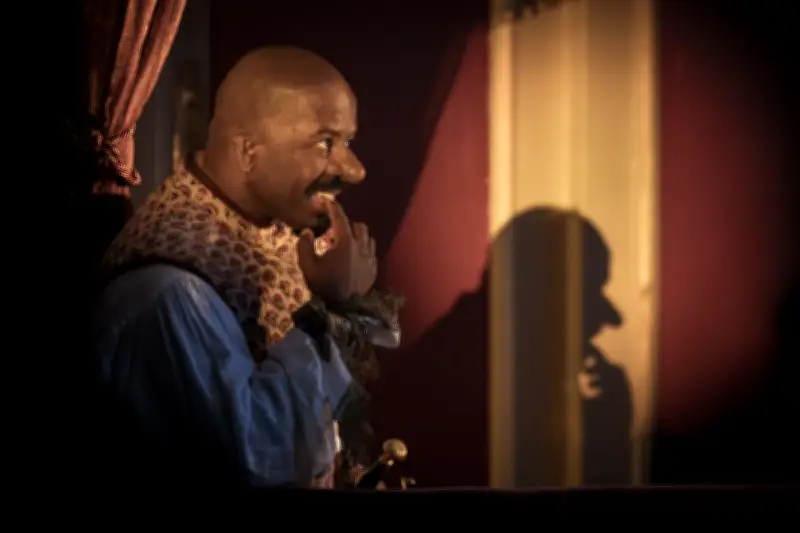
Fielding’s vivacious Roxane, first seen in the theatre box, is a merry widow who’s just buried the husband she was compelled to marry. Her bodice and choppy bob frame her elegant shoulders and laughing face. One of the many surprises is that when this idealised woman eventually speaks she is surprisingly earthy, almost vulgar. Christian, usually a himbo, is here a farm-boy looking for true love – “her hands in the soil beside mine” – who also knows the collective noun for all creatures.
Rostand’s play introduced the word “panache” to the English language and it’s impossible to avoid when considering Lester’s performance. There’s brio in his swordplay, verve in his iconoclastic disdain for the aristocracy, crisp delight in his relish for words. With a shaven head and a goatee, he’s dashingly attractive, despite a prosthetic proboscis with a bulbous, penile tip.
Heartbreaking Moments
One of the most heartbreaking moments comes at the end when the wounded Cyrano becomes literally lost for words. Eloquence is both celebrated and interrogated here, and there are endless gorgeous lines. Evans and designer Grace Smart match the verse with neat visual metaphors: Cyrano is haunted by his carefree younger self, brandishing a bullrush rapier; an acorn Christian gives to Roxane becomes a broken oak growing from a grave.
The battle scenes are brutally effective. This very humane version finds empathy even for the shifty de Guiche and gives Roxane’s sexually exuberant companion Abigal (Greer Dale-Foulkes) several comic moments. At the end, two women in the row behind me were prostate with tears, unable to move. A bittersweet joy.