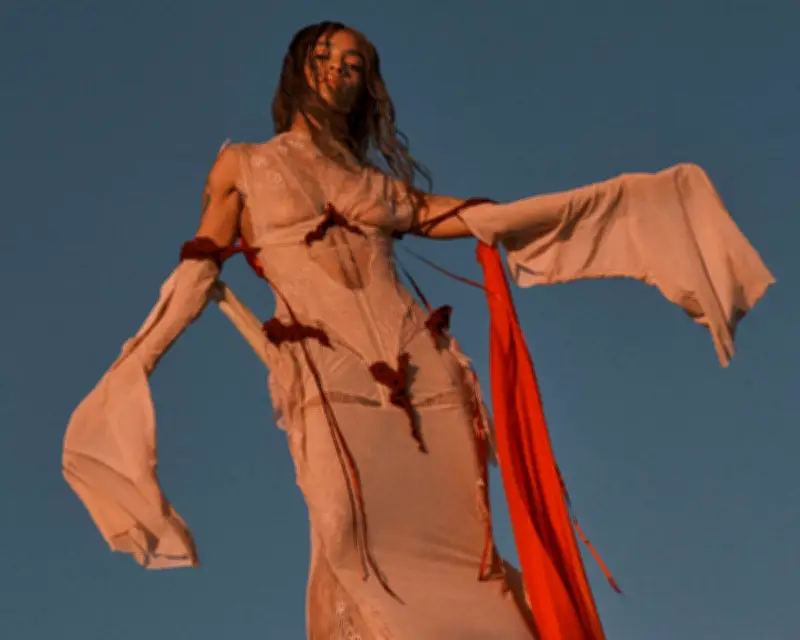
Effortlessly eclectic … Kelsey Lu. Photograph: Yumna Al-Arashi
Review: Kelsey Lu: So Help Me God review – strange, graceful songs drifting from pop’s edgelands
(Dirty Hit) Aided by Jack Antonoff, Kim Gordon, Sampha and more, the cello-playing singer-songwriter’s abstracted yet tuneful second album is worth the seven year wait.

Seven years separate the release of cello-playing singer-songwriter Kelsey Lu’s debut album, Blood, from its follow-up. Lu has suggested the long gap was an act of artistic rebellion against a music industry obsessed with providing a constant stream of new product – “tuning into my intuition, trusting myself and building a team to support that,” as they put it.
Perhaps they wanted to carve their own path after a cover version – of 10cc’s I’m Not in Love, used in HBO drama Euphoria – became their most successful song, or perhaps they simply didn’t have the time to make an album amid their plethora of other interests. They have scored two movies: the Bafta-winning Earth Mama and the Netflix documentary feature Daughters. They have collaborated with Beverly Glenn-Copeland, Yves Tumor, Mykki Blanco, Jamie xx, Boys Noize and visual artist Kevin Beasley and contributed a version of Manchild to a Neneh Cherry tribute compilation and more. They have been photographed by Nan Goldin for a Gucci campaign and staged a performance art piece at New York’s Metropolitan Museum of Modern Art. They have also appeared on stage with Debbie Harry, while dressed as Kermit the Frog, recreating the Blondie vocalist’s famed 1981 appearance on The Muppet Show.
Presumably alive to accusations of dilettantism, Kelsey Lu has presented all this not as a portmanteau career, but different aspects of a holistic artistic practice. Whether you buy that or not, So Help Me God suggests that their time away from album-making has sharpened their sense of purpose.
It’s more cohesive and less obviously in thrall to Lu’s influences than Blood – a very good album, but one that was regularly visited by the ghost of fellow avant-pop cellist Arthur Russell. It mostly proceeds at an unhurried, summer-afternoon pace – even the drum’n’bass rhythm of Only the Lonely feels languorous, distractedly fading in and out of the track – but its 50 minutes nevertheless pass in a flash.
The album’s guest list is as eclectic as Lu’s activities over the last seven years: pop super-producer Jack Antonoff, jazz saxophonist Kamasi Washington, British singer-songwriter Sampha and former Sonic Youth bassist Kim Gordon. But rather than jarring or showy, their appearances are beautifully sublimated. The melodies of the Antonoff-assisted Comfort or Running to Pain shine through abstract arrangements, though the melodies of the songs on which Antonoff gets no credit are every bit as strong. Gordon has been an exceptionally distinctive presence in alt-rock for more than 40 years, but here, her appearance is entirely in service to the song. Her guitar provides distant gusts of noise during opener Reaper, part of an echoing, hazy swirl of sound, over which Washington’s sax and Lu’s voice ripple delightfully.
In fact, Reaper is the perfect example of what the album has to offer. It starts out as a lovely piece of soft-focus pop-soul, before something more peculiar starts to encroach. The drums begin to drop unexpectedly out of the mix, then reappear, then vanish entirely. What initially seems to be an ambient coda, replete with Washington and Gordon’s contributions, turns out to be a lengthy interlude before the song gathers itself again, in a noticeably different form: slower, driven by a drum machine, the whole thing shimmering with tremolo effects. It’s strange and beautiful and entirely spellbinding, words you could usefully apply to virtually everything here, from Cutting Off the Head of a Ghost – an arena-ready ballad that sounds alternately triumphant and punch-drunk – to American Sonnet’s recasting of a Wanda Coleman poem to a stately piano and cello backing that’s gradually disrupted by crackling static and an out of time four-to-the-floor kick drum.

It’s an album that wears its weirdness lightly, that keeps moving in unexpected directions with an impressively graceful smoothness. Only one track, Better Than That, feels structureless and scattered, a little too self-conscious in its strangeness. But elsewhere it all feels effortless. The production is subtle – the rhythm track on 852 is muffled rumble, like a distant train – and the tunes stick with you. Lu’s voice is appealingly rich and potent: the lyrics detail the break-up of a relationship, often in quite vague terms – “like weeds in a field we yearn a connection / but deafening divide leaves me unprotected” – but the way they sing them means you always grasp the emotional force behind them.
It’s very clearly the work of someone who has their own vision and their own way of doing things. In a sense, it’s a shame that said way of doing things involves making albums so irregularly – you leave So Help Me God eager to hear more, but unsure of when you might. Though if it takes Kelsey Lu another seven years to follow it up, so be it: some things are worth waiting for, and So Help Me God is one of them.