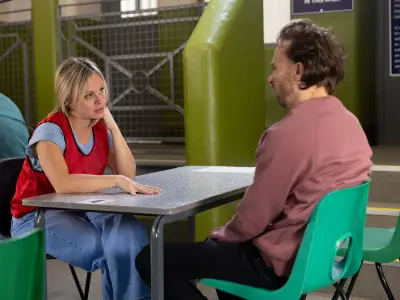
The look of love ... Keeley Hawes as Anna. Photograph: Robert Viglasly/Channel 4/The Forge/Robert Viglasky
Falling review – Jack Thorne’s religious romance is a god-awful mess
This tale of a nun and a priest’s forbidden romance has a stellar cast, but it’s odd from the very start – largely because Paapa Essiedu and Keeley Hawes don’t speak or act like adult human beings.
Yearning is a lost art. It is hard, in this day and age, to find ways in which to keep people apart enough for passion to grow, fed by hope and hopelessness in turn. What once were near-insurmountable obstacles – distance, marriage to others, unspeakable truths about sexualities – don’t really serve any more. How about religion, then? How about a love between two people doctrinally bound to remain celibate? Catholicism has just the thing, plus it comes with a side order of guilt about sex even for its non-clergy members.
In Falling, written by Jack Thorne, we have Keeley Hawes playing Anna, a nun who took her vows 20 years ago and has lived a sheltered life ever since, under the watchful eye of the abbess Francesca (Niamh Cusack). And we have Paapa Essiedu playing father David, a dynamic young priest patrolling the streets and trying to transform the lives of his impoverished parishioners in Easton, a deprived part of Bristol. It’s very odd from the start, largely because neither of them speaks or acts like an adult human being. Given that Anna is a nun who regularly goes to the shops and food banks with the produce she grows in the convent garden, this makes no sense. And given that David is a priest who lives very much in the real world, it comes to make even less sense. “Those look lovely!” says one grocer of Anna’s box of crops as she enters the shop. “YOU are lovely, Graham!” she replies. “THESE are vegetables!” I’m sorry, what?
This is emblematic of the inauthenticity that pervades the entire romantic (ie main) storyline. I don’t know whether Thorne, who has of course made his name through heavy, state-of-the-nation pieces such as the This Is England trilogy, and dramas about such meaty subjects as disability rights, the pandemic and (most recently, in the much-feted Adolescence) misogyny and the manosphere, felt unsure of his emotional ground or the lives of religious devotees, but rarely does a moment of their relationship ring true.
Sometimes, the derivative nature of what we are watching alienates us. Anna and David’s first touch happens when she burns herself while cooking for him, and he helps her run her hand under a tap. This is apparently enough for her to abandon the convent, catch the bus to his church and confess her love for him: “I have never felt the way you make me feel!” “Does the convent know you’re here?” replies David, looking – as he does for at least three episodes (before a wholly unconvincing volte-face) – not like a man struggling with his emotions but like a deer caught in headlights. Even a cloistered nun gets that kind of message and Anna moves in with a kindly parishioner called Muriel (Rakie Ayola) while she gets used to life in the secular world. This is quickly accomplished by a haircut, buying some long-sleeved T-shirts and shaving her legs. The abbess mentions something about a formal process of deconsecration, but this seems much more narratively efficient.
Anna’s behaviour toward David is more or less unreasonable, with Thorne seeming to conflate naivety and inexperience with infantilism, giving Anna neither consistency nor relatability (simply in human terms) for the viewer.
David, meanwhile, is having his backstory and secret, unimaginative sorrow revealed piecemeal while, naturally, making an enemy of bishop Peter (Jason Watkins), who would prefer to spend ecclesiastical funds on underfloor church heating than on a needle exchange or more food banks.
On it goes, too frequently jarring – despite the talented actors at the helm – to allow a feeling of real yearning, romance or passion to flourish, let alone deepen into meaningful connection. The question of what it means to break your vows is also hardly addressed – again, as if it is out of Thorne’s comfort zone.
Around the edges, however, where David is helping a troubled teenager find a way out of an unhappy home, witnessing the pain of a daughter as he gives the last rites to an unkind mother, handling the fallout from his past problems and especially in the fractious, deeply loving relationship he has with his sister Susan (Sophie Stone), there is more of a return to form and a sense that Thorne is on steadier ground.
The rest is a swing and a miss. But Thorne will be back with something better soon enough. Falling is on Channel 4 now.