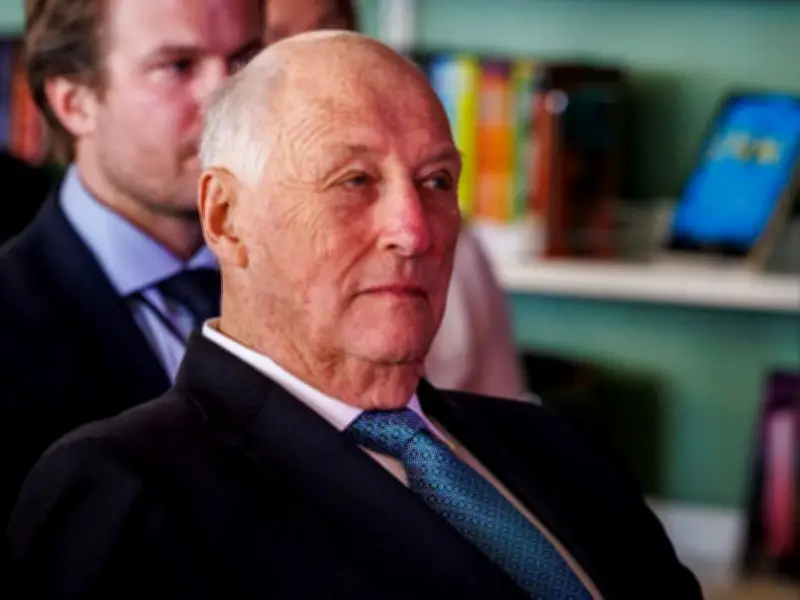
King Harald V of Norway has died aged 89 at the national hospital in Oslo. The palace said he died peacefully at 6.35am local time (4.35am GMT) on Friday, August 28, after being admitted to hospital last week.
In the final 24 hours, members of the Norwegian royal family visited the King, who was being treated for a rare blood condition. They joined members of the public in laying flowers at The Palace Square.
A 35-year reign
Harald spent 35 years on the throne and was Norway's first king born in the country since the 14th century. He will be succeeded by his son Haakon, who will become King Haakon VIII.
Harald was Europe's oldest monarch. The popular king modernised the royal house but refused to follow other ageing monarchs who have abdicated in recent times.
Like other European royal houses, the Norwegian monarchs serve a largely symbolic role, enjoying celebrity status while real power in the democracy of 5.5 million rests with an elected parliament.
Early life and wartime exile
Harald was born in 1937 in Asker, near Oslo, becoming the first Norwegian prince born in the country since King Olav IV in 1370. He was crowned after his British-born father, King Olav V, died in January 1991, and reigned during an oil-and-gas-driven economic boom.
Harald was three when the Nazis occupied Norway at the start of the Second World War. To avoid capture, he, his mother and his sisters, Ragnhild and Astrid, fled first to Sweden and then by boat to the US, while his father and grandfather went into exile in Britain with Norway's government. During their time in the US, the Norwegian royals were often guests at the White House. Harald was six when he carried out his first official duty, christening new warplanes at a Norwegian air base in Canada.
The family was reunited in Norway in June 1945, shortly after the war ended. Harald attended public schools, the Norwegian military college and Oxford University.
Marriage and modernisation
Like his father, an Olympic champion sailor in 1928, Harald loved the sea and sailboats. He represented Norway at several Olympics, and in 1987 he skippered his yacht to gold in the World Championships.
As a young man, Harald was urged to find a bride among the princesses of Europe. For nine years he shunned a series of noblewomen, holding out until he finally won his father's permission to marry his school sweetheart, Sonja Haraldsen, the daughter of a successful businessman. King Olav had feared the marriage would weaken Norway's still-young monarchy. Instead, Norwegians greeted the wedding with jubilation, and later embraced Sonja as their queen.
The couple had two children, Haakon and his older sister, Martha Louise. The Norwegian Constitution was altered in 1990 to allow the firstborn, regardless of gender, to take precedence in the line of succession. However, it was not applied retroactively, meaning Haakon continued to take precedence over his sister.
When Harald assumed the throne on January 21 1991, he adopted the same motto his father and grandfather had used: “All for Norway” and spent the following years trying to modernise the monarchy.
Legacy and later years
“It has been my experience that the monarchy stands strong,” he once said. “This is not least because my father and grandfather did most things right. That puts me under pressure, but I take it as a challenge.”
Harald won praise with an emotional speech at a memorial service after right-wing extremist Anders Behring Breivik killed 77 people in bomb and gun attacks in 2011. “I remain convinced that the belief in freedom is stronger than fear. I remain convinced in the belief of an open Norwegian democracy and society. I remain convinced in the belief in our ability to live freely and safely in our own country,” the king said.
In 2016, Harald gave an unexpected and impassioned speech in support of LGBT+ equality, refugees and religious tolerance, saying: “Norwegians are girls who love girls, boys who love boys, and girls and boys who love each other.” He added that many Norwegians have emigrated from Afghanistan, Pakistan, Poland and other countries and that they “believe in God, Allah, the universe and nothing”. The public speech extolled the diversity of the Scandinavian nation and was viewed on social media by millions.
During his reign, the royal family suffered relatively few scandals, though Martha Louise gave up royal duties after raising eyebrows by saying she could communicate with angels and becoming engaged to an American man who identifies as a shaman. In early 2026, Crown Princess Mette-Marit faced renewed scrutiny over her connections with the late sex offender Jeffrey Epstein, though she is not accused of any wrongdoing and apologised for the situation she put the royal family in. At around the same time, her eldest son, Marius Borg Hoiby, was convicted of rape in a high-profile trial and sentenced to four years in prison. Hoiby, Mette-Marit's son from a previous relationship, has no royal titles or official duties.
In January 2024, after the abdication of Denmark's Queen Margrethe, his second cousin, Harald said he stood by the oath he made when ascending the throne: “It lasts for life.” However, he was admitted to hospital twice on foreign trips after that, including during a 2024 holiday in Malaysia when he was fitted with a pacemaker and while dealing with a skin infection during a February 2026 holiday on the Spanish island of Tenerife.