Ukrainian-Russian Photographer Preserves WWII's Raw Truth Through 35,000 Negatives
In a quiet study in northern Germany, Arthur Bondar, a Ukrainian-Russian photojournalist and publisher, carefully handles a collection of photographic negatives that tell a story far removed from official histories. Wearing white cotton gloves, he lifts 4cm by 9cm negatives from an old cigarette box, holding them to the light. Inverted images appear—a woman on a horse, women tending cabbages in a field, laughing figures at the seaside, and a woman posing as a military ship sails by. These ghostly fragments, though tiny, reveal key details like uniform insignia or ship names, sparking Bondar's curiosity and driving his meticulous research.
A Burgeoning Archive of Unseen History
Since 2016, Bondar has amassed about 35,000 negatives from World War II, a collection he describes as "buying a black cat in a black sack" because he often only knows what he has purchased after flattening and scanning them. His latest acquisition, bought online from a German seller, depicts women from the Reichsarbeitsdienst, a female labour force that served the Nazi Reich. Bondar exclusively buys negatives—taken by amateur or professional photographers from the Soviet Union to the United States—to ensure he obtains the most unadulterated images of the war.
"Negatives are photographic truths that make it difficult to distort history," Bondar explains. "Prints on the other hand might well have been manipulated." He points to Soviet military practices, such as pasting two images together to create collages or cutting dead soldiers out of negatives, as reasons for his focus on original film.

Smuggling Truth Across Borders
In 2023, Bondar smuggled his photographic treasures out of Moscow, where he had lived for over a decade, in eight separate hauls. He left his own photographic archive behind, hoping to retrieve it one day, and transported the negatives first to Georgia and then to Germany. He and his wife, Oksana, a Ukrainian-Russian artist and photographer from Kharkiv, now live in exile—or what they call self-imposed relocation.
This risky endeavour could have led to confiscation, fines, or even imprisonment. Many images, though legally bought, might have been deemed by Russian censors to dishonour the "defenders of the fatherland" due to their honest depictions of soldiers—showing distress, injury, humanity, and humour. Since 2020, such acts have been prosecutable in Russia. "To boot, I was a Ukrainian doing this 'dishonourable' act," says Bondar, who was born and raised in a military family in Krivoy Rog, central-southern Ukraine. Despite being interrogated, he successfully smuggled the images out.
Challenging Propaganda Narratives
Bondar's archive serves as a counterpoint to what he calls the "comfortable" narrative of World War II—celebrating it as a triumph rather than a tragedy—that Moscow uses to justify its invasion of Ukraine. This narrative is embodied in the propaganda slogan "we can do it again," implying conquering Ukraine as it once did Nazi Germany. The war in his homeland fuels Bondar's determination to show "all the sides of war, above all its stupidity and uselessness."
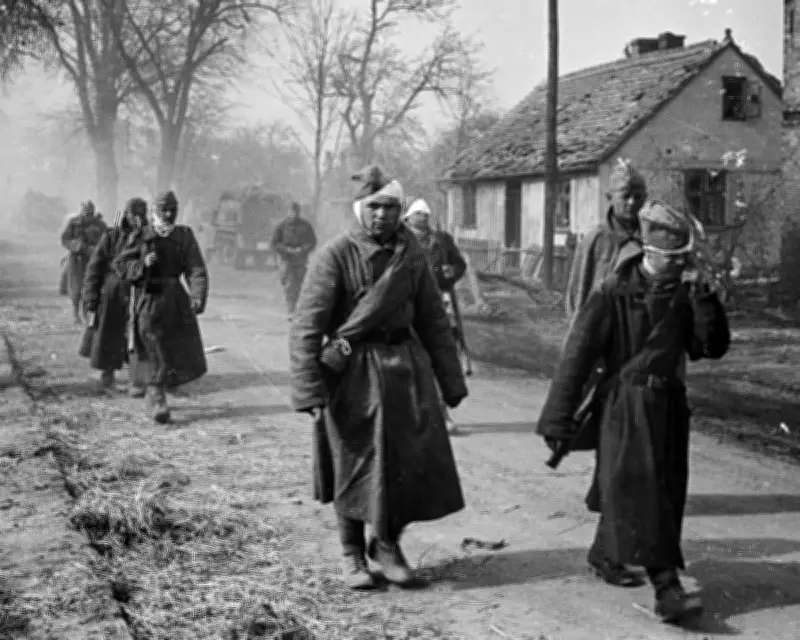
He has uploaded the photographs to a carefully curated website, published hardback books, and held numerous exhibitions. One current exhibition at a museum dedicated to the Battle of the Seelow Heights—the most vicious and bloody episode in the operation to seize Berlin from Nazi control in spring 1945—features images from Bondar's first and most precious find: Valery Faminsky.
Rediscovering Forgotten Photographers
Bondar recalls his awe upon first seeing Faminsky's works, after an advert was posted by the photographer's family. Faminsky, who died in 1993, had poor eyesight and was initially exempt from the front, with military leadership asking, "What good is a blind photographer to us?" In 1943, aged 31, he finally went to document first aid for the Red Army for the Military History Museum in what is now St Petersburg. However, he went beyond his brief, using his army accreditation to photograph German civilians and Soviet soldiers in non-staged, humanistic scenes of everyday wartime life.

"It is ironic to me that the legacy of a man with poor eyesight has been to give us one of the most enlightening views of war possible," Bondar reflects.
Another key figure in Bondar's collection is Olga Ignatovich, one of only seven female photographers working for the military. In 2020, her jumbled negatives were handed to Bondar in a shoebox in Moscow. He has since ordered and scanned all 1,500 frames, though some were too disintegrated by mould to save—"a metaphor for the fading memories," he says. Ignatovich, like Faminsky, was forgotten after the war, with some of her images, including photographs of the liberation of Auschwitz used in the Nuremberg Trials, attributed to her more famous brother, Boris.
Bondar searched for months before finding her snow-covered, white marble headstone in winter 2020-21. "The only information anyone could provide was that she died in Moscow in 1984." Despite working for Soviet media and her images being used for propaganda, Bondar is struck by their authenticity. "She got people to smile for the camera," he notes, "maybe they were surprised at being photographed by a woman. She was less interested in the fighting than she was in depicting the individuals caught up in it."
A Lifelong Mission of Preservation
Bondar has been contacted by people from Siberia to New York, excited to discover themselves or relatives in the images. After verifying claims, he sends high-resolution copies. He feels both haunted and thrilled by the millions of negatives lost to rubbish dumps or decaying attics, as well as the scores of unprocessed packages stored in his home. Even if he stops adding to them, he estimates "about 20 to 30 years of work" remains, expressing a heartfelt wish to find an institute for collaboration.
Through his dedication, Bondar preserves not just images, but the raw, unfiltered truth of a war that continues to echo in today's conflicts.