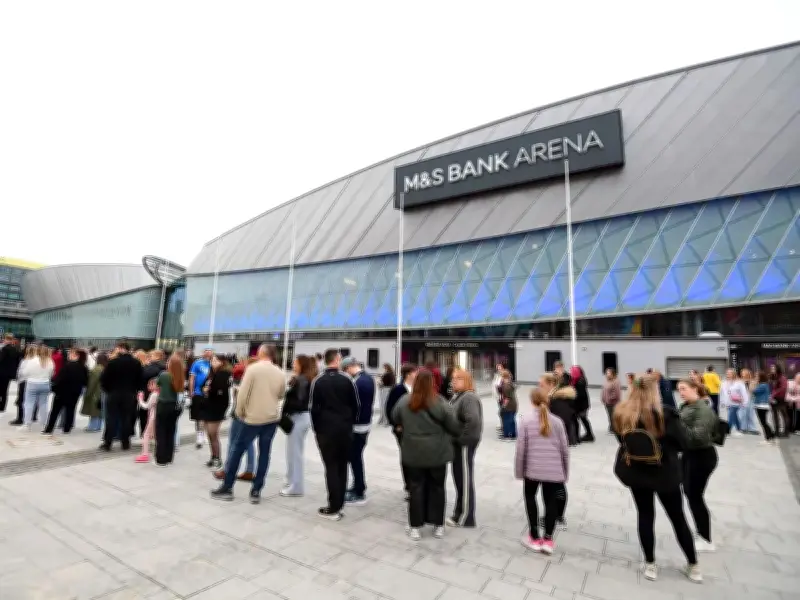
Liverpool's music scene is losing out on the biggest gigs because of its proximity to Manchester, industry favouritism and a lack of modern venues, according to local promoters who have shaped the city's music landscape for decades.
While Liverpool has produced some of the country's most celebrated acts, including the Beatles, Cilla Black, Frankie Goes to Hollywood and Echo and the Bunnymen, attracting big-name performers to Merseyside has become an almost impossible task. The M&S Bank Arena, the city's largest indoor venue, is frequently missed off the UK touring circuit by major acts.
Proximity to Manchester
Revo, a DJ and promoter who co-founded EVOL in 2003, said Liverpool's closeness to Manchester is a fundamental problem. "Geographically, Liverpool's a little dog's leg away from Manchester, we're too close, we're kind of included in the hinterland," he told the ECHO.
"The issue is people in Liverpool are more willing to travel to Manchester than people in Manchester are willing to travel here. Mancunians don't really come the other way down the East Lancs unless the bands are Manchester-based. They can be patient; they know the bands are going to come to Manchester. Manchester draws people from Greater Manchester, Leeds, Sheffield, Bradford, Halifax, Blackburn. Manchester vacuums them all up."
Dave Pichilingi, who founded Modern Sky records in 2016, agreed. "Liverpool is traditionally a tougher city to sell tickets than Manchester is, because of the amount of people that live in Manchester," he said. "Manchester has got a much bigger population and the promoters know that, so it makes more sense, with Liverpool and Manchester being so close together, to put things in Manchester. People from Liverpool will travel over to see those shows because it is not that far for them to go."
Industry favouritism
Both promoters said industry favouritism plays a significant role. Dave explained that credible acts often choose Manchester venues like the Albert Hall, the Ritz and Victoria Warehouse, partly because of promoter loyalties. "SJM, being a Manchester-based company, they will put things into the venues that they—listen, they know Liverpool venues really strongly as well, but they will tend to put things through to their Manchester venues first, including the Academy venues in Manchester."
Revo described a defined hierarchy: "Liverpool's not classed as a Category A city to national promoters. It's a B city to most and even a C city to some. The central spine of touring is usually Glasgow, Manchester, London." He added that historically, some promoters operated an informal rule: "if you play Manchester, you don't play Liverpool."
Dave pointed to Steve Vondy, who works for Live Nation and is from Liverpool, as a reason for hope. "All of the things that we see on the Pier Head, that is because Steve is from Liverpool and wants to bring these things here. All the stuff you see at Salt and Tar that we do, we work closely with Steve Vondy on that."
Lack of infrastructure
The M&S Bank Arena, opened in 2008, was pitched as Liverpool's premier music venue, but Dave said it is now less well-equipped than newer Manchester venues. "The size of the Co-Op Arena is bigger than the M&S, but you can still scale it. For example, you can still make the Co-Op Arena work on maybe 6,000 or 7,000 capacity because of the way you can design the layout of the venue in the same way as you can with the M&S Arena. If you are a promoter, you have also got a bigger ceiling to play with, in terms of Co-Op and MEN and other venues, because you have got the opportunity to go beyond a 12,000 capacity, which is currently what the M&S is, seated and standing."
Revo added that Liverpool lacks venues like the Krazyhouse, the Kazimier or a Factory International, describing Manchester's state-of-the-art venue as "incredible."
Club City vs Gig City
Revo believes Liverpool's nightlife has shifted towards clubbing rather than live music. "Liverpool for me is a club city," he said. "Still very much about the club nights, and obviously on a Saturday night it's still very much about hen dos and stag dos and that kind of vibe." He noted that an 18-year-old student into gigs would go to Manchester, while those into club music would come to Liverpool.
Despite this, he said a Liverpool audience is a valuable test for bands. "When a band conquers Liverpool, they feel they can go anywhere in the world then. A Liverpool audience isn't easy because the standards are high here and the musicianship's high here. It's a bigger achievement because we're a harder audience to please. When the band is on form and the Liverpool crowd have taken to them, I don't really think there's a better place to play."