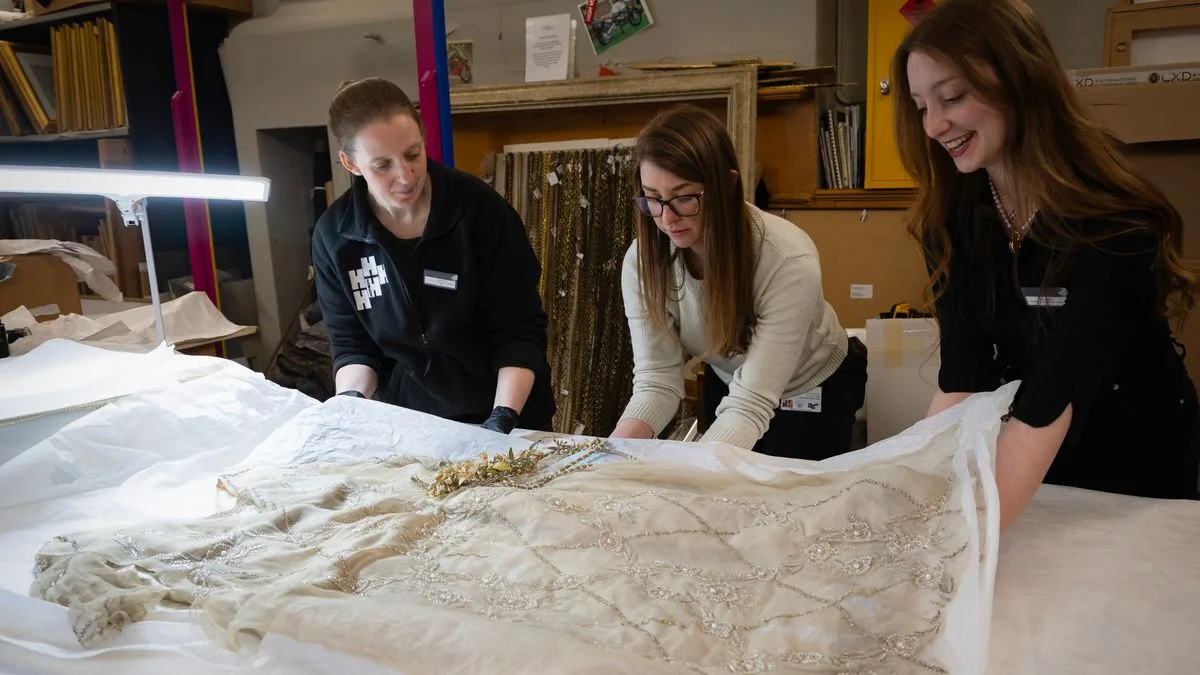
Princess Mary, the only daughter of King George V, is stepping back into the limelight six decades after her death, thanks to her 100-year-old wedding dress. The historic gown has been carefully restored and will be the centerpiece of a new exhibition at Harewood House in Leeds, her former home.
The First Modern Princess
Author and historian Elisabeth Basford, who has written a book about Princess Mary, said: "We think of Princess Diana as the first member of the British royal family to tear up the rule book, but before her there was Princess Mary. In life she was underestimated. But for a woman of her time she was quite something – campaigning for charities, training as a nurse and working to put women centre stage. And like her niece, Queen Elizabeth, she passionately believed she was a servant of the people."
Mary's 1922 wedding dress, headdress and train were stored at Harewood House for decades after her marriage to Henry, Viscount Lascelles, later the 6th Earl of Harewood. The post-war wedding was a sensation, covered by Vogue magazine, with crowds lining the streets. Her outfit was designed to reflect her role as both a princess and a modern woman.
Conservation Challenges
Samantha Harwood, senior collections and conservation officer at Harewood House, undertook the specialist repair. She said: "The dress is really beautiful, with its silver thread and crystal beads it must have shimmered on the wedding day – Mary would have looked like a fairytale princess. It has a dropped waist, which was very fashionable at the time, and a silk silver lame underdress decorated with beads. It also features Honiton lace, gifted by her mother Queen Mary, who had worn it at her wedding, and the train is embroidered with emblems representing different parts of the British Empire."
The ivory silk marquisette overdress, embroidered with crystals and pearls, needed intricate repair. Samantha added: "You can't forget you have history in your hands. There is no room for mistakes because these things can't be replaced. It took four of us to remove the dress from its box because it is so delicate and I took hay fever medicine before I started – I couldn't risk sneezing near it! I had to make sure my hands were clean at all times too – I was going to wear gloves, but the needle I was using was too fine."
Repairing the fragile areas took almost five hours, involving carefully sewing in a top layer of silk crepeline to stabilize the original material. "It was nerve racking putting my hands on the material and quite tricky trying to sew something flat on a table without resting my elbows on it – I had to keep them up in the air – so I had sore muscles the next day. The dress is too delicate to place on a mannequin – the weight of the crystal beads might tear it further – so it will be displayed laid across a bed. It was a huge relief to complete it all. Was I tempted to try it on? Not at all – it's tiny so it would never fit me."
A Life of Service
Born in 1897, Princess Mary was the only daughter of the Duke and Duchess of York, later King George V and Queen Mary. Fluent in German and French, she was determined to make her life of service meaningful. During the First World War, she launched an appeal to send Christmas gifts to every serving member of the armed forces, raising £15 million. She also worked to rehabilitate soldiers returning from war, at a time when post-traumatic stress was little understood.
By 1918, she had trained as a paediatric nurse at Great Ormond Street Hospital and promoted the Women's Land Army. She was president of the British Girl Guide Association until her death and the first female chancellor of a university. Elisabeth Basford said: "Many people think she was incredibly shy but she was one of the hardest-working members of the royal family. She was very intelligent and no-nonsense. She saw what had to be done and got on with it. For instance the Blood Transfusion Service had a shortage of donors in 1941 – there was a stigma around giving blood – so Mary invited an audience of the press to watch her donate. In two weeks 10,000 people had signed up."
Marriage and Legacy
After the 1922 nuptials, the couple honeymooned in Florence and Paris. They had two sons and were married for 25 years. Despite persistent rumours of an unhappy marriage, Elisabeth Basford disputes this: "There are so many myths and misconceptions about Mary and I think this is one of them. You can absolutely see the couple loved each other – they had so many similar interests such as horse racing and gardening and both were kind people, they were well suited."
Mary's husband died in 1947, and she threw herself into official duties at home and abroad. She died in 1965 after suffering a heart attack while walking in the grounds at Harewood, and is buried with the earl at nearby All Saint's Church. Samantha Harwood reflected: "A wedding dress is such a personal and intimate item so I do feel like I know the princess a little. I keep imagining her popping in to look over my shoulder and see what I have done. And I think she would approve."
The exhibition Cecil Beaton: Staging Icons opens on June 13 at Harewood House, Leeds. Princess Mary: The First Modern Princess by Elisabeth Basford is published by The History Press.