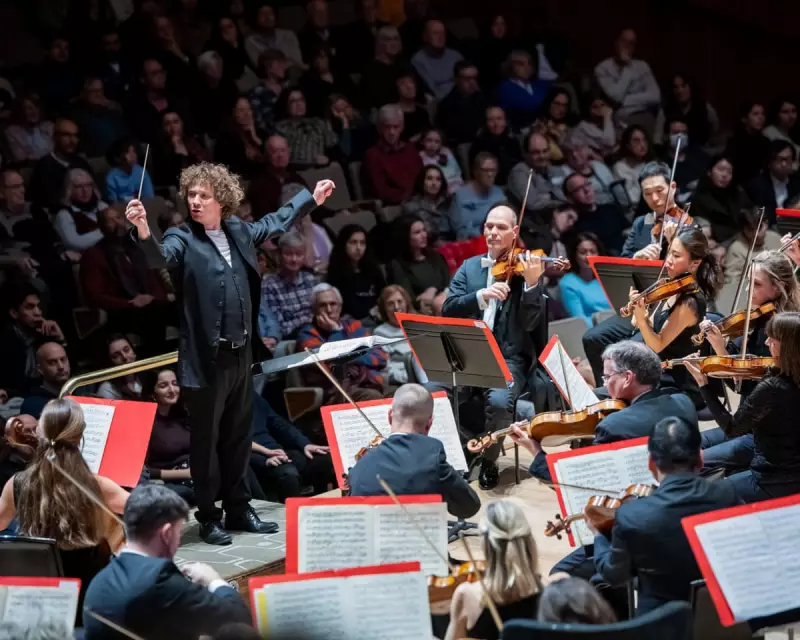
The Royal Festival Hall resonated with a profound sense of purpose on Monday evening as the Philharmonia Orchestra marked Earth Day with a powerful and contemplative performance. Under the baton of its principal conductor, Santtu-Matias Rouvali, the orchestra presented a programme that was both a celebration of the natural world and a stark warning about its fragility, headlined by the UK premiere of Fazıl Say's Mother Earth oratorio.
A Concert with a Conscience
The evening was framed as a direct artistic response to the climate crisis, a theme that permeated the entire event. The concert opened not with a traditional overture, but with the haunting tones of John Luther Adams's Become Desert. This piece, a study in shimmering, slowly evolving soundscapes, immediately immersed the audience in a sonic representation of vast, empty spaces. Rouvali masterfully controlled the orchestra's dynamics, drawing out ethereal string textures and delicate percussive details that seemed to hang in the air like heat haze.
This atmospheric beginning set the stage perfectly for the main event: Fazıl Say's Mother Earth. The Turkish composer and pianist took to the stage not only as the creator of the work but as its soloist, delivering a performance of immense physicality and conviction. The oratorio is a substantial, single-movement work for piano, orchestra, and chorus, with texts drawn from ancient Sumerian poetry. It moves through distinct sections, from the majestic creation of mountains and rivers to more turbulent passages depicting environmental destruction.

Fazıl Say's Powerful Premiere
Say's performance at the piano was nothing short of volcanic. He attacked the keyboard with a ferocious energy in the work's dramatic climaxes, producing cascades of sound that felt elemental. In contrast, the more lyrical, contemplative sections were handled with a tender touch, showcasing the piece's emotional range. The Philharmonia Chorus provided a crucial, human dimension to the work. Their singing, whether in hushed, prayer-like passages or in full-throated, anguished cries, gave voice to the text's urgent plea for stewardship of the planet.
The collaboration between Say, Rouvali, and the orchestra was clearly a deep one. Rouvali ensured the complex score had both clarity and tremendous impact, balancing the immense forces at play—from thunderous percussion and blazing brass to the delicate interplay of woodwinds. The UK premiere was met with an immediate and sustained standing ovation, acknowledging the work's timely message and the sheer power of its delivery.
An Evening of Environmental Resonance
While the Say premiere was the centrepiece, the concert's first half concluded with a compelling performance of Sibelius's Tapiola. This tone poem, a depiction of the vast, brooding forests of Finnish mythology, found a natural interpreter in Rouvali. He sculpted the work's dense textures with a keen ear for its narrative arc, building from mysterious, rustling beginnings to a terrifying storm and a final, exhausted calm. In the context of the evening, it served as a poignant reminder of the wild, untamed nature that climate change threatens.
The decision to programme this concert on Earth Day was a deliberate and impactful one. It transformed a standard orchestral event into a communal act of reflection and, perhaps, a call to action. The Philharmonia Orchestra and Santtu-Matias Rouvali demonstrated that the concert hall can be a vital forum for addressing the most pressing issues of our time. Fazıl Say's Mother Earth, with its blend of ancient text and contemporary musical language, proved to be a formidable and memorable vehicle for this message, leaving the Royal Festival Hall audience with much more than just the memory of beautiful music.