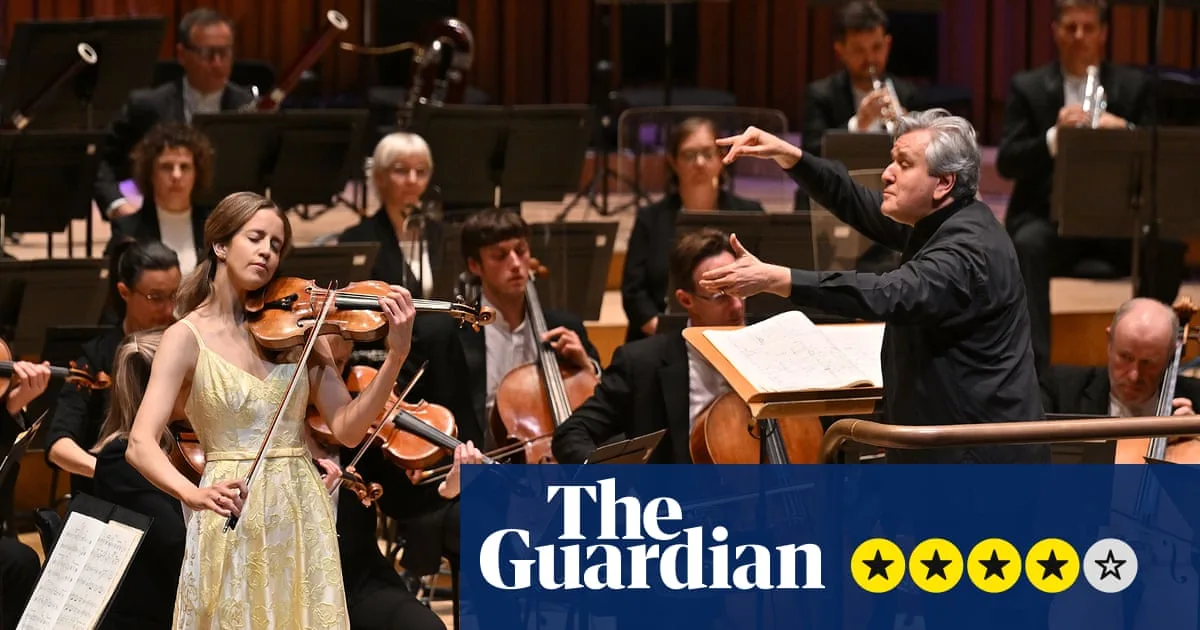
LSO's Barbican Concert: Frang and Pappano Deliver Thrilling Shostakovich and Korngold
LSO's Barbican Concert: Frang and Pappano Deliver Thrilling Performance

The London Symphony Orchestra, under the baton of Antonio Pappano, delivered an exuberant mid-20th-century programme at Barbican Hall on Thursday, featuring violinist Vilde Frang in a performance that revealed both the silky and spiky dimensions of Korngold's Violin Concerto.

Imogen Holst's Persephone: A Delectable Opening

The concert opened with Imogen Holst's Persephone, a 12-minute tone poem written in 1929. The piece begins with rippling woodwinds that might initially evoke Ravel's Daphnis and Chloé, but quickly establishes its own unique voice. Holst tells a story of rebirth, building towards a glowing culmination that references the opening music.

In between, there's no depiction of lustful kidnap, but a darker music takes over. The strings feel their way into an uneasy fugue, while muted brass play clustered chords that are then pounded out by the full orchestra. The work showcases a composer with distinctive ideas about texture, colour and tonality, drawing inspiration from models like Stravinsky's Rite of Spring while maintaining her own creative vision.

Wide Pickt banner — collaborative shopping lists app for Telegram, phone mockup with grocery list

Vilde Frang's Revelatory Korngold Interpretation

Vilde Frang's performance of Korngold's 1945 Violin Concerto reminded the audience that the Vienna from which the composer had escaped was not only a city of sachertorte and gold leaf but also the home of musical expressionism. Frang did not shortchange Korngold's melodiousness, spinning out those long melodic lines with silky intensity.

However, she brought forward elements of strangeness and spikiness that are often overlooked in this work. Particularly in the slow movement, she occasionally dispensed with vibrato to reveal the expressionistic bones of the concerto, highlighting aspects of the music that audiences don't typically realise are present in Korngold's composition.

Pappano's Drama-Filled Shostakovich

Antonio Pappano led the orchestra through a thrilling reading of Shostakovich's Fifth Symphony that maintained dramatic tension throughout. The first movement was kept on its toes with barely perceptible but relentless increases in speed that whipped up anticipation.

The second movement began in a gruff, angry fluster of cellos and basses before swinging into what felt like a heavy-footed dance for inelegant men in too-tight uniforms. By contrast, the slow movement achieved tragic, romantic dimensions, with Pappano consistently drawing out even more fullness from the strings just when they seemed at their peak.

The symphony could only end in a huge culmination, which the orchestra reached in thrillingly ear-ringing style, bringing the concert to a powerful conclusion that showcased both the technical precision and emotional depth of the London Symphony Orchestra under Pappano's direction.

A Concert of Contrasts and Revelations

This Barbican Hall performance demonstrated the London Symphony Orchestra's versatility in navigating three distinct 20th-century works. From Holst's student composition that hinted at greater things to come, through Korngold's concerto that revealed unexpected expressionistic elements in Frang's hands, to Shostakovich's dramatic symphony that Pappano shaped with masterful control, the concert offered both musical revelations and emotional contrasts.

The collaboration between Frang and Pappano proved particularly effective, with the violinist's nuanced approach to Korngold complementing the conductor's dramatic interpretation of Shostakovich. Together with the orchestra's responsive playing, they created an evening that balanced technical precision with emotional intensity, reminding audiences why live classical performances continue to resonate in contemporary cultural life.

Pickt after-article banner — collaborative shopping lists app with family illustration