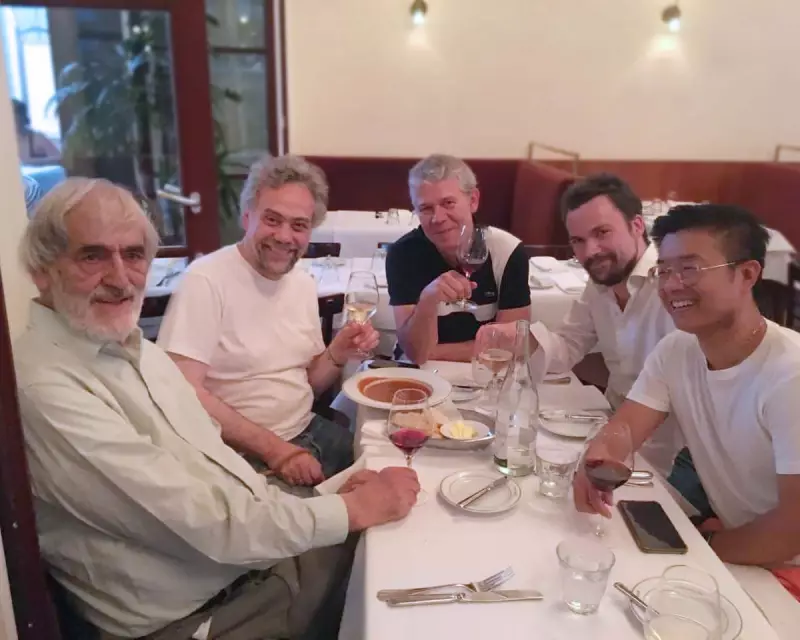
French ensemble Quatuor Diotima has released a comprehensive recording of Helmut Lachenmann's complete works for string quartet on the Pentatone label, offering listeners a definitive interpretation of the German composer's challenging and revolutionary compositions.
The Composer's Radical Sound World
Helmut Lachenmann, now 89, stands as one of Germany's most significant living composers, renowned for developing what he terms musique concrète instrumentale. This approach treats traditional instruments as sound-producing bodies rather than melodic vehicles, exploring the physicality of music creation through unconventional techniques.
The three quartets span nearly four decades of Lachenmann's career, beginning with Gran Torso from 1971-72, followed by Reigen seliger Geister (1989), and concluding with Grido (2001). Each work represents a distinct phase in the composer's evolving aesthetic while maintaining his commitment to expanding string quartet possibilities.

Quatuor Diotima's Technical Mastery
Founded in 1996, Quatuor Diotima has established itself as a leading interpreter of contemporary music, bringing both precision and passion to complex scores that demand extraordinary technical control and interpretive insight.
The ensemble approaches Lachenmann's works with remarkable clarity, navigating the extended techniques—including bowing on the wrong side of the bridge, tapping on wood, and producing harmonic whispers—with confident musicality rather than clinical execution. Their performance transforms what might seem like abstract noise experiments into compelling emotional narratives.
Particularly noteworthy is their handling of Reigen seliger Geister (Dance of the Blessed Spirits), where they create an otherworldly atmosphere through ethereal harmonics and delicate textures that seem to float beyond conventional tonality.
A Landmark Recording for Contemporary Music
This Pentatone release represents a significant contribution to the contemporary classical catalogue, providing both newcomers and seasoned listeners access to works that have too often remained in the domain of specialists.
The recording quality captures the full spectrum of Lachenmann's sonic imagination, from the violent outbursts in Grido (Italian for 'scream') to the subtle rustlings and microtonal shifts that characterise his entire output. The production allows listeners to appreciate both the macro-structure and minute details of these complex compositions.
For those unfamiliar with Lachenmann's work, this recording serves as an ideal introduction, demonstrating how beauty can emerge from unexpected sounds when approached with open ears and intellectual curiosity.
Quatuor Diotima's achievement lies not merely in mastering the technical challenges but in revealing the expressive depth and philosophical richness embedded within Lachenmann's radical musical language. This recording confirms both the composer's importance and the ensemble's position at the forefront of contemporary music interpretation.