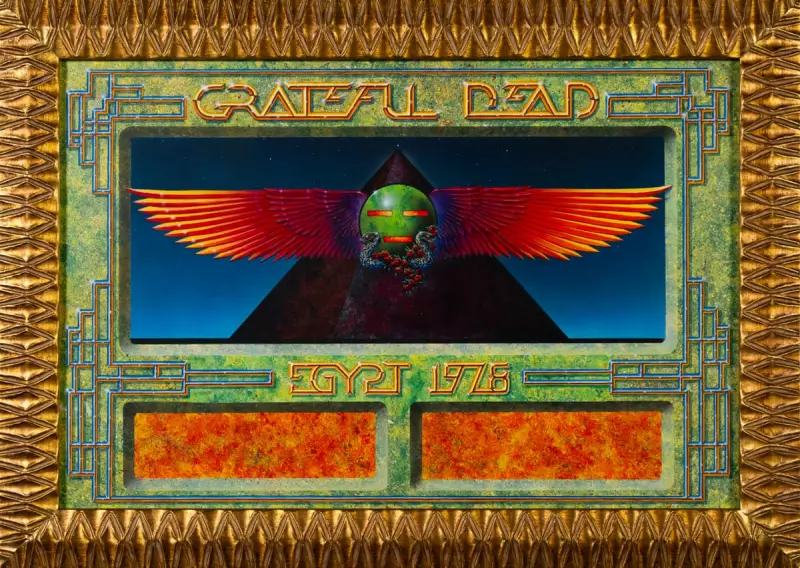
As the legendary rock group the Grateful Dead marks its 60th anniversary, a groundbreaking exhibition in California is finally shining a spotlight on the band's profound and often overlooked artistic legacy. '60 Years of the Grateful Dead' opens at the Chambers Project in Grass Valley on 6 December, two days after the band's founding anniversary, presenting the most comprehensive collection of original art from their history.
The Untold Visual History of a Musical Phenomenon
While the Grateful Dead's musical influence is well-documented, curator Brian Chambers argues their visual contribution has been historically neglected. "The visual vocabulary of the Dead was superior to other music groups," Chambers stated. "The Dead were a nexus and in San Francisco, there were always creatives surrounding them." The exhibition, curated by psychedelic expert Chambers, seeks to correct this by bringing together works that have never before been assembled in a single Grateful Dead context.
The journey to assemble the show was unconventional. Chambers, who owned some pieces, had to hunt others down in surprising locations. A pivotal work, Bill Walker's original painting for the 'Anthem of the Sun' album cover, was discovered stored in the artist's sister's garage in Sacramento, where it had lain for years.

Iconic Works and Legendary Collaborators
The exhibition features 20 artists who defined the band's look, including the celebrated 'big five' of psychedelic poster art: Rick Griffin, Stanley Mouse, Alton Kelley, Victor Moscoso, and Wes Wilson. It showcases seminal pieces like the original 1900 Edmund J Sullivan illustration, 'Skeleton Amidst Roses', which became the blueprint for the iconic 1971 'Skull and Roses' album cover.
Psychedelic comic genius Rick Griffin is represented by 20 works, including the original pen-and-ink drawing for 'Aoxomoxoa'. The show also features five historic, hand-coloured acid-test posters by Paul Foster, coloured by the band's legendary sound engineer and LSD chemist, Owsley 'Bear' Stanley. One poster bears the first public use of the name 'Grateful Dead'.
An Enduring American Gesamtkunstwerk
Art historian Michael Pearce, in the exhibition catalogue, emphasises the cultural significance: "Psychedelic art is uniquely American, and the art of the Grateful Dead is at its beating heart. This fearless show is honest art history at its finest." The exhibition frames the band's output as a gesamtkunstwerk—a total work of art—encompassing music, sound engineering, and visual design.
The show is presented alongside Pact: Psychedelic Arts and Culture Trust, a non-profit which will host auxiliary displays exploring craft forms like T-shirt, jewellery, and glassware that evolved from the Dead's six-decade influence. For original artist Bill Walker, who was introduced to peyote in the early 1960s and painted 'Anthem of the Sun' after a profound desert experience, the exhibition is a chance to see the legacy continue. "I enjoy seeing other people's work as much as my own," he said.
As Brian Chambers boldly proclaims, "The Grateful Dead is the biggest band that has ever lived. They will be around forever." This exhibition proves that their enduring story is told not just through their music, but through the vibrant, revolutionary art they inspired.