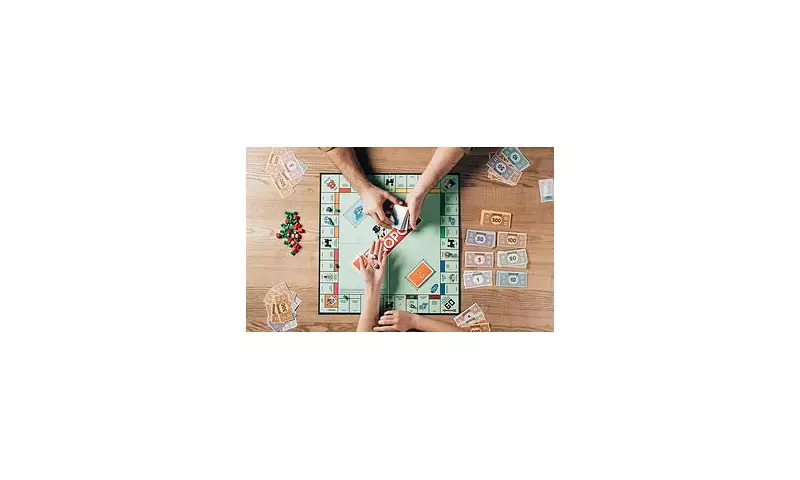
As Christmas approaches and families prepare for festive game nights, a board game expert has revealed that millions have likely been playing the classic property-trading game Monopoly incorrectly for decades. Adam Davis Fernsby, founder of the gaming website Playiro, has identified five common 'house rules' that are not found in the official rulebook and which significantly prolong gameplay.
The Five Unofficial Rules That Extend Your Game
Mr Fernsby explains that the notorious length of Monopoly games and the arguments they spark are often a direct result of players following invented rules. 'The only reason that Monopoly notoriously goes on for hours and causes so many arguments is because we're playing with everyone's interpretations of the game, rather than the rules actually created,' he states. Adhering to the official guidelines can make the game much shorter and more streamlined.
1. No Double Money for Landing on GO
A widespread custom is awarding a player M400 for landing directly on the GO space, doubling the standard M200 received for passing it. However, this is purely a house rule. 'While this may have helped you out of sticky situations in previous games, it is not actually a rule,' says Fernsby. The official position is clear: you only collect M200 for passing GO, whether you land on it or move past it. Similarly, you cannot collect your M200 salary in advance if you land on a property just before GO, even if you are short on cash.

2. Free Parking is Just a Resting Place
Another popular but unofficial rule involves placing money from fines and taxes in the centre of the board. The first player to land on Free Parking then scoops this jackpot. 'While this addition may add an exciting element of luck to the game, this is actually not an official rule at all,' Fernsby clarifies. According to the rulebook, Free Parking is merely a 'resting place' with no financial benefit. All fines should be paid directly to the bank to keep the game's economy in check and prevent it from dragging on.
3. Properties Must Be Bought or Auctioned
One of the most significant deviations from the official rules concerns property purchases. Many players believe that if you land on an unowned property, you can simply choose not to buy it and the turn passes. This is incorrect. If a player lands on an unowned property and declines to purchase it at the listed price, the banker must immediately auction it to the highest bidder. All players, including the one who initially passed, may bid. This rule ensures properties enter play quickly, accelerating the game.
4. You CAN Collect Rent While in Jail
A common misconception is that players in jail cannot collect rent from opponents who land on their properties. In reality, being incarcerated is not that restrictive. 'You can collect rent, or buy and sell properties or houses, as you normally would while in jail,' confirms Fernsby. The only caveat is that you must claim rent before the next player rolls the dice; you cannot retroactively demand payment once the turn has passed.
5. Getting Out of Jail Isn't Free
Many believe that if you fail to roll a double or use a 'Get Out of Jail Free' card, you are automatically released after three turns without penalty. The official rule is different. On your third failed attempt to roll a double, you must pay a M50 fine to the bank before moving your piece the number of spaces shown on the dice. There is no free exit.
The Surprising Origins of Monopoly
The game itself has a history almost as contentious as the house rules that surround it. Originally invented not to celebrate wealth but to critique it, the first version was called 'The Landlord's Game'. It was created in 1902 by Elizabeth Magie, a believer in land value tax, who designed it as a satire to demonstrate the 'gross injustice' of private land ownership.

Magie patented her game in 1904, but it was largely ignored by major manufacturers like Parker Brothers for being too complex. The game spread informally for decades until it was adapted and sold as his own creation by Charles Darrow in the 1930s. Parker Brothers eventually purchased the rights from Darrow for $7,000 (around $121,000 today) and, upon discovering Magie's original patent, paid her a mere $500 for her rights. The company rebranded it as Monopoly, with players embracing the goal of bankrupting opponents—the very outcome Magie had hoped would highlight the system's flaws.
So, this Christmas, if you want to avoid a marathon session of Monopoly that ends in a family feud, consider dusting off the official rulebook. By ditching these five common house rules, you might just find the game finishes in time for pudding.