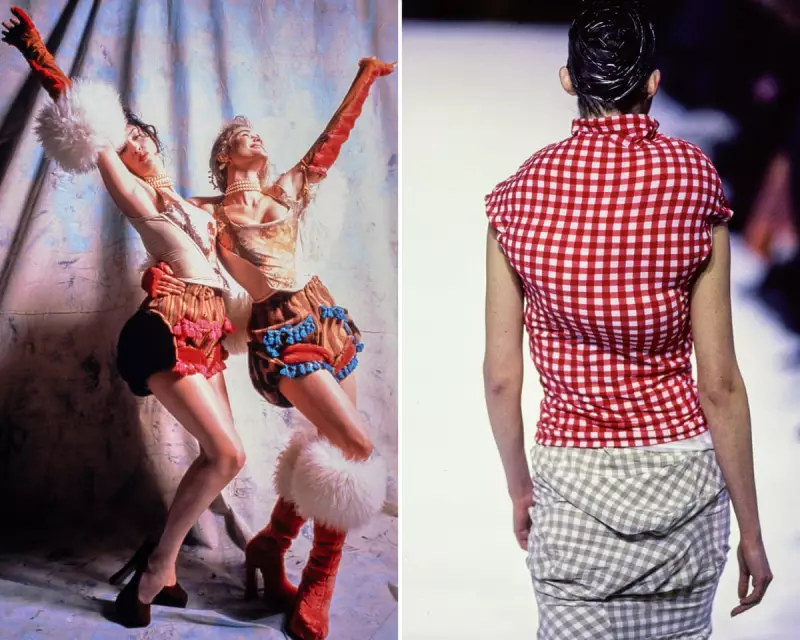
A groundbreaking new exhibition at the National Gallery of Victoria (NGV) in Melbourne is set to create fashion history by placing two of the most revolutionary designers of the last half-century side by side. 'Westwood | Kawakubo' opens on 7 December 2025 and runs until 19 April, marking the first time the work of British icon Vivienne Westwood and Japanese avant-garde master Rei Kawakubo has been presented together on such a scale.
Curating a Dialogue Between Icons
Katie Somerville, the NGV's senior curator of fashion and textiles, describes the pairing as a thrilling opportunity. The exhibition design thoughtfully reflects each designer's distinct philosophy. For Westwood, displays are 'full-bodied, head-to-toe, fully accessorised' with original pieces, including hats by renowned milliner Stephen Jones. In contrast, Kawakubo's works are presented with a 'spare and abstracted approach'.
A significant coup for the gallery was the acquisition of 45 works directly from Rei Kawakubo's personal archive, with 37 featuring in the final show. Curator Danielle Whitfield highlights this as a major highlight of the project.

Parallel Paths of Rebellion
Despite their different cultural backgrounds, both designers share a lack of formal fashion training and a foundational desire to challenge conventions. Vivienne Westwood, a former primary school teacher, began creating in the 1970s from her London flat and later the iconic boutique Sex, crafting the defining look of punk. 'She was using what she was creating... as a way of confronting what she saw as the rotten status quo,' explains Somerville.
Similarly, Rei Kawakubo shocked the fashion world with her 1982 'Holes' collection for Comme des Garçons. Her radical use of black, distressed fabrics, and asymmetry presented, as Whitfield notes, 'the complete antithesis' to the opulent couture of the era.
Mining History, Shaping the Future
Both designers are profound scholars of history, though they reinterpret it through vastly different lenses. Westwood's 1981 'Pirate' collection, her runway debut captured by photographer Robyn Beeche, revels in historical flamboyance with frills and prints that inspired the New Romantics. Her work often references 18th-century art, such as corsets printed with François Boucher paintings and dresses adorned with Fragonard cupids.
Kawakubo's '18th-Century Punk' collection fuses rococo decoration with punk rebellion, a fusion Whitfield describes as 'unlike anything we've kind of seen before.' A dress from this collection, famously worn by Rihanna to the 2017 Met Gala, features recreated brocade and structural panniers.
The exhibition also explores their contrasting relationships with the human form. Kawakubo's 1997 'Body Meets Dress–Dress Meets Body' collection uses padding to distort silhouettes, while her 2012 'Two Dimensions' pieces resemble flat paper dolls. Westwood's approach is more directly referential, such as a 1998 sheer dress inspired by classical Greek drapery that caused a media sensation.
Fashion as a Vehicle for Ideas
In their later careers, both used fashion as a powerful medium for expression. Westwood became a vocal activist for environmental and human rights causes, famously touring anti-fracking protests on a bus. Kawakubo's recent collections comment on the 'state of humanity more broadly,' with the exhibition's final room, 'The Power of Clothes', examining how both designers use fashion to protest and express values.
The exhibition design creates a distinct rhythm, from a lush, immersive 18th-century room to a clean, laboratory-like space showcasing tailoring experiments. Comme des Garçons even sent a dedicated team of dressers to Melbourne to prepare the garments, underscoring the importance of this unprecedented showcase.
'Westwood | Kawakubo' at the NGV is more than a fashion retrospective; it is a dialogue between two visionary forces who reshaped the aesthetic and ideological landscape of contemporary design, proving that clothes can be a profound form of cultural commentary.