The first major exhibition on James McNeill Whistler in three decades has opened at Tate Britain, showcasing the American artist's profound influence on British art. Known for his iconic painting of his mother, Whistler was a flamboyant showman whose minimalist works, particularly his nocturnal Thames views, are among the most hauntingly beautiful ever created.
A Showman Ahead of His Time
Whistler, born in Massachusetts in 1834 and raised in Russia, moved to London in 1859 and remained until his death in 1903. He championed "art for art's sake," sparking controversy long before the Young British Artists. His self-mythologizing flair paved the way for performative artists from Gauguin to Emin. The exhibition follows his progress through self-created environments rather than a traditional chronological sequence.
The opening painting, The Artist in his Studio (1865-6), shows Whistler watching himself work, with loose Impressionistic brushwork but a comically quizzical glance at the viewer. Chinese pottery and a reconstructed screen evoke his Chelsea studio, where he hosted media breakfasts with exotic fare like pancakes with maple syrup. The show includes more reproductions than typical, used as props to tell his story, with reconstructed arguments and speeches playing through the galleries.

Early Works and Unique Painterly Touch
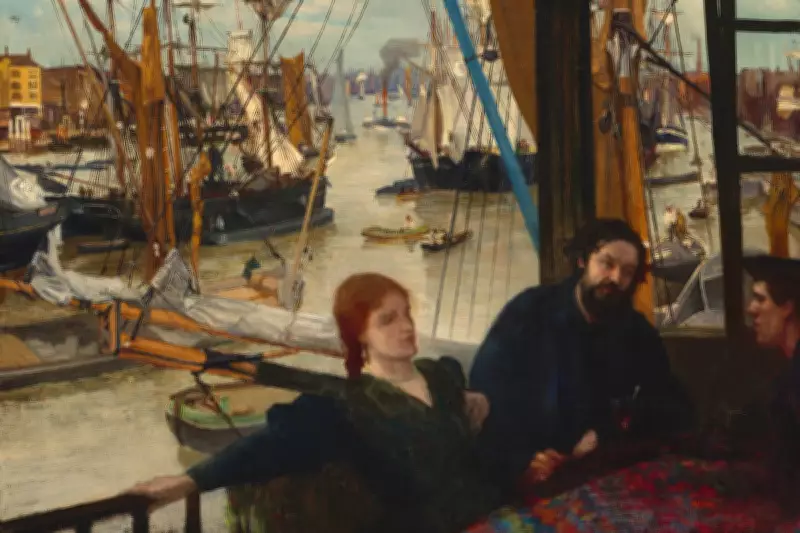
Early portraits of French peasants echo Gustave Courbet's dark realism, seen in Wapping (1860-4), where friends sit on a pub balcony before a panorama of shipping. Smaller works like Green and Grey, Channel (1865) and Chelsea in Ice (1864) show Whistler developing a unique touch, with narrow tonal ranges and luminous clarity. The latter captures the frozen Thames in masterfully manipulated white and steel grey, more daring than contemporaneous Impressionism.
The Famous Mother and Other Works
Whistler's Arrangement in Grey and Black No.1, known as "Whistler's Mother," feels conventional compared to his bolder works. He intended it as an abstract "arrangement" of colours and tones, but the detailed rendering of his mother's face and her remote expression evoke Old Masters. Similarly, Symphony in White, Number 3 and The Little White Girl have a period prettiness, while Three Figures: Pink and Grey feels modern with its stylized colour and mysterious mood.
The Peacock Room and Nocturnes
The exhibition evokes Whistler's Peacock Room, a Japanese-themed dining room that caused controversy with his patron Frederick Leyland. Wall-filling photographs show the blue and gold murals, but the highlight is the largest group of Whistler's Nocturnes ever assembled. Nocturne: Blue and Silver – Cremorne Lights (1872) is little more than smears of colour, with lights sparkling on the far shore. Nocturne in Blue and Silver (1875-8) reduces light to almost zero, with a barge as a dark slither against a ghostly water stretch.
One nocturne led to a famous libel case when critic John Ruskin accused Whistler of "flinging a pot of paint in the face of the public." Whistler won but was awarded a farthing and bankrupted.
Legacy
Whistler's later society portraits are gratingly theatrical, but a late self-portrait shows his cocky grin. While his provocative image has hindered his reputation, his nocturnal paintings are revolutionary. Far from a provincial sideshow to Impressionism, they are among the most extraordinary works of art's most momentous periods.
'James McNeill Whistler' is at Tate Britain from May 21 until Sept 27.