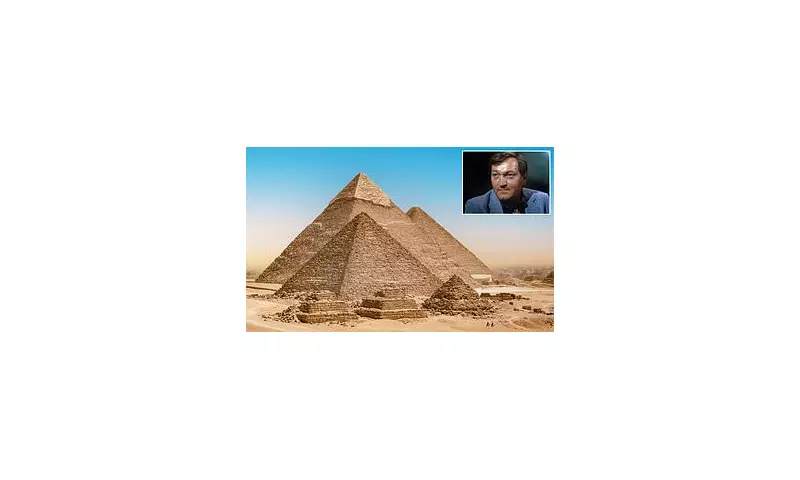
The enduring fascination with whether Egypt's pyramids were constructed by human hands alone has captivated conspiracy theorists for generations. No figure championed the extraterrestrial hypothesis more fervently than Swiss author Erich von Däniken, widely regarded as the founding father of ancient alien archaeology. Von Däniken, who passed away this month at the age of 90, dedicated his life to promoting the idea that visitors from other worlds directly assisted ancient Egyptians in creating monuments that defied conventional explanation.
The Bestseller That Launched a Movement
In his seminal 1968 work, 'Chariots of the Gods,' von Däniken laid out his controversial thesis. He proposed that alien 'astronauts' visited early human civilisations, including the ancient Egyptians and Mayans, sharing advanced technological knowledge. The book became an international phenomenon, selling over 60 million copies across 32 languages and fundamentally shaping popular discourse around ancient mysteries.
Questioning Human Capability
Von Däniken's argument rested on a series of perplexing questions about the pyramids' construction. He pointed to the extraordinary engineering precision of the Great Pyramid, the apparent lack of contemporary technology to move massive stone blocks, and the absence of evidence for internal lighting or large-scale worker presence within the structure. He further highlighted striking mathematical and astronomical alignments, suggesting knowledge ancient humans should not have possessed.

'An artificial mountain some 490 feet high and weighing 31,200,000 tons stands there as an incredible achievement, and this monument is supposed to be nothing more than the burial place of an extravagant king! Anyone who can believe that explanation is welcome to it…' he famously wrote.
Archaeological Rebuttals and Evidence
Despite its popularity, von Däniken's hypothesis has been consistently challenged by mainstream archaeologists and historians. Research has uncovered substantial evidence of large, organised human labour forces in ancient Egypt. Records detail how workers were fed and housed, while cemeteries and entire worker towns have been discovered near pyramid sites. Quarries showing how stones were cut and transported further contradict claims of impossible construction methods.
A Theory Rooted in Belief
Nigel Watson, author of Portraits of Alien Encounters Revisited, analysed von Däniken's appeal. 'At a time when there was the excitement surrounding the Apollo moon missions and the release of Stanley Kubrick's 2001: A Space Odyssey, Daniken used a mixture of speculation to link virtually any ancient structure with alien visitations,' Watson noted. He suggested the theory's success was based more on belief than empirical evidence, with von Däniken 'exploiting these beliefs' regardless of their factual basis.
Lasting Cultural Impact
Von Däniken's ideas have permeated popular culture, appearing in shows like Futurama and Star Trek, and even receiving a casual endorsement from billionaire Elon Musk in 2020. The author produced 25 more books expanding on his theories, and television series such as Ancient Aliens introduced his concepts to new generations. His work built upon earlier speculative theories, including those about the lost civilization of Atlantis.
A Controversial Legacy
The Swiss author, lacking formal archaeological training, used books, lectures, and videos to spread his message globally. His death on January 10 has reignited debate about his legacy. To sceptics, he was a purveyor of pseudoscience; to supporters, a pioneering thinker who dared to question orthodox narratives. As Watson concluded, 'Some will see him as a cynical conman, others as a fearless pioneer who fought mainstream science.' His central claim—that the technology to build the pyramids was not available to ancient Egyptians—remains a provocative, if widely disputed, footnote in the study of human history.