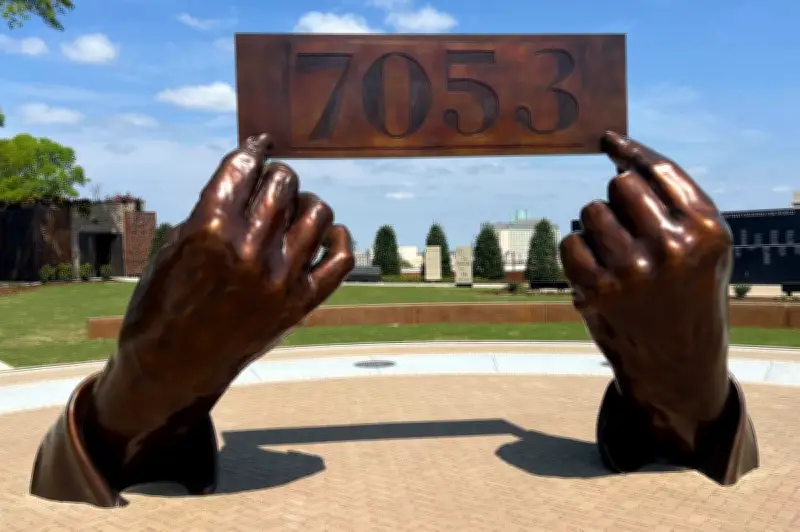
A new monument at Montgomery Square in Alabama transforms Rosa Parks's booking number into a powerful warning against the erasure of American history. Bronze hands rise from the pavement, holding a placard bearing the number 7053, the booking number from Parks's 1956 mugshot after her arrest during the Montgomery bus boycott.
Monument's Meaning
The monument reframes a number meant to reduce Parks to an arrestee into a symbol of resistance. Montgomery Square, an open plaza on Montgomery Street where voting rights marchers passed in 1965, is the newest Legacy Site built by the Equal Justice Initiative (EJI). Founder Bryan Stevenson stated that Americans have not fully appreciated the civil rights era's significance.
Timing and Context
The square's opening proved prophetic as the Supreme Court later gutted Section 2 of the Voting Rights Act, leading to Republican efforts to redraw congressional maps and dilute Black representation. Stevenson emphasized that the monument asks what memory demands, especially as conservative powers seek to erase civil rights victories.

An inscription on the square's exterior wall reads: "We have come too far to turn around now." Stevenson added this line late to declare something, not just commemorate.
Broader Legacy Sites
EJI's four Legacy Sites include the Legacy Museum, the National Memorial for Peace and Justice, the Freedom Monument Sculpture Park, and Montgomery Square. These sites attract about half a million visitors annually and preserve the memory of Black resistance.
For visitors like Josephine Bolling McCall, whose father Elmore Bolling was lynched in 1947, the sites hold family trauma. His name is etched at the memorial, and soil from his death site is preserved at the museum.
Control Over Narrative
Unlike federal institutions facing political pressure, EJI controls its privately built sites, allowing Stevenson to tell history without softening its indictment. He noted that this prompts conversations about family histories of racism.
Stevenson criticized the underestimation of racial injustice's injury, comparing it to a severe infected wound. He also condemned efforts like Florida's "anti-woke" history curriculum, likening it to letting the tobacco industry control education about smoking.
Civil Rights Movement
Montgomery Square resists the flattening of the civil rights movement into a simple narrative. The bus boycott was a collective response to daily humiliation, involving sacrifices from cooks, maids, and laborers who stayed off buses for over a year.
Stevenson noted that the Supreme Court decision proves the movement's work is not over. The Voting Rights Act was born from organizing, not judicial generosity. He stressed that reliance on law alone cannot solve racial problems; victories were won through collective action.
Relay of Justice
Stevenson described the work as a relay, with each generation passing the baton. The monument at Montgomery Square embodies this directive, lifting Parks's booking number skyward as a call to continue the race for racial justice.