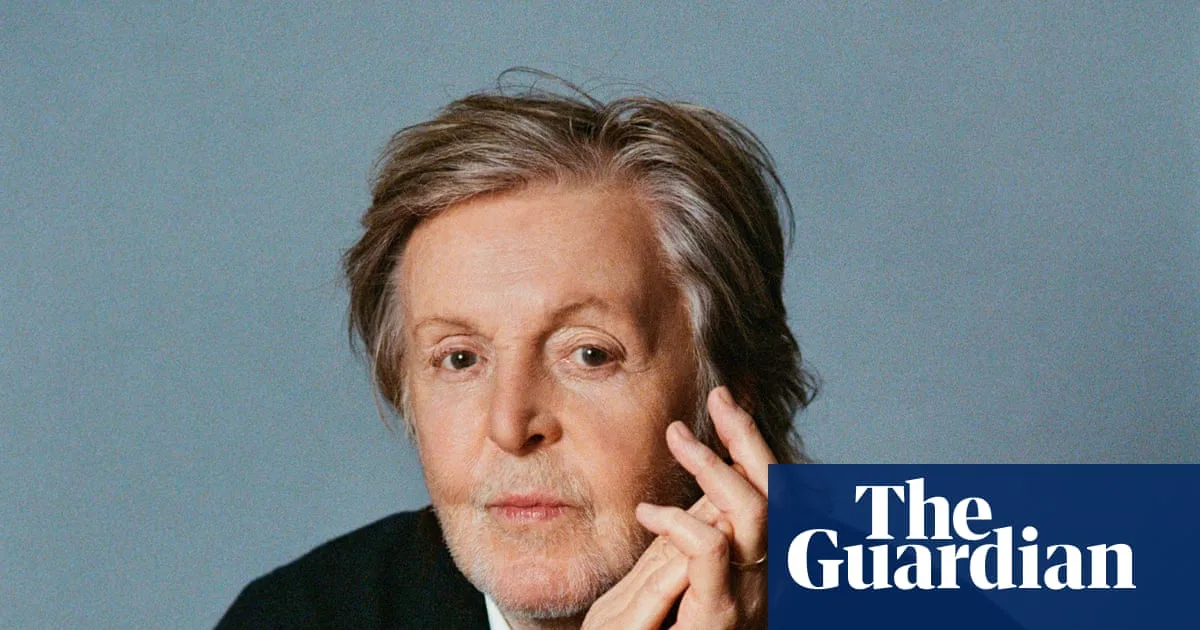
At 83, Paul McCartney is looking back for his 18th solo album, The Boys of Dungeon Lane, a collection of rare and revealing glimpses into memories never-before shared. The record is rich with sonic detail: skylarks, train whistles, the sound of a bus braking. But it is no syrupy exercise in nostalgia; instead, an adventurous and youthfully energetic take on guitar music.
Sitting in his office overlooking Soho Square, McCartney casts his mind back to the earliest sounds he can remember. 'OK, well, now we get into dubious territory, because I have a feeling I can remember being born,' he says. 'Highly dubious, but I feel the white tiles and chrome instruments and the sounds … It's probably total bullshit. An imagined memory! And I was a forceps delivery.'
He recalls infant school, running indoors with classmates; at 10 years old, living on Western Avenue in Speke, 'hanging out on the grass verge of the dual carriageway, with girls, and listening to them chatting, and one of them said, “You’ve got great eyelashes!”' There were family singalongs of Carolina Moon, Red, Red Robin, Bread and Butterflies; a joke told by an uncle, for which he can only remember the punchline: 'Repartee.'
The Dungeon Lane of the album title was a birdwatching destination close to the house on Ardwick Road where the McCartney family moved in 1950. 'Rows and rows and rows of council houses,' he says. 'But they were great council houses.' The marked upgrade was the indoor toilet.
McCartney says that when he writes songs, 'I don't particularly know what's going to come out.' He doesn't think there was 'anything conscious' behind the decision to revisit his past – it was just an opportunity for storytelling. The album, he says, gives him 'every hope that we'll get through' these febrile times that mirror our own.