The Milky Way Photographer of the Year 2026 competition showcases stunning images captured by photographers who venture into the most remote landscapes to find dark skies where the galaxy shines with extraordinary clarity. These photographers share not only their breathtaking results but also their methods, trials, and adventures.
Stargazing in New Zealand’s First Dark Sky Community
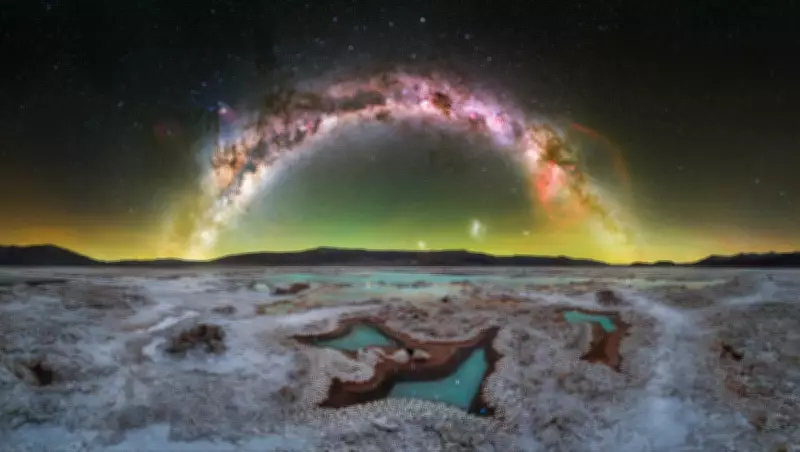
Reaching this location required travelling deep into the Puna de Atacama, a remote region in Argentina accessible only by 4x4 vehicles along rough dirt tracks, far from any source of light pollution. The nearest settlement was Antofalla, a small village of around 60 inhabitants, where electricity is generated locally and turned off at night. The untouched character and minimalist landscape immediately stood out.
The Milky Way Over a Field of Lupines
The Milky Way rises above a blooming field of lupines in New Zealand during November, when spring wildflowers transform the landscape beneath the night sky. Using a fisheye perspective, the flowers encircle the scene, forming a natural frame that draws the viewer into the celestial sphere above.

Geminid Symphony Over La Palma’s Guardian of the Sky
This winter Milky Way panorama captures a sky filled with Geminid meteors above the Gran Telescopio Canarias, the largest optical telescope in the world, on the island of La Palma, Spain. The final image is the result of an extensive post-processing workflow, combining meteor data registered using Auriga RegiStar from six cameras over five nights on La Palma.
Aoraki Mount Cook
The Milky Way arches above Aoraki/Mount Cook in New Zealand. Reaching this location required drawing on experience as a mountaineer, navigating steep rocky terrain and snow-covered slopes under winter conditions. The route presented constant challenges, including large washouts along the mountainside, unstable snow affected by solar radiation, and the demands of winter camping at altitude.
Sodium Milky Way
This scene was captured at the Very Large Telescope (VLT) on Cerro Paranal, in Chile’s Atacama desert, under exceptionally pure observing conditions where the boundary between Earth and sky feels almost seamless. Situated at 2,635 metres above sea level, the site benefits from extremely dry conditions, stable atmospheric layers and minimal light pollution, resulting in more than 300 clear nights each year.
Celestial Light Over Sea Cliffs
This image was captured by sea cliffs in the south of France. The night sky takes on a distinctly different character during this time of year, especially with the arrival of the winter constellations. The tones feel cooler, the air sharper, and Orion rises prominently above the horizon, becoming the centrepiece of the scene.
Night at the Remarkables
The galactic centre of the Milky Way, composed of billions of stars, gas and dust, rises above an icy, ancient landscape deep within Aoraki/Mount Cook national park in New Zealand, part of the largest Gold Tier Dark Sky Reserve in the world. The stillness, clarity and calm of the night stood in stark contrast to a place more often defined by its wild and unpredictable nature.
Firewater
At the Grand Prismatic Spring in Yellowstone national park, US, the raw energy of the planet meets the quiet vastness of the night sky. The constantly shifting steam transformed the scene from one moment to the next, briefly revealing the stars before concealing them again.
Lost in the Ripples of Space and Time
There is something uniquely powerful about a calm, windless night in the Pinnacles desert, and Western Australia offers some of the finest night skies in the world. In this composition, the main limestone pillar aligns almost perfectly with the south celestial pole, anchoring the image beneath the rotating sky.
Perseid Meteors Over Durdle Door
Ancient fireworks from Comet Swift-Tuttle hurtled through the atmosphere captured with an ultra-wide angle lens. The natural limestone arch of Durdle Door, Dorset, UK is included. In the foreground, a singular glow worm was documented among reeds along the sea cliff edge.

Galaxy on the Rise
Although it was only a few minutes from the parking area, it took nearly four hours of scouting to finally locate this cave in Tenerife, Canary Islands, Spain. Capturing the image proved just as challenging, requiring careful positioning and focus stacking across different planes in near-total darkness.
Divinity
Capturing a setting Milky Way core from this beach on the west coast of New Zealand had been on the photographer's list for a long time, with the starfish-covered reef offering a distinctive and compelling foreground. The terrain is hazardous, with gaps between the rocks posing a real risk, and the rapidly rising tide added constant pressure throughout the shoot.
Milky Way Over Tatra Mountains
This image is taken in the Białka Gorge in Jurgów, Poland. In the foreground, the river creates a natural leading line, guiding the eye from the Earth towards the mountains and into the night sky, visually connecting the terrestrial and the cosmic.
Double Milky Way Over Monfragüe National Park
This image was taken in Monfragüe national park, Spain during one of the few nights of the year when both the winter and summer Milky Way can be seen in the same sky. It is a composite that captures the transition of the Milky Way over several hours.
Salto del Agrio
This image was captured at Salto del Agrio, in the province of Neuquén, Argentina. The 45-metre waterfall plunges into a canyon carved by ancient lava flows from the Copahue volcano. Surrounded by basalt, the scene is enriched by the vivid colours left behind by minerals.
Galactic Spine
The photographer is drawn to Milky Way photography because of its ability to spark curiosity. It offers a perspective that feels entirely different from other forms of photography, often revealing a world that many people have never experienced.
Valle de la Luna, Universo Triassico Ischigualasto
This photograph was captured in Argentina, in a Unesco world heritage site. Cancha de bochas has geological importance as the only place on Earth where the complete sequence of the Triassic period can be observed, preserving key fossils from the earliest dinosaurs.
Fireball in Paradise
This single-exposure image became a reminder to always expect the unexpected in astrophotography. The capture was part of a larger day-to-night time-lapse that began shooting at golden hour, working through biting insects and the intense tropical humidity of Florida.
Caldera Galaxy Panorama
This panorama was captured at the highest point of the volcanic island of La Palma, a location defined by its unique terrain and exceptional night sky conditions. The lack of ambient light made the process more demanding, requiring extensive focus stacking to achieve sharpness across the entire scene.
Il giardino delle stelle
Among rows of blooming lavender, the air filled with fragrance, fireflies appeared like small lanterns beneath a sky dominated by the summer Milky Way, a perfect meeting between the wonders of Earth and the night sky above.
Standing on the Shoulders of Giants
This photograph comes from the heart of the Sierra La Giganta in Baja California Sur, Mexico, following a two-day expedition from the small village of San Juan Londo. The final approach required an ascent of more than 800 metres by mule along a long-forgotten section of the historic Camino Real.
Botswana Baobabs by Night
The photographer spent 10 days travelling through Botswana, living out of a car and moving through remote desert landscapes in complete isolation, focused entirely on photographing the night sky. This location became the highlight of the trip: a small, ancient island rising from the middle of a vast salt pan.
Where Earth Meets the Cosmos
A two-week camper trip along the coasts of Normandy and Brittany became a continuous struggle against wind and cloud cover, until a single clear night transformed the entire experience. While reviewing one of the final frames, an unexpected red glow in the sky appeared – aurora.
Milky Way Over Syme Hut and Mount Taranaki
Reaching Mount Taranaki, New Zealand involved over five hours of hiking through deep snow and ice in extreme conditions, with windchill dropping to around -15C and a heavy 20kg pack. This image is the result of a large-scale panorama composed of 78 individual frames, captured over approximately one hour and 15 minutes.