Lubaina Himid on Her 40-Year Battle to Represent Britain at Venice Biennale
Lubaina Himid: 40-Year Battle to Venice Biennale

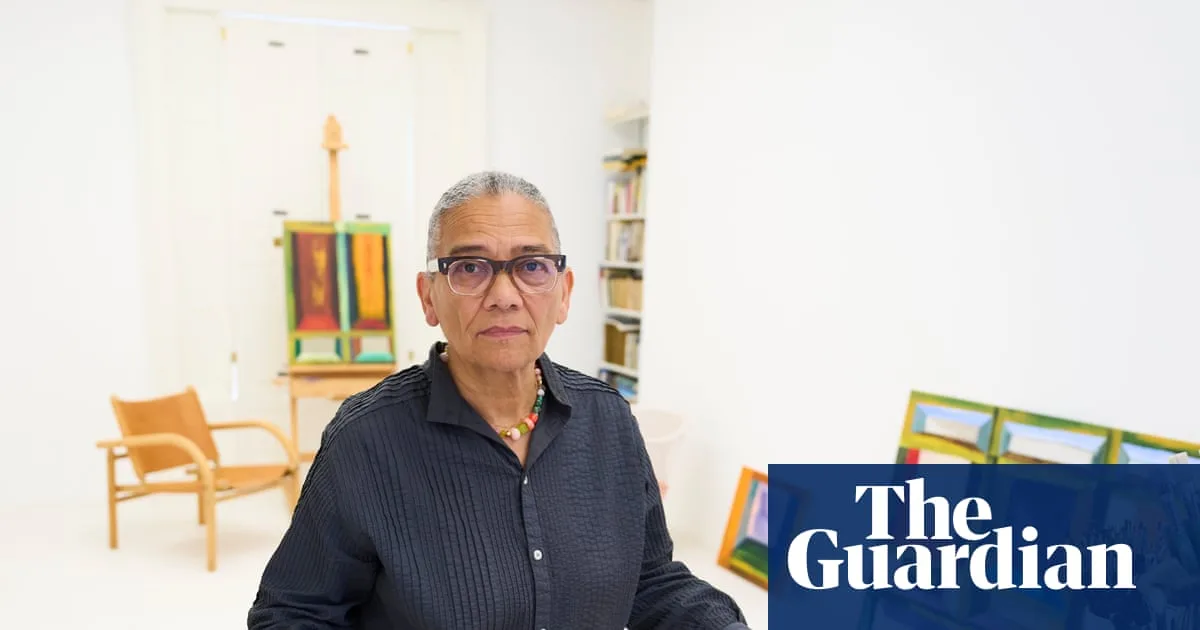
The Venice Biennale opening is just days away, but Lubaina Himid is in no rush. The artist, who will represent Britain at the "Olympics of art," is at home in Preston, where an air of calm prevails. Her wife and frequent collaborator Magda Stawarska is making tea, while gardeners move paving slabs in the back yard.

Wandering through her beautiful Victorian terrace, Himid leads the way to the house directly behind. She bought it, knocked down a wall between the two properties, and has almost finished turning it into a studio. Airy, light-filled, and serene, the space is dotted with works on canvas; paintbrushes sit neatly in custom-made cabinetry. Everything is in its right place.

The Zen-like vibe may stem from the fact that Himid has already installed her work ahead of the biggest week in her career. "I'm very obedient," she confesses. "I did as I was told, unlike John Akomfrah, who does what the fuck he likes." She jokes about her friend Akomfrah, who, along with Sonia Boyce in 2022 and now Himid, completes a trio of black British artists from the same generation who have stormed the pavilion in recent years.

Wide Pickt banner — collaborative shopping lists app for Telegram, phone mockup with grocery list

The British Council, which has run the UK's pavilion for nearly 90 years, gave her a schedule: work photographed in January, shipped in February, and installed by the end of March. When Himid and her team arrived at the Giardini, they were the only team on site. Himid was given April off, but rather than rest, she decided to get married before May and the madness of previews. "We had a break, so we got married," she says matter-of-factly.

The idea of the 71-year-old being obedient doesn't fit the public persona of an artist who has said her work must "disrupt," "remind," and "cause tension." For over four decades, she has called out the art world's hypocrisy. She keeps a "little black book" of "big name" curators who shunned her but now embrace her. Paintings on canvas, cupboard doors, crockery, and textiles have been her weapons, often reaching across the Black Atlantic into art history, giving silent black figures agency. Her figures are often cut-outs, harking back to her training in theatre design; she has wrapped buildings in textile to connect their grandeur to colonial-era exploits.

Once dubbed a "cultural terrorist," she insists her work is like "perfume"—subtle and seductive, with lingering power. At the Royal College of Art, she fought tutors who said there was "no such thing as a black artist." Himid told them to get stuffed and wrote her thesis on contemporary black British artists, becoming a key figure in the 1980s Black Art Movement alongside Akomfrah, Boyce, Maud Sulter, Donald Rodney, Claudette Johnson, Veronica Ryan, and Ingrid Pollard.

For much of her career, Himid existed in the margins. It wasn't until the mid-2010s that "mainstream" galleries showed her work. In 2017, aged 63, she won the Turner Prize after a rule change made artists aged 50 and over eligible. "I won it for all the times where we put our heads above the parapet," she said. "We tried to do things, we failed, people died in the meantime." (Sulter died in 2008, Rodney in 1998.) Back in the 80s, she curated landmark shows like The Thin Black Line, taking over a corridor in the ICA near the toilet. Now, the grand pavilion at Venice is hers.

How does it feel to represent Britain—a country whose history she has wrestled with for so long? "I know about this place," says Himid, who moved to the UK as a four-month-old baby with her mother after her father died in Zanzibar. "I've seen a lot of things happen, a lot of governments come and go, policies come and go, people come and go. People get born, people die, cities change, and I've learned lots from our different cities, not just London. I could smell Brexit coming."

For Himid, the question of whether she should represent Britain is flawed. "The question seems completely mad," she says. "You never would ask Cathy Wilkes that. It's a racist question." But was there a part of her that wanted to turn down the honour? The British pavilion, like the rest of the Venice Biennale, is rooted in colonialism and destructive nationalism that her work has critiqued. "If you're an artist, I think, you absolutely believe, whether it's true or not, that you can change spaces," she says. "So you believe that once you put your project in there, it becomes about your project."

Pickt after-article banner — collaborative shopping lists app with family illustration

Himid's pavilion, called Predicting History: Testing Translation, sounds a bit like David Lynch's Blue Velvet—a seemingly quaint story that veers off to reveal darker layers. The interior has been transformed with 78 litres of very bright bianco ottico paint, illuminated with a barrisol lighting system to create brightness reminiscent of a British summer's day. "It sounds like a cliched summer's day too," adds Himid, revealing that Stawarska has composed a soundtrack from birdsong, insect chatter, and the English folk tune Early One Morning sung by Greek star Nana Mouskouri. "Then it goes slightly odd. And it gets stranger and stranger."

Himid has created half a dozen vast paintings, each presenting different figures: boatbuilders, architects, chefs, gardeners, and tailors. Throughout her career, she has referenced makers and doers: street-sellers, seamen, and servants. Here they all represent her central idea: the question of belonging. The tailors, she explains, engage in a conversation about sartorial choices, culture, and conformity. "Should you show your identity in the new place by wearing your own clothes, or do you wear these new clothes, even though they don't fit you? Since when have you found a dress in Primark that accommodates your big bottom? It's about that—obvious everyday ways everyone understands."

She also poses 26 questions that, like the soundscape, start off normal enough ("Where do you come from?", "What reminds you of home?") and quickly become confounding and unsettling ("Why are you still here?", "Can flies settle here?"). Some feel like questions black Britons have always wrestled with, from Stuart Hall in the 1980s to CLR James in the 1960s and Amy Ashwood Garvey in the 1940s. "I'm trying to work out whether you hang on to the languages and behaviours of the old place," she says. "Or whether you try to learn the languages and the behaviours of the new place and what that does to the things you've just about remembered."

At Venice, it won't only be the politics of immigration on display. Himid is one of 200 participants who have signed a letter demanding the cancellation of the Israeli pavilion, billed as "a collective refusal to allow you to platform the Israeli state as it commits genocide." Why did she sign the letter, organised by the Art Not Genocide Alliance (Anga)? "You can't be neutral on something like that," she says. "I think the issues are deeply, deeply complicated, but bombing and murdering is not deeply complicated. It simply is bombing and murdering, you know?"

Himid is uneasy that Anga is remaining anonymous, while artists like her and Chile's Alfredo Jaar are not. "People who were in the anti-apartheid movement, white people and black people, you knew who they were," she says. "There are plenty of people now who wouldn't show my work, because I signed that thing, but I don't know who Anga are." Once again, Himid knows her head is above the parapet during an event that could be one of the most politically fraught in years. Israel's foreign ministry has condemned Anga and the push for a boycott, calling this "anti-Israeli political indoctrination" and "direct discrimination."

On the walk from the station, Himid's studio manager mentioned that, just before she was announced as Britain's representative in Venice, they were working on a show featuring the painting Surprise Navigation. In it, two black figures look out at a lagoon and a pair of gondolas. Himid joked she was manifesting her Venice selection. A week later, the British Council unveiled her as its 2026 representative. "I was ready to do it when I was 30," she said. "It's just that the British Council weren't ready for me." Now her moment is here on the biggest stage of all. The Venice Biennale opens on 9 May.