The island of Naoshima, once heavily polluted and dominated by a Mitsubishi plant, has been transformed since 1989 by billionaire Sōichirō Fukutake into Japan's renowned 'art island.' With 3,000 inhabitants rising from the Seto Inland Sea, the island features dim, concrete-walled galleries sunk into hillsides, designed by architect Tadao Andō. These spaces exude a contemplative, almost worshipful ambience, housing extraordinary works by artists from Claude Monet to Walter De Maria. The most Instagram-famous piece is Yayoi Kusama's giant yellow-and-black spotted pumpkin on a pier, installed in 1994.
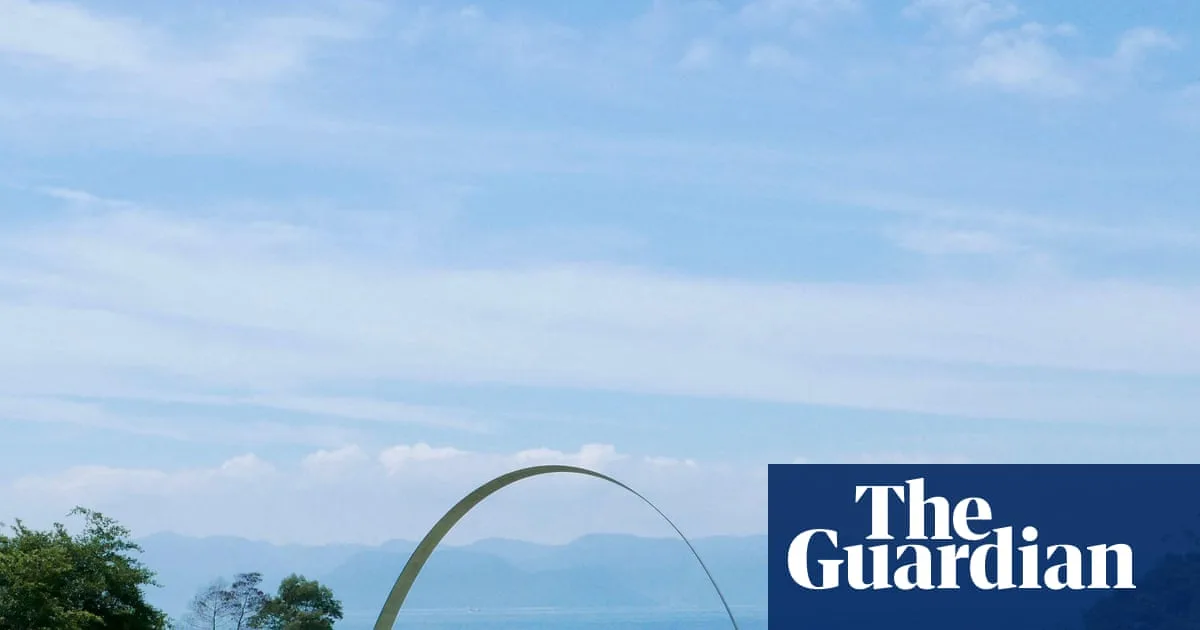
For many visitors, the ultimate transcendental experience occurs when walking downhill to the coast and encountering a massive steel arch, 11 metres tall and 13 metres wide, pinned between two sand-coloured boulders. Beneath it, a long steel plate acts as a runway, inviting passage toward the sea. This sculpture, titled Porte Vers l'Infini or Gate to Infinity, intensifies the beauty of its surroundings—the sky appears bluer, birdsong louder, and pine-covered hills lusher and more dramatic. Its creator, Korea-born artist Lee Ufan, explains from his studio in Kamakura: 'I want my work to take you to a place where you can feel the deep breath of the universe.'
Lee Ufan: The Master Behind the Gate
Lee Ufan, respectfully called 'Mr Lee,' turns 90 next month. He has two museums dedicated to him—one on Naoshima and another in Arles, France—and is opening two major shows. In Venice, coinciding with the Biennale, a retrospective covers his career from the late 1960s to the present, including early sculptures from the Mono-ha movement. Mono-ha, or 'School of Things,' explores how objects relate in nature, often compared to American land art, post-minimalism, and Italian arte povera, using materials like soil, rock, and sand.
'I was in my early 30s,' Lee recalls. 'At that time, in the late 60s, America, Europe, and Japan were in a period of rebellion.' His first 3D work, Phenomenon and Perception B (now retitled Relatum), featured a pane of glass cracked by a boulder's weight—a nod to Marcel Duchamp and an exploration of industry versus nature. 'In the beginning, my work wasn't about being slow or quiet. It was more about violence and resistance.'
In 1969, for Things and Words, Lee chased three enormous sheets of paper blown around a square on a windy day. 'I wanted to show how we have a dialogue with material. Over time, the paper gets wrinkled and I become exhausted.' The work was named after Michel Foucault's book, reflecting philosophy as a key inspiration. Did people understand? 'Maybe not.'
From Line to With Winds: Evolution of an Artist
At Dia Beacon in upstate New York, eight works will be displayed: three sculptures and five paintings, including the 1970s series From Line, where meticulously straight stripes fade as dark blue oil paint runs out. Lee stopped these physically demanding works in the 1980s due to hand tremors. Others are from the 1990s series With Winds, featuring swirling lines.
Eight works might seem sparse, but the entire Lee Ufan Museum on Naoshima holds only 17 pieces, and photography inside is forbidden. Lee opposes overproduction in art and life, mastering the art of reduction. He once said: 'I want viewers to perceive the things I did not paint as much as the things I did.'
The Naoshima Experience: A Room for Contemplation
The visitor's journey on Naoshima concludes in a room with a curved white ceiling and pale wooden floor. After removing shoes, visitors sit to contemplate three works from Lee's Dialogue series, painted directly on the wall. Each features a lozenge of grey paint transitioning from pale to dark, appearing as a single brushstroke but composed of many smaller ones built over a week, each layer dried before the next. This meticulous human care balances with natural imperfection, offering deep calm. 'My work is very powerful,' Lee says. 'It's not my power, but a vibration that happens in the relationship with the person who views it.'
Meeting the Master in Kamakura
The following day, three other journalists and I travel to Kamakura, an hour from Tokyo, then by bus to Lee's studio. Running slightly late, his studio manager frantically urges us uphill—whether due to Japanese punctuality or Lee's dislike of lateness is unclear. Lee greets us cheerfully at his gravel garden, where sculptures include curving rusted steel beside a boulder.
Dressed in jeans, black leather slippers, and a rust-coloured quarter-zip knit under a grey cardigan, Lee looks far younger than his age. 'I just work hard,' he says of his youthfulness. 'I call myself a nomad—I travel a lot, visiting many places and meeting people. I still don't understand the world and want to know more. That gives me energy to stay young.' He rises at 7am, walks for an hour, buys fresh vegetables, and does acupuncture. Before painting, he performs breath exercises: 'I always have 10 to 15 minutes of tuning my breath, achieving quietness, calming my body. In a way, I use silence as a medium.'
Before the interview, Lee serves tea in cups bearing his unmistakable brushstroke. His studio holds brushes of every thickness and shelves of books on artists like Richard Serra, Jasper Johns, and land art. His From Line paintings hang on walls and even in the loo. Joined by an interpreter and one of his three daughters, Lee ruefully admits he hasn't always been the greatest husband and father: 'My family had to make sacrifices for my work. I talk about connecting to nature and art, but I am self-centred—there's an irony.'
From Korea to Japan: A Life of Art and Philosophy
Born in Kyongsang-namdo, a Korean mountain village in 1936 during Japanese occupation, Lee excelled in poetry, art, calligraphy, and music. He studied the last at university in Seoul, aspiring to be a composer. At 20, he delivered medicine to an uncle in Japan and stayed to study philosophy at Nihon University in Tokyo. His art faced severe criticism from the start, so he became a critic to defend himself. After being astonished by Nobuo Sekine's Phase: Mother Earth—an 8-foot column of earth beside the hole it came from—he joined Mono-ha. He has since written 17 books on philosophy, poetry, and art history.
His international reputation grew, but in 1970, organisers of a Japanese art festival in New York barred him because of his Korean birth, reflecting enduring enmity. 'I was a bit hurt,' Lee says, 'but I felt I needed to communicate with people with opposite positions.' Today, he values his internationalist perspective: a Korean in Japan, speaking several languages, with a home in Paris.
People may puzzle over his boulders, their careful placement, or a concrete pole on pebbles at his museum's entrance. Yet they serve as conduits to deeper contemplation, expressing relationships between interior and exterior, awareness of our bodies in nature, and finding our essential selves amid noise. 'My work always bridges to something,' Lee says. 'Being open to connecting with others is so important.'
Lee Ufan is at Dia:Beacon, Upstate New York, from 8 May, and at SMAC, Venice, from 9 May to 22 November.