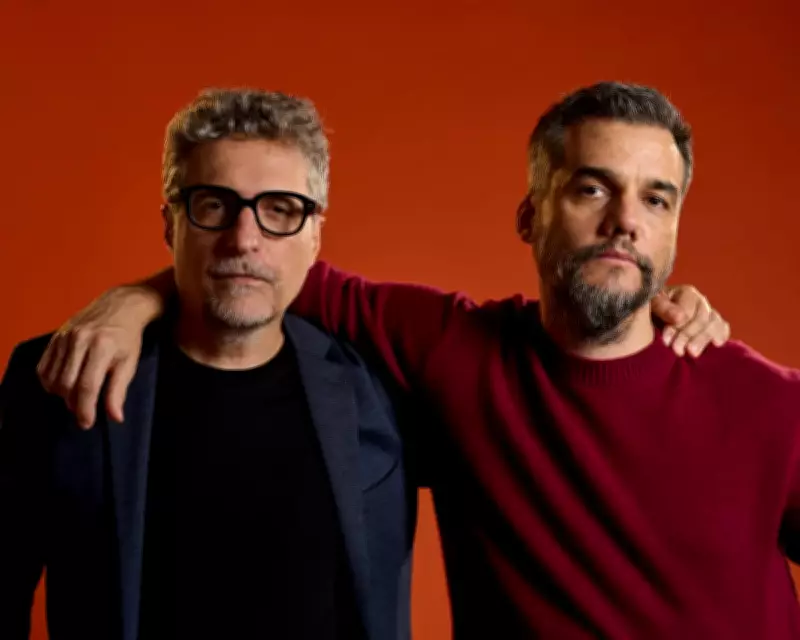
In an era where democracy often feels fragile, artists who dare to voice dissent can face severe repercussions. This reality is vividly illustrated by the experiences of Brazilian actor Wagner Moura and writer-director Kleber Mendonça Filho, whose latest film, The Secret Agent, has become an unexpected awards contender despite its challenging subject matter and non-English language.
Awards Magnet Amid Political Turmoil
Unusually for a political period drama that runs nearly three hours, blends authentic portrayals of military dictatorship with dark humour and violent shootouts, and is not in English, The Secret Agent has emerged as a significant awards magnet. The film is competing in four categories at next month's Oscars, including Best Picture and Best Actor for its star Wagner Moura, who recently secured a Golden Globe win.
Seasoned Professionals Unfazed by Acclaim
When meeting Moura in a London hotel room, the seasoned 49-year-old actor exudes a relaxed, matinee idol charisma, coupled with an air of decency reminiscent of his character Armando in the film. A widowed academic hiding in a Recife safe house during Brazil's 1977 dictatorship, Armando plots to flee the country using a fake passport while evading hitmen hired by a vengeful industrialist.

Beside him sits the film's unexcitable 57-year-old director, Kleber Mendonça Filho, whose shrewd gaze and thin, amused lips draw comparisons to Peter Sellers. Both men have already accumulated accolades, beginning with Best Actor and Best Director wins at last year's Cannes festival. For them, the success of The Secret Agent represents not just victory but vindication, reflecting a turbulent decade in Brazilian politics and the personal bruising they have endured.
Friendship Forged in Shared Struggle
Their friendship spans two decades, originating when Filho was a film critic and Moura an actor. They bonded over shared origins in Brazil's beleaguered north-east, a region often mocked by those in the south-east. "There's still a lot of prejudice towards us," Moura explains. "As an actor, if you go to work in Rio or Sao Paulo with this accent, you get relegated to playing the funny guy or the doorman. My attitude, and Kleber's too, is: 'Fuck this. Fuck you.'"
This defiance comes at a cost, especially in political matters. "The Secret Agent is a result of something that we both … I don't want to say, 'the price we paid', but it wasn't easy to be vocal about Bolsonaro," Moura reflects.
Professional Persecution and Personal Attacks
In subsequent years, both men faced significant backlash. Filho was pilloried after he and the cast of his 2016 film Aquarius protested the impeachment of then-president Dilma Rousseff at Cannes, a moment he describes as "one of the proudest of my life." The film, which metaphorically addressed Brazil's unfolding crisis, was blocked from being Brazil's official Oscar entry.
Around the same time, Moura wrote a newspaper article warning of an impending coup and criticising judge Sérgio Moro, later confirmed by the UN as biased. "I was attacked for that article," Moura says gravely. "I received death threats. It was hardcore."
In 2019, Moura's directorial debut Marighella, about revolutionary Carlos Marighella, was sabotaged by Bolsonaro's government, remaining unreleased for over two years. "It was cynically and unofficially sabotaged," Filho notes. "And Wagner will never get an explanation. That's where Kafka comes in."
The Secret Agent as Political Commentary
Out of this shared experience of persecution emerged The Secret Agent. "In the film, you've got an honest man who doesn't follow the script," Filho explains. He disputes the notion that the campaign against Armando is low-level, arguing that persecution can be "incredibly destructive," even without overt violence.
Both men continue to face attacks in Brazil, with false stories alleging they received millions in government funding. "If you express yourself in a time when democracy is running on fumes, the attacks can be pervasive, brutal and cruel," Filho asserts.

Blending Politics with Pop Culture
The film mixes political commentary with B-movie touches, such as a disembodied leg attacking people—an urban legend from 1970s Recife that served as coded criticism of the regime. This element has become a surprising symbol for the movie, alongside Moura's acclaimed performance.
Filho's approach echoes that of US indie pioneer John Sayles, blending exploitation shockers with conscientious dramas. His cinephilia and political awareness are vital to the film, but nothing is more integral than its alertness to history. A flash-forward to modern-day researchers transcribing Armando's recordings underscores this, with Filho noting, "It's the whole idea of making a time-travel film without a time machine."
The Urgency of Artistic Expression
In an era of governmental lies and misinformation, The Secret Agent feels profoundly relevant. "The way these autocrats are discrediting journalists, people getting information from social media," Moura says, "it scares the shit out of me."
Both emphasise the importance of not being muzzled. "I don't think you can be a serious artist and go through life without exposing your views on things," Filho states. "If you keep quiet, you will not have my respect."
Moura acknowledges that actors are often discouraged from speaking out, and he has been advised against certain statements. When asked if he would be discouraged from criticising the current US president, he replies with a twinkle, "Yes. Right now, I'm being very discouraged. But I'll keep saying it, right?"
As The Secret Agent prepares for its UK cinema release, it stands as a testament to the power of art in confronting political corruption and the personal costs of speaking truth to power.