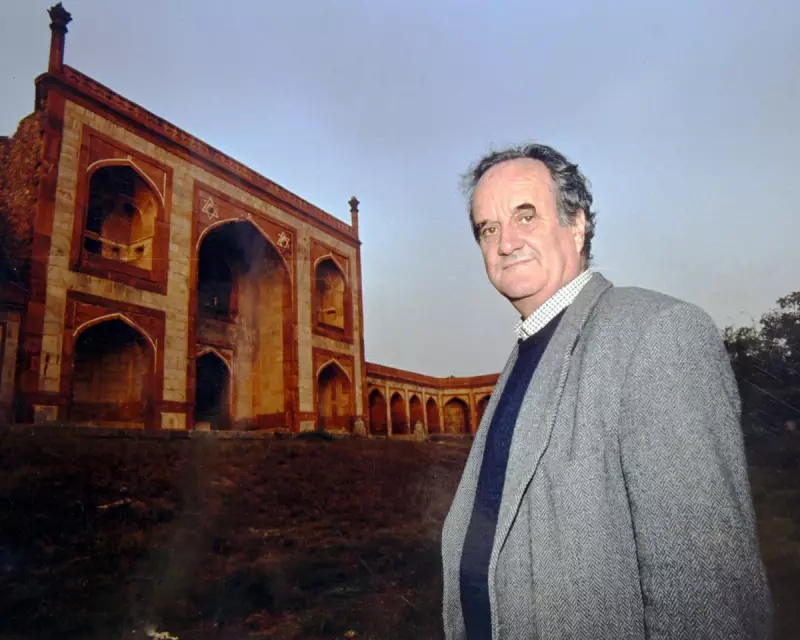
The distinguished career of Sir Mark Tully, the BBC's former Delhi bureau chief whose profound connection with India made him a household name across the subcontinent, has drawn to a close with his passing at the age of 90. For over two decades, from 1972 to 1993, Tully served as the corporation's chief correspondent in India, later continuing as South Asia correspondent, becoming synonymous with authoritative and empathetic reporting from the region.
A Revered Public Figure Beyond Journalism
Mark Tully's standing transcended that of a typical foreign correspondent. He evolved into a genuine public figure, widely recognised and respected throughout India. This enduring legacy was vividly demonstrated as recently as 2017, when he was producing a BBC World Service documentary marking the 70th anniversary of Partition. Frank Stirling, the documentary's producer, recalled that Tully could not walk down a street without people approaching to shake his hand, a testament to his deep-rooted popularity and the trust he had earned.
Reporting on Tumultuous History
His journalistic tenure covered some of India's most pivotal and turbulent events, where his sensitive approach shone through. He reported with notable depth on the catastrophic Bhopal industrial disaster, the intense siege of the Golden Temple in Amritsar (Operation Blue Star), and the assassination of Prime Minister Indira Gandhi, all occurring in the fateful year of 1984. Tully possessed a rare understanding of the nation's complex and often volatile political landscape, which informed his nuanced broadcasts.

A Life Intertwined with India
Tully's bond with India was multifaceted. Born in Kolkata (then Calcutta) to William, an accountant for the British Raj, and Patience Tully, his connection was innate. Although sent to the UK for education at Twyford School, Marlborough College, and Trinity Hall, Cambridge, where he studied theology, he returned to India in 1965 for an administrative role with the BBC. His fascination with the country extended beyond politics into the spiritual realm, a theme that later enriched his work.
After retiring from frontline reporting, from 1995 to 2019 he was the main presenter of BBC Radio 4's contemplative programme Something Understood, exploring life's meaning through poetry, prose, and music. His theological background, once aimed at priesthood, informed but never dogmatised his perspective. "I still cling to Christianity and identify myself as Christian," he told Radio Times in 2019. "But living in India with so many religions around me, I no longer believe that Christianity is the only way to God."
Literary Contributions and Controversial Departure
Alongside his broadcasting, Tully was a prolific author. His first book, Amritsar: Mrs Gandhi's Last Battle (1985), co-authored with Satish Jacob, detailed the Golden Temple siege. Other notable works include No Full Stops in India (1991), India in Slow Motion (2002) with Gillian Wright, and Upcountry Tales (2017). His departure from the BBC in 1994 was preceded by controversy after a 1993 lecture where he criticised then Director-General John Birt for creating a "secretive monolith," leading to a contractual dispute and his eventual resignation.
Honours and Personal Life
Sir Mark Tully's service was recognised with a knighthood in 2002 and two of India's highest civilian honours: the Padma Shri and the Padma Bhushan. In his personal life, he was married to Margaret Butler from 1960, with whom he had four children: Sarah, Emma, Sam, and Patrick. He maintained homes both in London with his wife and in Delhi with his partner, Gillian Wright, describing the arrangement as "complicated."
William Mark Tully, broadcaster and author, born 24 October 1935, died 25 January 2026. His voice, once the definitive BBC link to India for a generation, now falls silent, leaving behind a legacy of journalistic integrity and a unique bridge between cultures.