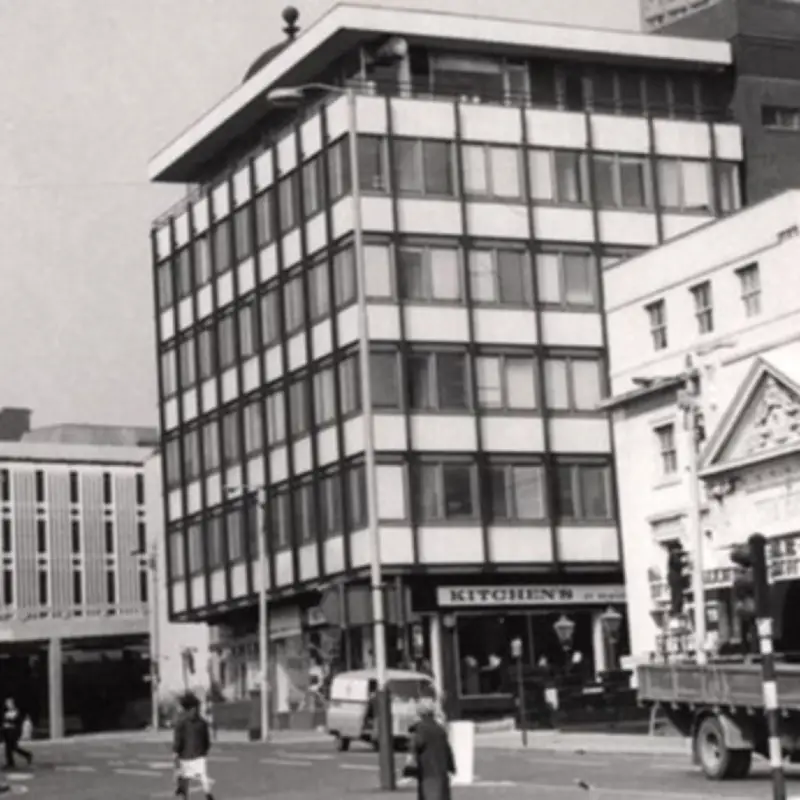
A Newcastle street in 1971 - an iconic dance hall and vanished musical instrument shop. Recalling the Oxford Galleries and Kitchen’s music store on New Bridge Street.
New Bridge Street West in 1971
This was Newcastle’s New Bridge Street West 55 years ago - and at its heart stood a location that shaped the social lives of generations of Tynesiders. When our photograph was taken in 1971, the building on the right was on the brink of becoming a nightclub-cum-newfangled discotheque called Tiffany’s. Before that, as the Oxford Galleries, it had long been the much-loved venue where countless couples met, danced the night away, courted and kissed, before very often going on to tie the knot.
Dating from 1825, the elegant building was originally the home of John Dobson, the visionary architect who helped rebuild central Newcastle in the early 19th century. Exactly 100 years later, the Oxford Galleries dance hall enjoyed a grand opening. Describing it as “the perfect ballroom”, a large advert on the Evening Chronicle’s front page of Saturday, June 20, 1925, outlined the programme of events for the first week. There was dancing billed every night from Monday to Saturday, 7pm to 11pm: Opening Night; Flannel Dance; Plate Day Ball; Midsummer Night’s Revel; Cabaret Night and Gala Night. Admission was two shillings (10p in today’s money). Afternoon tea dances on Wednesdays and Saturdays would also come to be hugely popular.

The Roaring Twenties and Beyond
If the years immediately after the First World War were marked in our region by industrial decline and widespread unemployment, many Geordies were doing their best to enjoy the ‘Roaring Twenties’. Certainly, when couples performed “depraved steps like the Charleston” at the Oxford, they provoked anger from traditionalists and clergymen who wanted to ban this new “dangerous” style of dance. The venue over time earned a reputation as a place of style and sophistication. In the 1950s and early ‘60s, young people would get dressed up and enjoy formal dancing - and there was no alcohol on sale.
In 1971, as Newcastle’s after-dark and music scenes shifted, it reopened as a “luxury late nitespot” called Tiffany’s offering “dancing, cabaret, supper, and mini menus”. It was the first of the venue’s many reincarnations. In subsequent years, the nightclub would undergo a succession of revamps and name changes: Ritzy, Ikon, The Studio, Central Park, Diva, Liquid Envy, and Club LQ. The end finally came in 2015 when it was reported the illustrious building would be transformed into student accommodation. Fittingly, it would be called Oxford House. Today, only the façade remains, but for 90 years the Oxford Galleries was where Newcastle danced, flirted, celebrated, and grew up - an important landmark in the city’s collective memory.
Kitchen’s Music Store and Other Landmarks
To the left of the Oxford building in our photograph from 55 years ago, we see Higham House (behind which, out of sight, still stands the Laing Art Gallery dating from 1904). Comprising offices and ground-floor shops, the corner unit was home to Kitchen’s of Newcastle. A newspaper advert from 1971 noted that the store stocked “all types of musical instruments to suit all pockets”. For many years, it was a regular haunt for budding Tyneside musicians, a young Mark Knopfler among them. The future Dire Straits frontman reputedly bought one of his first guitars at the shop. It was reported earlier this year that Higham House is to be demolished after lying mainly empty and being covered with scaffolding for the last five years.
On the far left of the streetscape, we see the former Newcastle Central Library. Designed in period Brutalist style by Sir Basil Spence, it opened in 1968 on the site of the recently demolished Victorian-era library. It had opened in 1883 and been built in a neoclassical style. Spence’s concrete and steel structure was itself torn down in 2006 and replaced by the current Newcastle City Library, designed by Ryder Architecture, which opened in 2009.