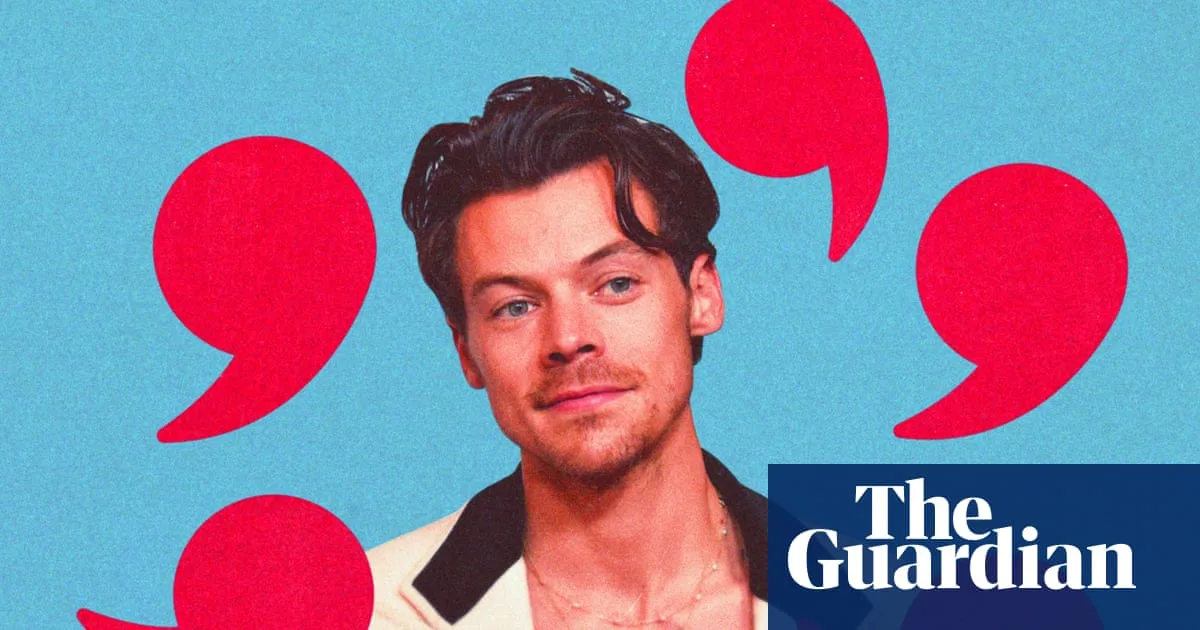
Harry Styles' Album Title Sparks Grammar Debate: Is the Comma Correct?
Harry Styles Album Title Grammar Debate Over Comma

Harry Styles' New Album Title Ignites Grammatical Controversy

The announcement of Harry Styles' first solo album in four years has sparked an unexpected debate that has little to do with music and everything to do with punctuation. The follow-up to 2022's Grammy-winning Harry's House bears the intriguing title Kiss All the Time. Disco, Occasionally. – and it's the placement of a single comma that has grammar enthusiasts and pop culture observers in a frenzy.

The Central Punctuation Puzzle

At the heart of the controversy lies a simple question: is the comma in the right place? The album title presents two distinct sentences, with the second featuring a comma that some argue disrupts grammatical parallelism. As one viral social media post with nearly a million views noted, the construction appears to shift from what could be parallel imperative sentences to something more fragmentary and ambiguous.

Britt Edelen, a PhD candidate in English at Duke University who authored the viral analysis, suggests that the unconventional construction might be intentional. "It's not a perfect construction by our grammatical standards and that's fun," Edelen explains. "The result adds some kineticism to what would otherwise be boring and fits into a larger scheme of people trying to articulate things via commas that aren't actually how we use them."

Expert Perspectives on Creative Punctuation

Grammar experts approached the title with a mixture of analytical rigor and appreciation for creative expression. Ellen Jovin, author of several books on grammar and star of the documentary Rebel With a Clause, sees the comma as creating a deliberate pause. "When I see 'disco, comma', it's giving me a little bit of a mental break," she observes, suggesting that the punctuation serves to "render the time of speech graphically, as in: disco [pause] occasionally."

Jovin further notes that Styles appears to be playing with parts of speech, shifting from what might be interpreted as imperative verbs to a more noun-focused construction. "The comma leads to a different adverbial idea: not all the time, just occasionally," she explains, emphasizing that album titles exist in a different creative space than formal writing.

The Broader Context of Artistic Expression

This grammatical debate occurs within a larger trend of artists experimenting with punctuation and capitalization in their work. In recent years, musicians have increasingly played with unconventional styling in song and album titles. Billie Eilish's 2017 EP dont smile at me featured predominantly lowercase titles, while her 2024 album HIT ME HARD AND SOFT used all caps. Dijon's album Baby includes tracks titled HIGHER! and (Freak It), demonstrating the creative freedom artists now exercise in digital presentation.

The shift toward more informal, text-like presentation in music titles reflects broader cultural changes in how we communicate. As streaming platforms prominently display artist-preferred styling and punctuation, musicians have embraced the opportunity to make visual statements through their titling choices.

Grammar Rules Versus Creative License

Experts remind us that grammar rules are fluid and context-dependent. Unlike the perception often developed in formal education, there is no single authority dictating correct English usage across all contexts. "I think Americans are overly punctilious punctuators. They tend to pay attention to rules and prohibitions a lot," Jovin notes, suggesting that creative works deserve different standards than formal documents.

This doesn't mean grammar never matters – clarity remains essential in many contexts. The Guardian's style guide famously illustrates how comma placement can change meaning entirely, as in the difference between dedicating a book "to my parents, Martin Amis and JK Rowling" versus "to my parents, Martin Amis, and JK Rowling." But in artistic contexts, ambiguity might be precisely the goal.

Styles' Grammatical History and Intentionality

For those wondering whether the comma placement was accidental, Styles has previously demonstrated grammatical awareness. At a 2015 concert, he famously corrected a fan's sign that read "your so nice" by adding an apostrophe and an E to make it "you're so nice," then returning it with the message "thank you – love, Harry." This suggests that if Styles is indeed a grammar enthusiast, the controversial comma in his album title was likely deliberate.

As the debate continues among fans and language experts, one thing remains clear: Harry Styles has succeeded in creating conversation and anticipation around his new work through something as seemingly simple as punctuation. Whether the comma is technically correct matters less than the creative statement it makes and the discussion it has generated in both musical and linguistic circles.