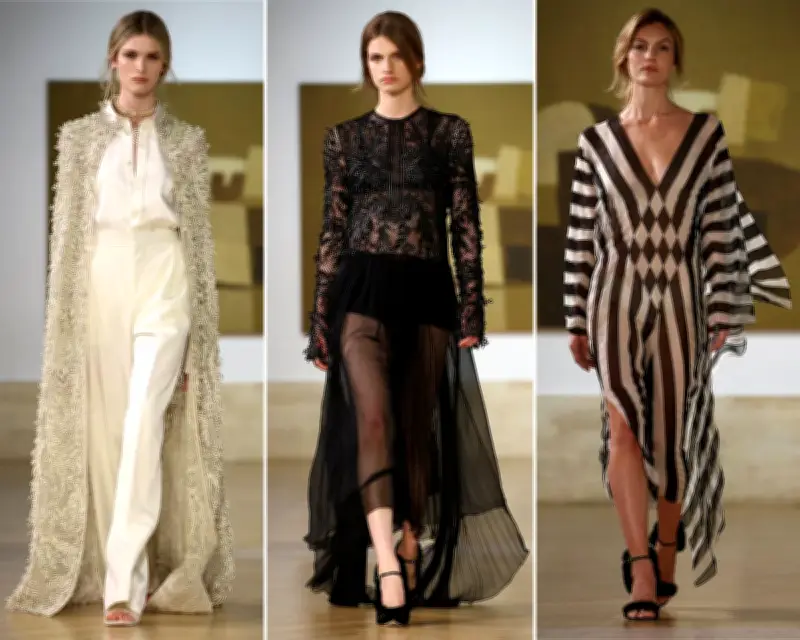
Maria Grazia Chiuri, before her first haute couture catwalk show for Fendi, declared, "This is a cultural problem, and a political problem." The designer argues that Italy fails to recognize fashion's cultural role by not allocating museum space for it. To challenge this, Chiuri bookended her Rome catwalk event with two fashion exhibitions in the city.
Exhibitions Accompany the Show
A revival of Karl Lagerfeld's early designs for Fendi, which ran briefly in 1985, was held at the Galleria Nazionale d'Arte Moderna e Contemporanea, the same venue as Chiuri's show. A second exhibition at another Rome location showcases Fendi's haute couture collections since 2015.
Chiuri's catwalk presentations always carry a message. During her decade at Dior, she featured feminist slogan T-shirts and collaborated with local female writers and artists for destination shows worldwide. Now at Fendi, she aims to challenge Italy's perception of fashion as a business rather than an art form.
Chiuri's Vision for Fashion as Art
Chiuri recalled the 1985 exhibition: "I remember seeing it. It changed so much for me, but it was highly criticised." She noted that Italy lacks institutions like London's Victoria and Albert Museum, Paris's Musée des Arts Décoratifs, or New York's Costume Institute at the Metropolitan Museum of Art, which regularly host major fashion exhibitions.
Rome is Chiuri's hometown, where she was born and returned to on weekends while working in Paris. It is also where the five Fendi sisters—Paola, Carla, Franca, Anna, and Alda—took over their parents' fur and leather boutique in the 1940s, transforming it into a global luxury brand.
Roman Influence on the Collection
Chiuri's couture debut featured a distinctly Roman style of power dressing. "I love a cape – probably because in Rome, we have the Vatican," she said before the show. A full-length ivory caped coat with silk embroidery sweeping the floor captured the grandeur of the Eternal City, while also suiting red carpet events. The collection included black lace, both solemnly layered and daringly sheer, and trailing ecclesiastical sleeves with wide contrast satin cuffs.
The silhouette was free-flowing, with shapes suspended from the shoulder. "Completely different from the other couture house where I worked," Chiuri said, referring to Dior's hourglass "New Look" silhouette. She drew inspiration from kimono shapes and clothing traditions that create shape by draping around the body rather than compressing it.
Upcycled Fur and Brand Growth
Real fur appeared on the catwalk, but upcycled from pelts and garments in the Fendi archive. "Fur is durable, and I think we should use it up," Chiuri stated. Fendi's roots in the fur trade, once glamorous, now pose an image challenge Chiuri must address to grow the brand, which is significantly smaller than its LVMH stablemate Dior. At Dior, where she served as the first female creative director from 2016 to 2025, she nearly quadrupled revenues from €2.2bn (£1.9bn) in 2017 to €9bn in 2024.