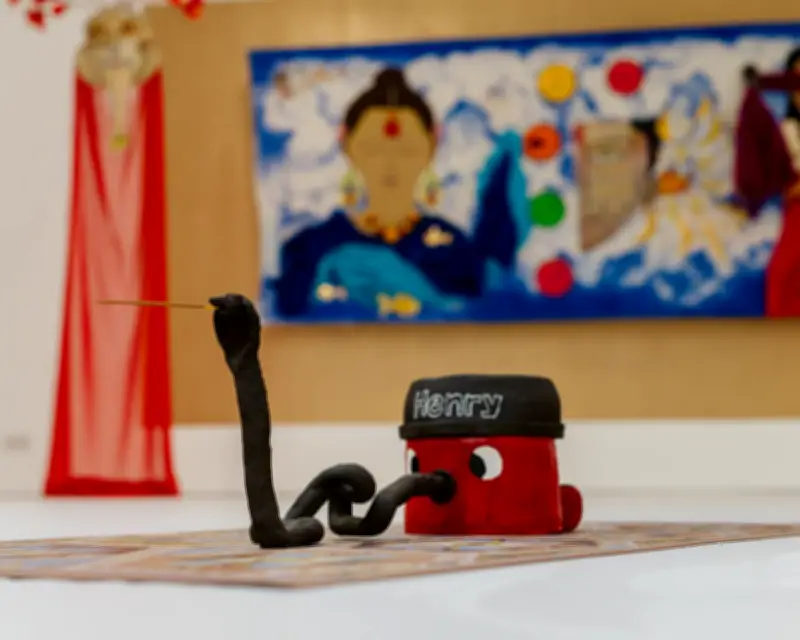
Debjani Banerjee's exhibition at Bluecoat, Liverpool, features a striking sculpture of a Henry hoover transformed into Ganesha, the elephant-headed Hindu deity. This piece, titled Henry-Ganesha, sits on a strip of garishly patterned carpet and captures the double consciousness of anyone growing up with multiple cultural inheritances, according to the review.
A Blend of Cultures
Banerjee's work reflects an imagination shaped by 1980s British suburbia and ancient Bengali literary traditions. The artist's father insisted she watch all 94 episodes of a BBC adaptation of the Mahabharata, leading to the fusion of the family's Henry hoover with Ganesha's iconic trunk. The sculpture raises questions about how every generation adapts inherited cultures to their own circumstances for traditions to survive.
Film and Shrines
A film in a music room collages scenes from two TV adaptations of the Mahabharata, a photograph of the artist's mother in a saree holding a Pepsi can on a British hillside, and clips from a CBeebies cartoon featuring a wheel of cheese named Cheese. The exhibition includes twin shrines to the demoness Putana, who haunted Banerjee's childhood dreams, and Cheese, a formative character for her daughter. These juxtapositions re-enchant everyday life, bringing Indian gods into a British world of vacuum cleaners and carpets.
Community and Tradition
A patchwork quilt along the longest wall depicts five female characters from the Mahabharata, embroidered with sequins, silk, and feathers. Created during a workshop with local residents in Glasgow, it emphasizes collective labour and communal creative expression. The review notes that cultures are preserved in museums only after they die; living ones survive through storytelling, home decorations, family television, and neighbourly quilting.
Music and Influence
Two songs play on a loop in the music room: one by Bengali poet Rabindranath Tagore and another invoking the mother goddess Kali, both sung by the artist's sister, Mita Pujara. The exhibition takes its title from Satyajit Ray's film Jalsaghar, which features a dancer performing for a landowner whose patronage enabled Bengali art. In the film's climax, the landowner's servant reveals that the sun will continue to rise, symbolizing cultural continuity. Banerjee includes this scene alongside a clip of herself dancing in her own music room.
The exhibition, Debjani Banerjee: Jalsaghar, runs at Bluecoat, Liverpool from 11 July to 6 September.