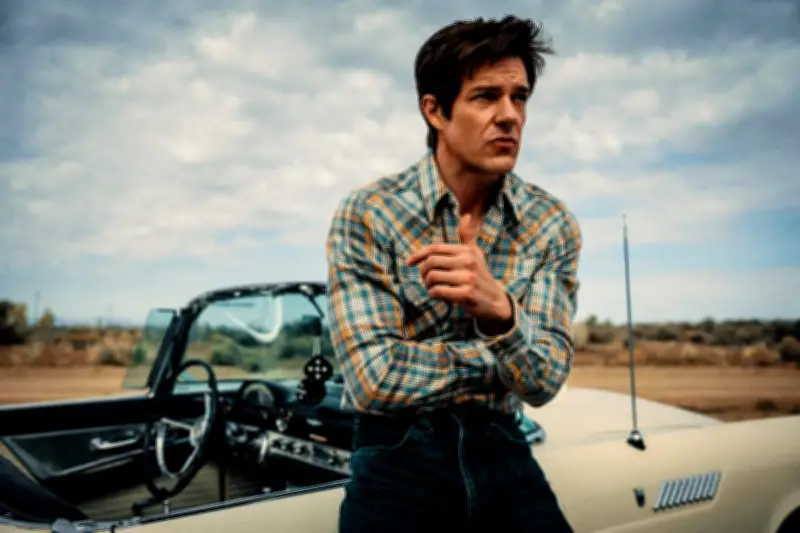
Brandon Flowers has spoken about how the love, hardship, and country music of his Utah childhood shaped his third solo album, Thrasher, which he brings live to the Royal Albert Hall this week.
Even through 45-year-old eyes and an ice-white rock star smile, the little kid in Flowers often bursts out. He is still awestruck when he recounts last night’s Michelin-starred meal at Ambassadors Clubhouse, meeting Bernard Sumner for the first time at an NME Awards urinal, or having Happy Birthday sung to him at a party at Elton John’s Windsor home at the weekend.
“They brought a cake out,” The Killers’ frontman says. “If you would have told me when I was a kid that Elton John was gonna sing me happy birthday one day…” He shakes his head. “It’s insane.”
From Pressure Machine to Thrasher
That bright-eyed Young Brandon is all over Thrasher, the confessional top-three hit steeped in the country music and dark memories of his youth. A relatively intimate occasion for a man more used to blazing dazzle-jacketed across arena and stadium stages, but hardly a one-off – The Killers have often been known to play tiny club shows for hardcore fans immediately after a major gig.
“The energy can be wild,” Flowers says. “We once did it in El Paso. We played our gig, and then we went and played in a bar. They had to shut down the roads.” The thrill this time, he says, will be in indulging Thrasher’s storytelling core onstage.
It is a sequel of sorts to The Killers’ most recent album, 2021’s revelatory Pressure Machine, which painted a darkly atmospheric portrait of Flowers’s remote Utah hometown of Nephi. “Pressure Machine might have messed me up a little bit,” he says. “It made me rethink everything. It was the most fulfilling creative endeavour that I’ve ever had… Every word is right, every word. I’ve never done that before. I have gotten away with murder on other records.”
He is not flattering himself; The Getting By, particularly, was luminous blue-collar poetry. “I don’t know where it came from,” he says. “It’s smarter than I am. I was able to be a conduit for something… There’s so many characters and stories that I’ve been carrying around — I unlocked something with Pressure Machine. I didn’t want to stop.”
Returning to Nephi
Away from the band, Flowers went even further inward. Having recently moved back to Nephi with his family, he was struck by intense memories of his time there, having arrived from Henderson, Nevada — in the glow of the Vegas Strip — at the age of eight. The beauty of the Wasatch Mountains and the smell of wet leaves in autumn infused within him a fresh fondness for a town he’d spent his teenage years desperate to escape.
“When I was there it was all about getting the hell out of there,” he says. “These towns, instead of saying the next town is 20 miles, the freeway exits and entrances just say Las Vegas. I was seeing it every day, arrows literally pointing and saying Las Vegas, Las Vegas. It must have been bombarding my conscience.”
He appreciates more, now, the innocence of the times. “It was the mischief that I remember. Most people were Mormon, but the people that weren’t were not Mormon. They would have coolers in the back of their trucks, and it was commonplace for us on Friday nights to go from house to house of the guys that aren’t Mormon and look in their coolers and see if they left any alcohol in them. If you got lucky it was harder than beer.”
Also, flooding back, came memories from the backseat of his father’s classic cars, country music blasting. “I was surprised at how familiar I was with it,” Flowers says. “I had been soaking it in on the way to school with my dad, or at school dances in Nephi. My first dance, the first time I touched a girl’s hips, would have been probably to a country song. It’s just always been there.”
Country Stories and Family Grief
New songs began arriving with a slap of boot-dust and one thumb in their belts. “I’ve always been a storyteller,” he says, “but the tradition in country music of stories is so integral. These stories that I wanted to tell so easily become country.” Many are “country-adjacent” folk rockers rather than full-on yee-haws, but they definitely wouldn’t fit onto the album The Killers are currently putting together.
Recording in Nashville with musicians who’d played with Elvis, Roy Orbison and Bob Dylan, Flowers crafted a solo album drawn from the darker sides of his origin story. “If Pressure Machine was Nephi, I narrowed it in even further to my inner circle on this record,” he admits. “It was very idyllic in the sense that my parents stayed together and they loved each other, but we were always in debt. They tried to keep it hidden, but it was impossible, so I always think I carried that anxiety around that I could feel from my mom. My dad seemed to let it just roll off of him, but my mom didn’t.”
Many songs are so close to home they could use the wi-fi. The ageing Vegas parking valet bemoaning his lot on Paradise is a real-life cousin, the broken navy vet running from squad cars on Angel is a brother-in-law, and Tiger’s Blood a flashback of old Nephi scenes sung to a childhood friend later taken by the US opioid epidemic. “I feel like it was just yesterday I was jumping with them on a trampoline and now they’re gone,” Flowers says. “That tenderness and that sadness and the grief that you carry…and there’s the guilt that I feel that I moved out of there and did what I was able to do. Until you start delving into it, and really writing about it, you don’t realise that you’re carrying that weird grief around with you.”
Rawest of all, it’s in the voice of his sister: Flowers writes an open letter about her suffering at the hands of an abusive ex-husband on the haunting Miss America. “I saw a lot of violence and would hear stories about what my sister was going through,” he says. Though the songs have all been green-lit by any family members involved, he’s cautious about saying too much. “Our jobs as writers and as artists is to be authentic and reflect things,” he says. “And this is about as authentic as I can get.”
An American Dream and Springsteen
Thrasher’s most fascinating track is arguably An American Dream, a hallucinatory, imagistic epic mingling personal touches with snapshots of classic American mythology: Chevys and chewing tobacco, cowboy hats and denim, even a psychedelic joyride with Elvis. “The America that I love and I believe in and I’m even singing about here, it does still exist, it’s still there, it’s just not the front-page news right now,” he argues, hoping for a “course correction” in post-Trump America. “What’s scary is the lack of opposition on the left. That’s the thing that’s baffling. Does no one have the charisma or brain to rise up? We’ve gotta find somebody. Gavin Newsom, Robert De Niro and Bruce Springsteen are basically the only three people that you hear.”
Speak of Springsteen, of course, and Brandon’s inner child returns, beaming over the time he was preparing to duet on Thunder Road with the Boss himself in a dressing room at the Netherlands’ Pinkpop Festival. “He put a piece of paper down and a pencil, and it was almost like, ‘how well do you know the song? Write out what you’re going to sing, what I’m gonna sing’. And I knew every word. We sang it together alone in his room, and that is about as close to heaven as you can get.”
It seems, after over two decades of rock stardom, Brandon Flowers has kept his feet firmly on the ground. “It all goes back to that foundation, from my parents and my faith, and all of that,” he says. A youthful twinkle. “But, man, Rod Stewart still looks like he’s having fun.”