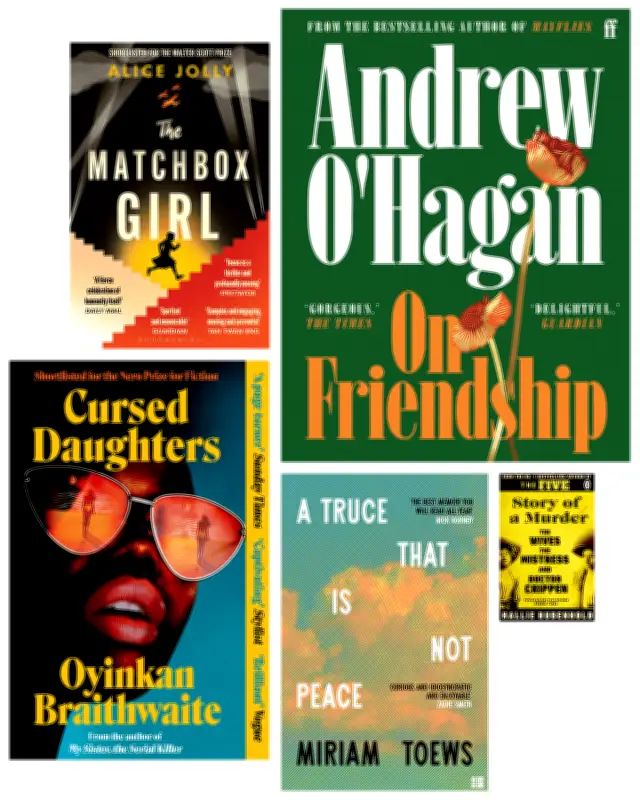
This July's paperback releases offer a rich tapestry of fiction, memoir, and true crime, with standout titles from acclaimed authors including Oyinkan Braithwaite, Andrew O'Hagan, and Miriam Toews. From the supernatural family saga of 'Cursed Daughters' to the intimate reflections of 'On Friendship', these books promise engaging reads for every taste.
Fiction Highlights
Nigerian-British novelist Oyinkan Braithwaite returns with 'Cursed Daughters', her second novel following the acclaimed 'My Sister, the Serial Killer'. The story centers on the Falodun family, where generations of women share tales of heartbreak and a curse that looms over their lives. Characters include Fikayo, whose husband left due to her chronic illness; Afoke, who seduced her younger sister's boyfriend; and Feranmi, the matriarch who became pregnant by a married man and received the curse from his first wife. The novel explores dark secrets binding the women together, focusing on three main characters—Monife, Ebun, and Eniiyi—as they grow up, fall in love, and attempt to defy supernatural forces. Chelsea Leu reviews, calling it a swap from true crime to atmospheric spookiness.
Michael Clune's debut novel 'Pan' follows 15-year-old Nicholas, who lives with his father in a cheap housing development that inspires existential terror. When the god Pan enters Nicholas, he experiences disabling anxiety, which he interprets as black magic. Sandra Newman notes the novel's honest treatment of mental illness and adolescence, showing how they can be experienced as black magic. Nicholas becomes convinced he might leave his body, and his friends are easily preyed upon by Ian, a college-age cult leader. The group stages rituals incorporating sex, drugs, and animal sacrifice. The novel eschews traditional coming-of-age rewards for visions and revelations.
Hal Ebbott's debut 'Among Friends' depicts the friendship between Amos and Emerson, who bonded on the first day of college despite surface differences. On Emerson's 52nd birthday weekend, something happens that changes everything, raising questions about whether we can ever truly know anyone. Christopher Shrimpton praises the novel as a bracingly honest depiction of abuse, family dynamics, and self-deceit, sharply observed and psychologically astute.
Alice Jolly's 'The Matchbox Girl' introduces Adelheid Brunner, a fierce narrator obsessed with matchboxes. She is brought to a children's hospital by her grandmother, where she becomes the object of study by doctors, including Dr Hans Asperger, whose research in 1930s Vienna laid groundwork for autism understanding. Adelheid learns to present herself to thrive, realizing "one can put on the coat of a Life." Natasha Walter notes the synergy with Naomi Klein's 'Doppelganger', which explores how the hospital became a key node in sorting who would live or be murdered.
Rhiannon Lucy Cosslett's 'Female, Nude' follows Sophie Evans on a Greek island holiday with university friends to celebrate Helena's wedding. Ten years after meeting, money has made itself known among the women. Sophie, working in a museum shop while trying to be an artist, is commissioned to paint a nude portrait by Alessia. When the beautiful Ky appears, rivalries turn toxic. Christobel Kent calls it an energetic, ambitious novel with sensual detail and a serious interrogation of art.
Tom Cox's 'Everything Will Swallow You' features depressed nature writer Billy Stackpole, who wishes for a big sloppy cardigan. Listening incognito is Carl, a magical sea creature with 24 fingers who can pass for a large brown dog, knit, and speak six languages. Carl is one half of a charming odd couple with record dealer Eric. Toby Litt describes it as a materially hopeful state-of-England novel.
Rebecca Wait's 'Havoc' is set at St Anne's, a decaying girls' school in Eastbourne, where 16-year-old Ida Campbell arrives in 1984 with a scholarship and baggage. The school is deeply eccentric and teetering on bankruptcy. Christobel Kent finds echoes of St Trinian's and Ealing comedy, with an unsettling undertone edging towards Shirley Jackson territory, combined with excellent pacing and dark narrative threads.
Thriller
David McCloskey's 'The Persian' centers on Jewish Iranian dentist Kam Esfahani, who accepts an offer from Mossad to return to Tehran, running a fake dental practice as cover for sowing chaos in Iran. Things go awry when he enlists double agent Roya Shabani. The book takes the form of confessions Kam writes for his torturer, interspersed with flashbacks. Laura Wilson calls it a masterly novel, tragically topical and utterly gripping.
Essays
Andrew O'Hagan's 'On Friendship' comprises eight essays reworked from a Radio 4 series. He reminisces about a lost childhood friend, former colleagues at the London Review of Books, and his adult daughter's imaginary friend. He considers why actors, politicians, and Republicans make bad friends, and how Colm Tóibín makes a good one. The most intriguing item concerns the late Edna O'Brien, whom he met in 2009. Anthony Cummins notes that O'Brien is the only one permitted insight into O'Hagan himself, calling it a piecemeal memoir that leaves you wondering about a larger autobiography.
Memoir
Miriam Toews' 'A Truce That Is Not Peace' is a meditation on writing, suicide, guilt, and silence. Asked why she writes, Toews mentions teenage letters to her sister Marjorie, who suffered from depression and killed herself in 2010. Blake Morrison describes the book as a triumph, fragmented account of Toews's life, illustrating why she's one of Canada's most admired writers. Despite sadness, there is laughter in the family, and Toews's mother remains indomitably cheerful. Toews writes to her sister: "Are you OK? I miss you so much. I wish I could take your sadness away."
True Crime
Hallie Rubenhold's 'Story of a Murder' recounts the 1910 Crippen case, where Dr Crippen killed his wife Belle Elmore. Rubenhold aims to shift focus from the murderer to the women his shadow crossed, but Anthony Quinn notes it doesn't quite come off, as Crippen remains the fiendish engine. The book cannot supply a convincing answer to why he killed, with Rubenhold often admitting to limitations: "is unknown," "is a mystery." Nevertheless, it offers excitement and intrigue, including the discovery of a dismembered corpse with traces of hyoscine.
Biography
Amy Odell's 'Gwyneth' opens with the vaginal egg episode, a symbol of Paltrow's ability to sell dumb ideas. The book offers an earnest jog through Paltrow's years of fame, from her youth as the indulged daughter of showbusiness parents to her Hollywood years and the creation of Goop. Emma Brockes finds the story less about how Paltrow became this figure than why she was elevated in the first place, calling her a charmless subject who never rises to monstrous.