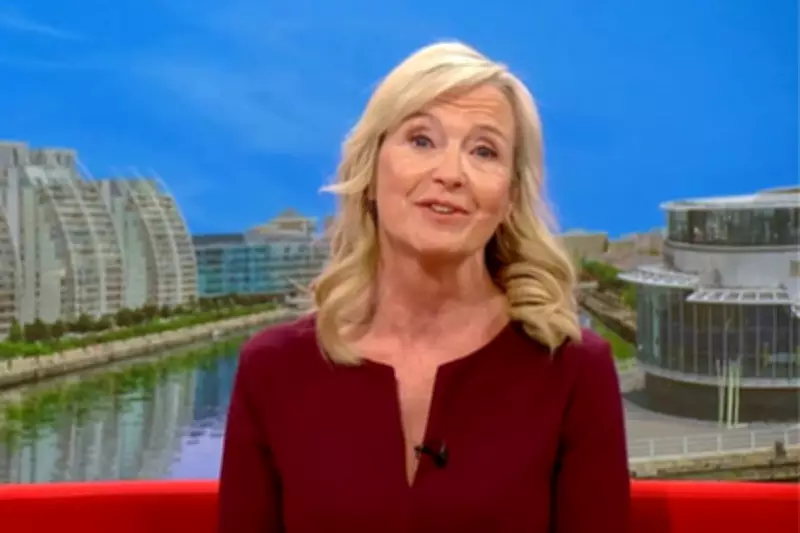
BBC's Token Woman Problem Resurfaces with Kirkwood Departure and Male Leadership Appointment
The announcement of a male interim BBC director-general this week, coinciding with Carol Kirkwood's unexpected departure from BBC Breakfast, has reignited concerns about the corporation's persistent gender imbalance. Former BBC producer and editor Fiona Chesterton examines the institutional barriers that continue to disadvantage women, particularly those of advancing age, within the broadcaster's structure.
Diversity Review Reveals Stark Age and Gender Disparities
Presenter Carol Kirkwood, aged 63, sparked widespread speculation with her resignation after more than two decades on air. While framed as a personal decision to retire, her exit follows a damning diversity review commissioned by the BBC itself. The report, led by former Bafta Chair Anne Morrison and former Ofcom executive Chris Banatvala, uncovered "a noticeable mismatch" in the treatment of older female presenters.
The investigation found nearly four times as many male presenters over 60 compared to female counterparts on screen, with the news division lagging significantly behind entertainment in gender parity. These revelations make it difficult to dismiss concerns that the BBC has failed to move beyond the age discrimination case it lost to Miriam O'Reilly in 2009, when the Countryfile presenter successfully claimed unfair dismissal.

Missed Opportunity for Historic Female Leadership
When Tim Davie resigned as the BBC's 17th consecutive male director-general last November, many hoped the corporation might finally appoint its first woman to the top role in its 103-year history. Despite Davie having promoted several women to board-level positions, and numerous qualified female candidates existing with experience in streaming and media leadership, the interim appointment went to Rhodri Talfan Davies.
"Who would have thought that a female Archbishop of Canterbury would be appointed before a woman elevated to the top job at the BBC?" Chesterton questions, highlighting the glacial pace of change at the broadcaster compared to other British institutions.
Historical Context: From Sex Discrimination Act to Present Day
To understand the BBC's prolonged struggle with gender equality, one must look back half a century to the 1975 Sex Discrimination Act. Chesterton joined the BBC that same year as the only woman on a fast-track graduate news training scheme among seven men. All tutors and supervising editors were male, with the sole exception being the woman who taught shorthand.
A 1973 internal report on "limitations to the recruitment and advancement of women in the BBC" quoted senior male executives expressing openly prejudiced views. The head of radio news claimed women couldn't handle hard news as they "would be overcome with feeling," while others suggested young women giggled excessively and middle-aged women suffered from "menopausal tension."
Institutional Sexism and Class Barriers
The BBC's graduate training schemes traditionally recruited from a narrow base of public-schooled Oxbridge men, while newsrooms drew experienced journalists almost exclusively from Fleet Street. Management remained the preserve of middle and upper-middle-class men, creating multiple barriers for women from diverse backgrounds.
Chesterton recalls encountering what would now be termed everyday sexism, including a deeply embedded drinking culture that excluded women, who were expected to "mind the shop" while male colleagues visited pubs. Assessment of female applicants included crude physical evaluations, with one young woman's potential as a TV reporter being discussed in terms of having "great tits."
Until Kate Adie's arrival in the 1970s, no women worked as news reporters or correspondents, with assumptions persisting that women were unsuitable for international affairs, political, economic, or sports coverage. Routine sexual harassment by middle-aged managers and high-profile presenters was routinely brushed aside as something women should simply endure.

Progress and Persistent Barriers
Chesterton found a more conducive atmosphere in the current affairs department at Lime Grove, where women like Barbara Maxwell and Esther Rantzen had established significant roles. She progressed rapidly from assistant to senior producer by the mid-1980s, only to encounter new barriers upon becoming a working mother.
The BBC lacked clear policies for working mothers, and Chesterton became one of the first women to negotiate retaining a staff job while working part-time in 1985. "If I hadn't had the support of my male editor, I doubt I'd have got anywhere," she acknowledges, highlighting how individual advocacy rather than systemic support enabled limited progress.
Statistical Evidence of Systemic Inequality
The 1985 Sims report, to which Chesterton contributed anonymously, revealed eye-opening statistics about women's positions within the BBC. In television, 88% of women occupied the two lowest bands, with just 13 women in senior producer grades and only one in management. Radio showed even worse figures, with just seven female senior producers and zero women in management roles.
Nations and regions outside London demonstrated particularly poor representation, with just one woman in a senior producer or manager role anywhere outside the capital in 1985 - despite Margaret Thatcher famously occupying Downing Street at the time.
The Snakes and Ladders of BBC Careers
Chesterton ultimately left the BBC in the early 1990s, becoming "collateral damage" during the takeover of current affairs by news and the closure of Lime Grove. While she didn't prosper in what she describes as the "snakes and ladders world of the BBC," other women broke through to top jobs in subsequent decades.
Women like Patricia Hodgson, Dame Jenny Abramsky, the late Jana Bennett, Lorraine Heggessey, Helen Boaden, Dame Liz Forgan, and Caroline Thomson all achieved significant leadership positions. Yet none ascended to the director-general role, with Chesterton suggesting some may have wisely avoided "this most thankless of public roles" rather than simply being overlooked.
Contemporary Challenges and Future Prospects
Despite a new generation of outstanding female candidates, Chesterton fears that behind closed doors, voices still argue that the BBC's current "existential crisis" requires "a strong man" at the helm. The persistent narrative suggests the time is never quite right for a woman to lead the corporation, with promises that "next time" might be different.
As the BBC faces ongoing scrutiny over its diversity record, the coinciding events of Kirkwood's departure and another male leadership appointment underscore how far the broadcaster still must travel to achieve genuine gender equality at all levels of its organisation.