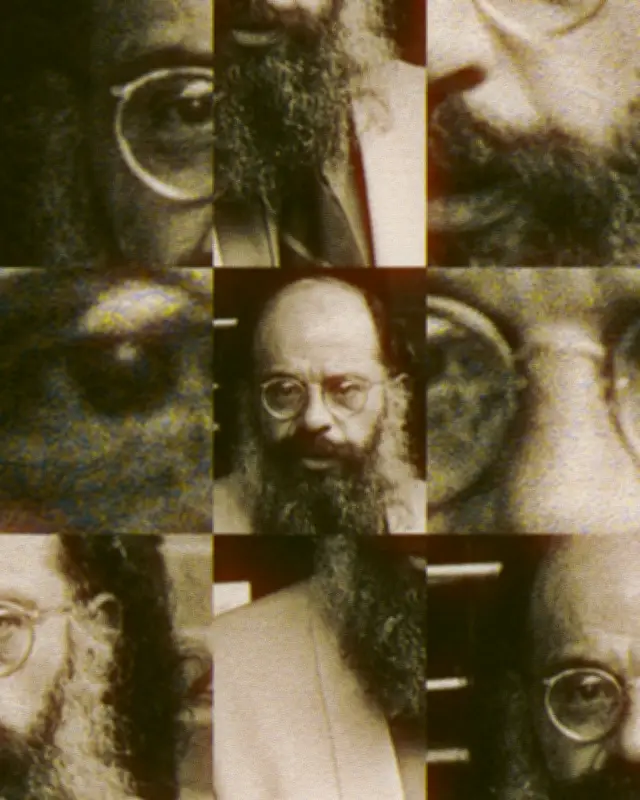
In 1985, Allen Ginsberg sat his friend, an out gay 17-year-old named Peter Hale, down and gave some advice: “Get a wife, settle down, and have kids.” At the time, Hale was enrolled in a summer program at Naropa University, a Buddhism-inspired college where Ginsberg, then 59, ran the writing program. “He told me not to live the life of the itinerant poet going around heartbroken, forever unfulfilled,” Hale recalls. Ginsberg was, in Hale’s words, “very much a traditionalist.”
A Conservative Image of a Beat Libertine
It’s a surprisingly conservative image of the poet who, alongside Jack Kerouac and William S. Burroughs, broke new ground for postwar American literature, popularized Buddhism in the West, and scandalized polite society with Howl, his 1956 poem that led to a historic obscenity trial. Ginsberg lived his life as exactly the thing he cautioned against: an out gay “itinerant poet.” He toured with Bob Dylan’s Rolling Thunder Revue, was called an “immoral menace” in 1965 by the Czechoslovakian government and expelled from the country, and is immortalized in Kerouac’s novels On the Road and The Dharma Bums. All this created the Ginsberg mythos: the sandalled guru, the hippie before there were hippies.
Hale, who now runs the Ginsberg estate, first met the poet in the late 1970s. “I met him shortly after he did the project with the Clash, where he was on the Combat Rock album,” Hale says. “He was always showing up at punk shows and things.” Ginsberg never quieted in his later years, Hale adds. “He was always being involved, even into the 90s, to just a few years before he died. He’d be off to San Francisco to do an introduction for someone, or he’d be part of the American Academy of Arts and Letters to induce more radical writers, to keep shaking things up a bit. He was always in there, fingering the beehive.”
Centennial Celebrations and an Enduring Legacy
The centennial of Ginsberg’s birth on 3 June is being marked by a September vinyl reissue of the poet’s landmark 1959 spoken-word album. As well as a live reading of Howl, the release includes his deliveries of America, A Supermarket in California, Kaddish, and others. The centennial program also includes an evening at London’s Southbank Centre this month, an exhibition at Stanford University, and New York events featuring Laurie Anderson and Patti Smith this fall.
The Thorny Legacy: Nambla and Free Speech
Hale calls Ginsberg’s association with the North American Man/Boy Love Association (Nambla) a “headache.” Founded in 1978, the ultra-controversial group campaigned to abolish age-of-consent laws and “end the extreme oppression of men and boys in mutually consensual relationships,” according to its site. Hale says Ginsberg saw his support as just another protest against state policing of debate and ideas, but it tarnished his legacy forever. “Allen was incredibly naive to think it was a real free speech thing,” Hale says. “All you had to do is say someone was a member and the FBI could set you up. There were so many of these witch-hunts happening at the time that it caught Allen’s eye.”
Hale argues Ginsberg was less a believer in the organization’s cause than an opponent of censoring it. Almost from its inception, Nambla was rejected by the organized gay rights movement, investigated by the FBI, and in 1994 was formally expelled from the International Lesbian and Gay Association. Ginsberg argues the free-speech angle himself in Thoughts on Nambla, an essay in the posthumous collection Deliberate Prose, where he writes that he joined “as a matter of civil liberties” in response to an FBI campaign of entrapment and “dirty tricks” that he likened to the bureau’s earlier targeting of Black and anti-war activists. He describes Nambla as “a forum for reform of those laws on youthful sexuality which members deem oppressive, a discussion society, not a sex club.”
Conflicting Views and Unrepentant Moments
The truth is murkier. As Beat scholar David S. Wills has documented, the essay’s closing reference to “consensual intergenerational affections and affairs” reads a bit like a defense of the relationships themselves, not just the right to discuss them. Ginsberg writes that “people like myself do not make carnal love to hairless boys and girls,” and that his support of Nambla “shouldn’t be distorted to apologize for rape and mental or physical violation of children.” People close to Ginsberg, including his friend and archivist Bill Morgan, have described him as naive about what the organisation and its members advocated for, but Hale says the poet saw it with clearer eyes. “He said it was probably a mistake,” he notes. “He certainly voiced that to several people.”
Elsewhere, Ginsberg seems less repentant. In a 1994 Advocate article, three years before his death, he defends Nambla as “an innocent little organization about people who want to talk about their inclinations, their Eros, which happens to center on younger people. It’s not always sexual. It’s quite harmless.” That same year, he appeared in the documentary Chicken Hawk: Men Who Love Boys, in which Nambla members defend it; on video, Ginsberg reads a poem called Sweet Boy, Gimme Yr Ass (from Mind Breaths: Poems 1972-1977), which ends on the line “ever slept with a man before?”
Wills writes that Ginsberg’s attraction to younger men was widely known. Just how young? Wills cites Ginsberg telling the Rocky Mountain News that “anyone above puberty is okay as long as it’s consensual and nobody complains,” though this can’t be verified; the newspaper ceased publication in 2009. Complicating matters is that Ginsberg was an out gay person during decades when anti-gay activists routinely conflated homosexuality with paedophilia. Wills notes that Kerouac writes widely about chasing young girls but does not receive the same damnation: “We do not assume that Kerouac was raping female children when he talks about being sexually attracted to ‘girls’.”
Provocation or Principle?
Was it pure provocation? Many observe that Ginsberg “hated” political correctness; today, we might call him a shit-kicker, someone who likes to rile. His friend Bob Rosenthal recalled Ginsberg saying: “At last, I’ve found an organisation which is totally indefensible!” The poet spent most of his career aligning himself with society’s outcasts, from communists to drug users to sex workers. But other voices, like the feminist critic Andrea Dworkin, call him an abuser and paedophile. Whatever his private behavior, he spent decades publicly endorsing an organisation that supports sex with underage people.
Ginsberg is not the first queer luminary to get caught up in debates around age-of-consent laws. In the early 1970s, before he co-founded Nambla, David Thorstad was president of the Gay Activists Alliance in New York, and in 1977 founded the Coalition for Lesbian and Gay Rights. The activist Harry Hay and feminist critic Camille Paglia publicly supported the organisation. In France, queer intellectuals including Michel Foucault, Roland Barthes, Simone de Beauvoir, and gay liberation activist Guy Hocquenghem signed petitions in 1977 calling for the decriminalization of sex between adults and minors.
Enduring Impact and Final Works
Regardless, Hale sees no sign of interest in Ginsberg slowing down. “People keep discovering his work,” he says. “People are still reading Ginsberg in school.” He believes the writing still holds the power it has always had. Ultimately, he says, this is what the centennial is about. He points to a later work that still feels current: Ballad of the Skeletons, a politically charged 1995 poem Ginsberg read to Paul McCartney, who accompanied it on guitar for a live reading before the two recorded it for Mercury Records with Philip Glass on piano. In 1996, Gus Van Sant turned it into a music video. This, Ginsberg’s last major work, perhaps shows his best side: an artists’ artist, a protest poet who rallied and inspired the best minds of his generation.
Ginsberg remained idiosyncratic until the end: on 5 April 1997, he lay dying of liver cancer in his Lower East Side apartment as friends gathered. Ginsberg’s Buddhist teacher, Gelek Rinpoche, gave Hale a brown pill and told him to give it to Ginsberg “after the last breath leaves his body.” Hale stood by the bed, spoon in hand, next to Patti Smith, a hospice nurse and others, and at 2:23 in the afternoon tipped it to Ginsberg’s lips. I ask what was in the pill. “No idea!” Hale says. “Chances are it was a mix of herbs and yak dung. Everyone has a theory. But it probably was just a few herbs. A few herbs and a few prayers.”