Upward Bound is a dismal adult daycare centre in the Los Angeles suburbs, with 'poop-coloured' walls and a small swimming pool out the back. The name on the sign is cruelly misleading because Upward Bound serves as a dumping ground for the city's disabled community, a pen to hold people who have aged out of school. Any inmate who manages to clamber free – be it up, down or sideways – has slipped the net, beaten the odds and might therefore be viewed as a small miracle.
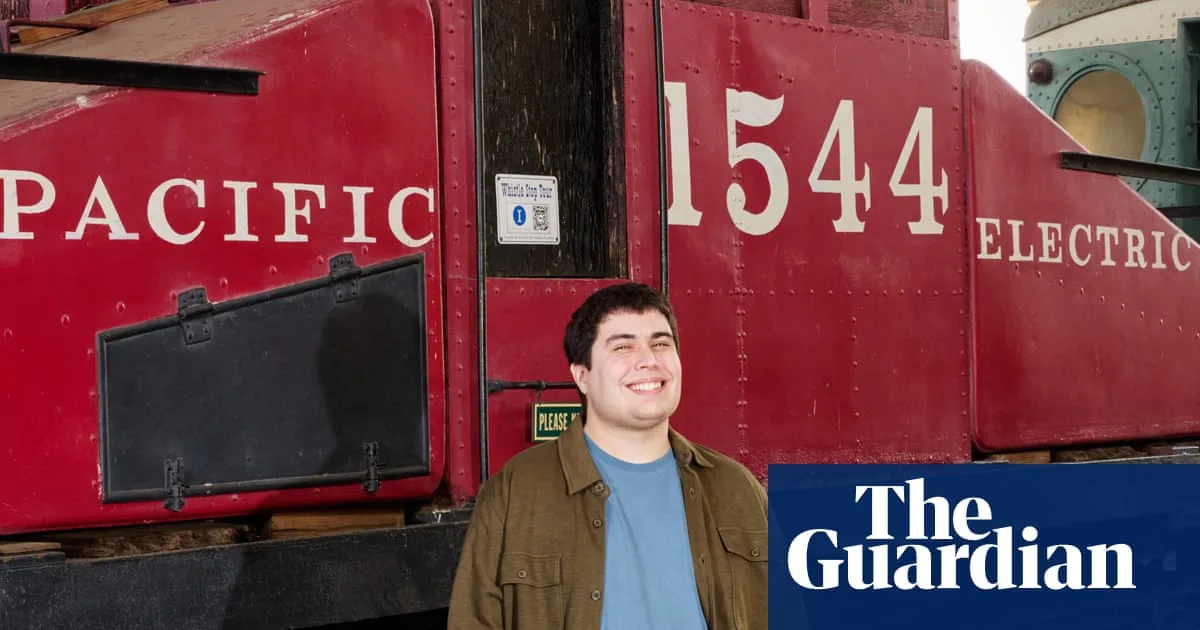
The author Woody Brown feels similarly touched with magic, having swerved the hell of adult care in pursuit of a professional writing career. He's the first non-speaking autistic graduate of UCLA and a 2024 alumnus of the writing programme at Columbia University; Upward Bound, his triumphant first novel, looks back not with anger but with compassion and grace. Brown feels for the centre's exhausted staff almost as much as he does for its mouldering, desperate 'clients', who are forced to map out their days with pointless time-wasting activities. Upward Bound – a jailbreak story of sorts – suggests that practically everyone here has been falsely imprisoned. His book is the literary equivalent of sending the ladder back down.
'I am the echolalic kid,' explains Walter, the tale's autistic main player and presumably Brown's alter ego, who lifts lines from Thomas the Tank Engine and Toy Story 3 as an approximation of speech and inevitably struggles to get his true message across. Walter scored straight As at community college and dreams of becoming a writer, but his prospects are dim. 'The bottom line is being able to communicate': non‑speakers rarely land even menial work. For the foreseeable future, then, he's marooned at Upward Bound, parked next to people he's known half his life but has never once spoken to. He thinks he loves Emma, a fellow client, and that she might love him back. But when they stand side by side in the rec room they might be 100 miles apart, communing on a different plane altogether, like two whales in the ocean listening out for sonic booms.
It's tempting to file Brown's illuminating insider account alongside the work of other neurodivergent artists – Turner prize-winner Nnena Kalu; the architectural illustrator Stephen Wiltshire – except that this would only be reaching for another crude holding pen. Upward Bound is at pains to emphasise the difference of its characters – the range of conditions and presentations that complicate this community of outcasts. No one person is alike or even necessarily on the same page, and so the book gives us multiple viewpoints, occasionally of the same scene. Its lively criss-crossing structure weaves from first person to third, and from Walter through the staff and the clients, casually exploding the lie that autistic people lack empathy.
There are no monsters or villains inside Upward Bound. Jorge, the hulking problem case, only wants more time with his comfort toy. Dave, the stressed-out manager, is stressed out for a reason. At one point the perspective hops out of the centre altogether to frame the thoughts of Avery, a bored Target checkout girl. The inmates are brought in by bus every Friday and she observes their unhurried comings and goings. 'The weird group slowly moves into the store,' she reports. 'There are 10 people and two handlers. People. Of course they're people. It's just that they look fuzzy around the edges, as if they haven't fully materialised after their interplanetary transport.' Brown's prose draws connections and pulls his figures into focus. Avery is at least curious, and she watches the group with sharp eyes.
This tolerant spirit extends to the daycare centre itself. It's 'an insane asylum', Walter tells us. 'A dead-end way-station.' And yet for at least one of the staff, the place is a lifeline. Carlos is the closest thing Upward Bound has to a saint, a tattooed former tearaway who finds his purpose and passion in his work as a carer. The novel is episodic, a series of vivid character sketches. But it is Carlos's hunt for the absconded Jorge that gathers its threads and forces them to a climax.
As for Brown, his story arc as a novelist is just getting started, and it's hard to imagine a more vertiginous lift-off than this. His book is flawed in the way that most good first novels are flawed: it overexplains, provides too much exposition. But it is also a vital insider's perspective, a garrulous, charming story of a young man stuck in a daycare centre for disabled adults.