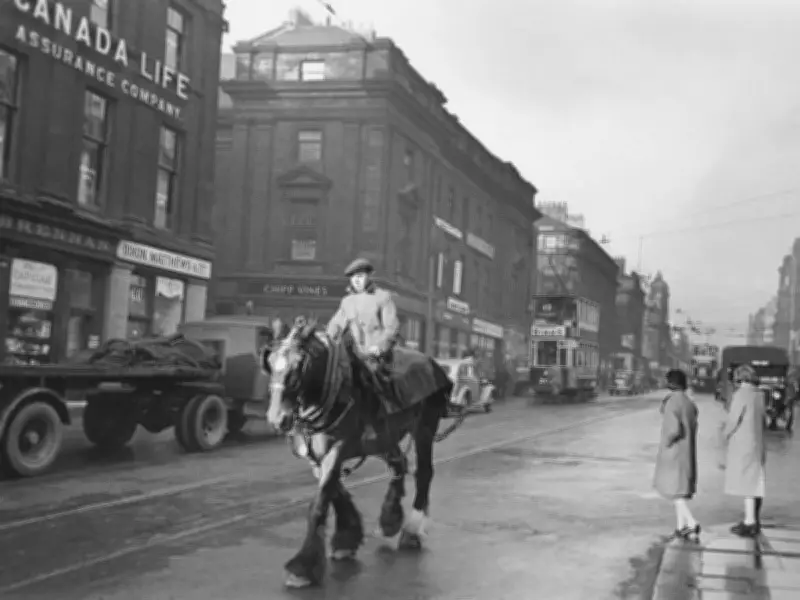
More than 900 rediscovered photographs of Britain in the 1930s, including scenes from Newcastle and the North East, have been published in a new book, Britain in the 1930s, released on November 5. The black and white images offer a rare glimpse of life in the region at a time when the country stood on the brink of major change.
The photos capture streets in Newcastle, the iconic quayside, and the coastal market town of Berwick in Northumberland, alongside other locations such as Whitby, Scarborough and Robin Hood's Bay in Yorkshire. Many of the landscapes remain recognisable today, though the communities living and working there would soon be transformed by the Second World War.
A Decade of Contrasts in the North East
The book, which has been 15 years in the making, documents a decade in which old ways of life endured even as Britain embraced the modern age. Among the images is one of Pilgrim Street in Newcastle city centre, showing a man riding a workhorse in the foreground while trams and cars appear in the background. Another shows people enjoying the view from the West Cliff at Whitby in 1935.
Historian and conservationist Steven Brindle, one of the book's authors, said: "In the North East the 1930s were associated with mass unemployment, with the Jarrow march and the Great Depression and that is a really important aspect of the decade. But of course it's never the whole picture."
Three Visions of 1930s Britain
Brindle described three distinct aspects of England and Britain in the 1930s. The first, "Old England," encompassed the countryside, villages, market towns, farms, mediaeval churches and country houses that continued as they always had. The second was the Victorian world, which was especially strong in the North East, with shipbuilding on the Tyne, chemical industries and steel making on the Tees, the Armstrong Ordnance work in Newcastle at Elswick, and Newcastle Station and the railways.
"That whole world was having a real battering from the Depression," Brindle said. "But alongside that there was a newer England, a newer kind of society coming into being, which went with new industries - the spread of electrification to ordinary households alongside gas, which had really powered the Victorian world, and greater prosperity for ordinary people - for working class and lower middle class people."
Signs of a New Era
Brindle noted that the new world of the 1930s could be seen in the North East in cinemas, seaside resorts, more people taking seaside holidays, and semi-detached houses spreading outside towns and cities. The 616-page coffee table book, written by Brindle and Maureen Hill and published by Atlantic, includes a range of North East images from the period.