
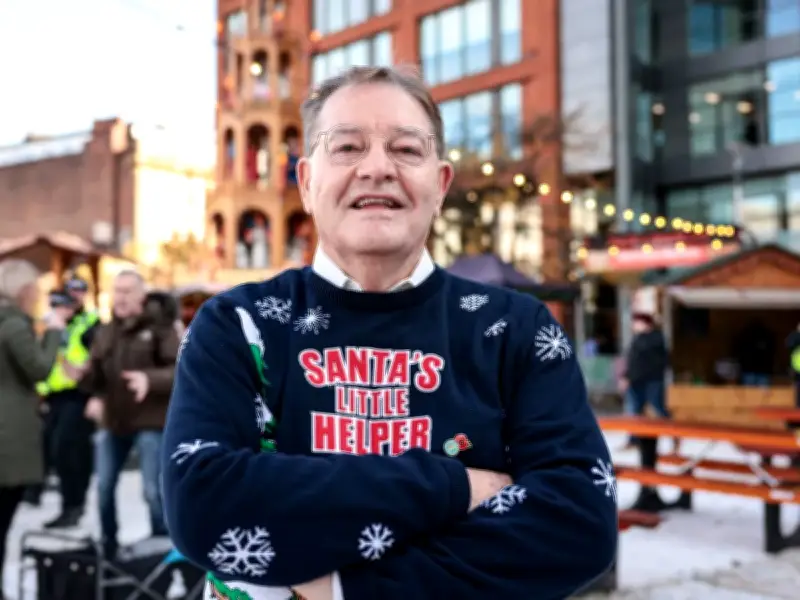
Councillor Pat Karney, known to generations as 'Mr Manchester', has died aged 78. He was one of the city's most prominent and well-known local politicians, serving as a councillor in Harpurhey from 1979.
The last time I saw Pat Karney he was in great spirits. “We all have to wear these now,” he said with a wry smile as he pointed to the Andy Burnham T-shirt beneath his tracksuit jacket. “They’re standard issue council uniform.” That was Pat - funny, playful, loved a prop.
As he sat across the table from me at the Manchester Evening News’ offices last month, he joked about how odd it was to see ‘Andy’ as Prime Minister and teased us about our extensive coverage of Mr Burnham these past few months. I had asked him to visit the office to record a podcast about the origins of Manchester Pride - something Pat certainly knew a thing or two about as part of the trailblazing 1980s council who took on a homophobic police force “and won”.
A life of service and spectacle
Extremely proud of his Irish roots, the St Patrick's Day parade was among his many obsessions - along with Piccadilly Gardens, the city centre and the Christmas Markets. He was instrumental in bringing the now annual Christmas Parade to life, after the success of the Manchester Day parade, his brainchild, began in 2010. These events, which bring joy to thousands of people each year, are a special part of Pat's legacy.
Pat loved a parade and when his home patch of Harpurhey started its own in 2025, he hailed walking in it as "the proudest moment of my life." He once even invited the mayor of Paris to the official opening of the H'Eiffel Tower - a converted chimney on top of the Harpurhey Baths illuminated with blue lights. “I think Parisians would recognise themselves in Harpurhey people,” Pat said at the time. “Like them, we are proud of our area and aspirational about our place in the world. We are also very romantic - in the summer, Rochdale Road is like the Champs Elysees.”
When Noel Gallagher’s High Flying Birds released a new single called Council Skies, it was accompanied by a music video filmed in Collyhurst and Monsall. Quick as a flash, Pat said: “Now Noel’s got a love affair with Collyhurst we’d love him to pop down and unveil [the William Mitchell concrete sculpture] for us when he’s back in Manchester in June.”
A trailblazer for gay rights
But Pat’s good humour and self-deprecation softened a formidable nature. He was one of the pivotal figures in the regeneration of the city centre following the 1996 IRA bombing, chairing the committee established to oversee its rebirth. But it was Pat’s work fighting for gay rights in Manchester at a time when LGBT people were vilified that is perhaps his greatest achievement. While religious groups termed the Gay Village ‘Satan’s Square’, Pat and his colleagues ‘put their arms around’ the district. “We had this thing that there’s no second class citizens in Manchester,” he said.
Alongside council leader Graham Stringer, Pat went on a mission to make the Village a safe space during “very dark times”. Most feared persecution, not least from Greater Manchester Police chief James Anderton who used his position to order brutal raids on gay venues in Manchester. After a large-scale police raid on the Village’s oldest bar, Napoleons, under a Victorian law citing ‘licentious dancing’, the matter came before the council’s licensing department.
Recalling the moment with acerbic wit, Pat said recently: “We said: ‘Why don't you catch some burglars or car thieves or something? Why are you stopping men dancing? Is that a priority?’.” “We stood up to them and we said: ‘no, the license continues at Napoleons’. Slowly and surely they didn't want to take on the council. We learnt that we had a powerful platform.” Mr Stringer, who was a close friend of Pat’s for decades, today said: “Manchester has lost one of its most significant figures over the past 50 years, and I've lost a friend.”
‘He was a civic institution’
Greater Manchester mayor Bev Craig says Pat was “a force of nature” and a “trailblazer in politics, someone who sacrificed a lot to be himself”. “Through Manchester’s renaissance, Pat championed making our city what it is today from the regeneration of the city centre, improving the health of Manchester people, to the creation of Manchester Day - he was incredibly proud of Manchester and recognised the need to bring people together.”
Among those paying tribute today was Andy Burnham, who hailed Pat as “a tireless champion for the people he represented”. “Pat gave nearly 50 years of his life to serving Manchester. He saw the city through some of its toughest times and played his part in the growth and transformation that followed.”
Speaking to my current and former colleagues about Pat today, one key characteristic has consistently shone through. His kindness. It’s a quality former M.E.N Politics editor Jen Williams recalls from her early days as a young reporter making sense of the council. But she also remembers “a more complicated person and sophisticated politician than his public persona as the city centre showman”. She says: “He was highly intelligent and cared deeply about the city, but was also a constant source of entertainment. I will remember his obsession with the drama of US politics, his perennial willingness to set up a taskforce on any issue of concern, for his face cream recommendations and for once comparing Rochdale Road to the Champs Elysees. He was a civic institution. I will miss him and Manchester will be a poorer place without him.”
As our former Politics Writer Jo Timan says, Pat was “a deeply intellectual, incredibly effective and emotionally intelligent man” who made Manchester what it is today. “Returning to his deindustrialising hometown after studying at the London School of Economics, he helped turn the city from a place in decline that people were desperate to leave, run by socially conservative homophobes, into a thriving, successful and fun-loving safe haven for all.”
Jo adds: “You might think from all the silly stunts that he loved the spotlight - and maybe he did. But it was never about him. He often put his pride aside for a greater good, whether it was returning to his hometown to help turn it around when he had a chance to get out, as so many others dreamed of, or getting down on his hands and knees in a ridiculous outfit to draw attention to a serious issue. For Pat, it was always about Manchester and he would do whatever it took to make it happen.”
A book of condolence was opened today at Manchester Central Library, where a flag will be flying at half-mast in tribute.




