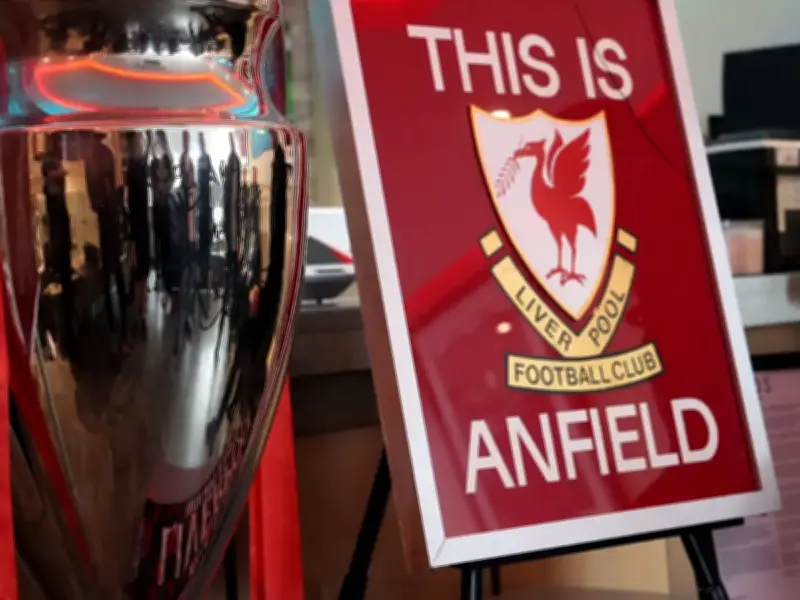
The original 'This Is Anfield' sign, first hung in the players' tunnel at Anfield in 1972, has returned to the area after decades away, unveiled at The ARC Hotel on Anfield Road on Friday (Oct 9). Former Liverpool captain Phil Thompson, who was handed his debut by Bill Shankly the year the sign was first displayed, unveiled the sign to media, auctioneers and members of the Shankly family.
A ritual of intimidation since 1972
The sign was first hung at the behest of legendary manager Shankly, who is said to have rejected a suggestion to place a sign bearing the phrase 'Welcome To Anfield' before suggesting its less friendly - and now notorious - phrasing. Touching it prior to entering the pitch became a rite of passage for Liverpool's players and a ritual of intimidation for their opponents.
The historic sign has been replaced at least twice since its original iteration, which passed to the Wilson family in the Isle of Man, where it was displayed in the family's Rutland Hotel in Douglas until 2000. Auctioneers Budds put the sign under the hammer last month, where it fetched £115,000 - nearly eight times the guide price - from an unknown buyer. It will now be displayed at The ARC Hotel on Anfield Road, just metres from its original home inside the ground.
Thompson and Shankly's family react
Thompson, who won the First Division title in 1980 and the European Cup in 1981 as captain, told the ECHO: "It's wonderful [to see the sign return to the Anfield area]. Somebody said to me just before that it looks a bit old - come on, get a life. Of course it's going to be old, it's from back in 1972! And it should be like that, because that's quite unique; you've got this crack in it here - nobody knows how and why that's come about."
He added: "'This Is Anfield'. Bill Shankly made that more intimidating because, as legend does go, the groundsman said why don't you put up a sign there in the tunnel: 'Welcome To Anfield'? But that makes it too nice, 'welcome'. 'This Is Anfield' is more intimidating, has more impact. And I think that was Bill Shankly all over. He was different, he was unique."
On whether the sign helped instil an atmosphere of intimidation for opposition teams, Thompson said: "I do think it grew legs. It grew its own identity. And we never came out both teams together back in the day. We either went out first, or the opposition went out before us. So we would all come out, everybody. I'd be a young player, they'd all be coming down the steps and you would have to touch this sign. But they also knew the opposition, if they were coming out behind you or they're waiting at the top of the stairs for us to go out, they're looking at everybody - and 'This Is Anfield'. Because most players back in the day were English, Irish, Scottish or Welsh, so you all knew about this. And I did think it had this intimidation about it, so it had exactly what Shankly demanded from it."
Shankly's legacy lives on
Chris Carline and Karen Gill, grandchildren of Bill Shankly, were present at the unveiling. Chris told the ECHO: "[We're] obviously incredibly proud. We were saying before as well, it's such a fundamental building block in Liverpool's history and in the Anfield atmosphere as well. That statement - 'This Is Anfield' - is certainly quite profound and had the desired effect on the opposition over the years, and obviously has gone on to build that reputation that Anfield's got for its atmosphere. So yeah, incredibly proud to see it back in Liverpool 4."
Karen said: "He was a motivator, and if he could use anything at all to motivate his players, he would have used everything in his power and all the tools that would have come out. So I'm sure that was used in team talks and things like that, because that's a perfect way to put the fear of God into the opposition, isn't it? And obviously we know about his many different tactics when the opposing team were arriving on the bus and things. One of my favourites is when he would hand out toilet paper to the opposition as they arrived. So I think that was quite a good way to get people to be a bit scared before the match."
In a quote now emblazoned inside the stadium, Shankly once said of the sign: "It is there to remind our lads who they're playing for, and to remind the opposition who they're playing against." With the second iteration of the sign restored to its place in the tunnel by then-manager Brendan Rodgers in 2012, and the iconic design remaining an emblem of the club, Shankly's legacy continues to burn bright at Liverpool.