In 1894, late-Victorian Britain stood as a major world power, driven by industry and an empire spanning a quarter of the globe, policed by the Royal Navy. Newcastle was a booming industrial and commercial hub, defined by coal, shipbuilding, and engineering, with a proud neoclassical architecture embodied by Grey Street and its Theatre Royal.
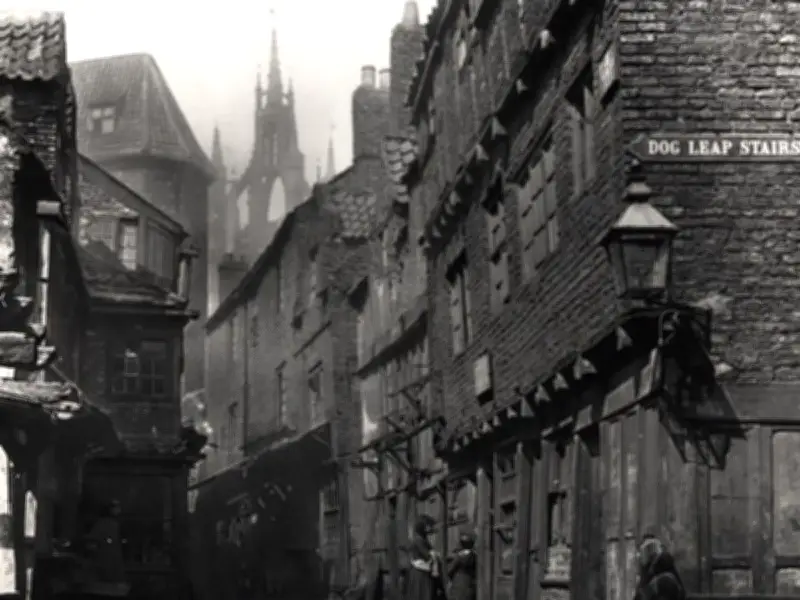
Yet behind this prosperity lay harsh poverty. Many families in the city endured slum conditions, irregular work, disease, and hunger, relying on charity and the workhouse for survival. A photograph from the era shows the grim reality of life in Newcastle's impoverished Castle Garth, an area that had grown around the Norman fortress into a cluster of courts, taverns, and workshops within the old walls.
A Densely Packed Working-Class Enclave
By the early 19th century, Castle Garth was a densely packed working-class enclave. Parts were later demolished for the Moot Hall and the High Level Bridge, and a significant area was cleared for the York, Newcastle and Berwick Railway, which cut the site in two and now forms part of the East Coast Main Line.

In the distance stands the Lantern Tower of St Nicholas' Cathedral. To the left, among crumbling buildings, sits the Black Gate, a 13th-century fortified barbican to the castle. To the right are the Dog Leap Stairs, a steep medieval passageway linking Castle Garth with Side and the Quayside.
Lawlessness in the 19th Century
Contemporary newspapers reveal Castle Garth could be lawless. In September 1869, The Journal reported that Fred Kelly and James Dryden attacked an Irishman, Patrick Gallagher, with a poker and coal rake, causing six serious injuries to his head and face. The bench, describing the defendants as "wild beasts," sentenced them to two months in prison with hard labour.
In April 1876, Frank Connelly was reported to have violently assaulted Ralph Stark at the head of the Dog Leap Stairs, knocking him down and kicking him. Connelly returned after a few minutes and kicked Stark again, saying: "When I begin a job I like to finish it."
In June 1880, under the headline "Suicide in Newcastle gaol," a labourer named George Robson was found hanged in his cell, having been sent down for an "aggravated assault on a girl five years of age while in the Dog Leap Tavern, Castle Garth."
From Slum to Heritage Attraction
By the turn of the 20th century, the Castle Garth slum dwellings had been swept away, with residents dispersed across Newcastle to the Quayside, Sandgate, Manors, Ouseburn, and the terraces of Benwell and Elswick.
Today, the area is part of a heritage attraction centred around the Castle Keep and Black Gate, branded as Newcastle Castle since 2015. It offers a vivid sense of old Newcastle.