Stirling, a small Scottish city with a volcanic centre, is the place to go this autumn. Holidaymakers are keen to visit, according to an Expedia study, which found interest in visiting has risen 90% since last year. It's easy to see why, given how much the city of 38,000 has to offer.
A stay with views and a gateway to the Highlands
When I visited, I stayed at Stirling Youth Hostel, set in the grounds of stunning Erskine Church, just a short walk from historic Stirling Castle, high above the town center. It offers magnificent views over the surrounding area, as well as great-value rooms. Beds in a dorm go for as little as £22 and rooms £90. It's a warm and welcoming space, perfect for sheltering from the rain when it comes, and for meeting fellow travellers over a hearty Scottish breakfast come the morning.
I stopped in Stirling on my way to the mountains, which is apt, given the city's nickname as the Gateway to the Highlands. It sits north of Edinburgh and Glasgow, between the two, making it a natural stopping point as you head further north.

Stirling Castle: a 900-year history
The first thing you'll notice as you drive into the city is Stirling Castle, the undoubted headline draw and one of Scotland's grandest castles. It sits perched above the town on a volcanic crag with sweeping views over the surrounding plains. The castle has a 900-year history, which arguably peaked in the early 1500s, when Italian alchemist John Damian de Falcuis became so embarrassed by his failed attempts to create gold that he decided to impress King James IV by flying from Stirling to France.
In December 1507, he arrived at the castle wearing huge wings, clambering to the top of the wall, and then launching himself off, a la Buzz Lightyear. Somewhat predictably, he fell with style, crashing into the ground and breaking his leg. A similarly vertiginous incident had happened 50 years before, when King James II launched Earl William Douglas out of the castle window at the end of a testy dinner in which they failed to settle their differences.
Given its rich history and the magnificence of the structure, the castle is well worth a visit today. It costs £18.50 for adults and £11 for kids.
Independent shops and historic streets
Heading down from the castle will take you along the cobbled High Street and then to Murray Place, the Craigs, Port Street, Barnton Street, Friars Street, the old Arcade, and King Street. The latter is a historic thoroughfare made up of local sandstone buildings, independent stores such as Made in Stirling, which supports local talent from across the region, and specialists in Scottish treats, Contempo.
King Street runs into the Stirling Arcade, a beautifully restored Victorian thoroughfare that is home to a number of surprising independent shops, including the Justice Comics store, an axe-throwing parlour, and SRTD Vintage - a high concept second-hand clothing store. Music fans will find a lot of joy in Europa Music, one of Stirling's longest-standing independent record shops, with a strong collection of vinyl, CDs, and memorabilia.
While Scotland has a strong claim to be the best of the home nations, where it can fall down is in its pubs. Glasgow and Edinburgh are largely exempt from this sweeping criticism, but too many Highlands pubs pair stunning views of the mountains with pebble-dash walls and drab interiors. Stirling does a solid job of bucking this trend. A favourite of mine is Nicky Tam's on Baker Street. It dates back to 1718, one of the oldest bars in the city, and is a cosy spot to enjoy a whisky and, occasionally, some live music. At the complete other end of the spectrum, a warm welcome is offered by Slanj-A-Va, which specialises in indie bands and smashed-looking burgers and sticky wings.
Monuments to Scottish heroes
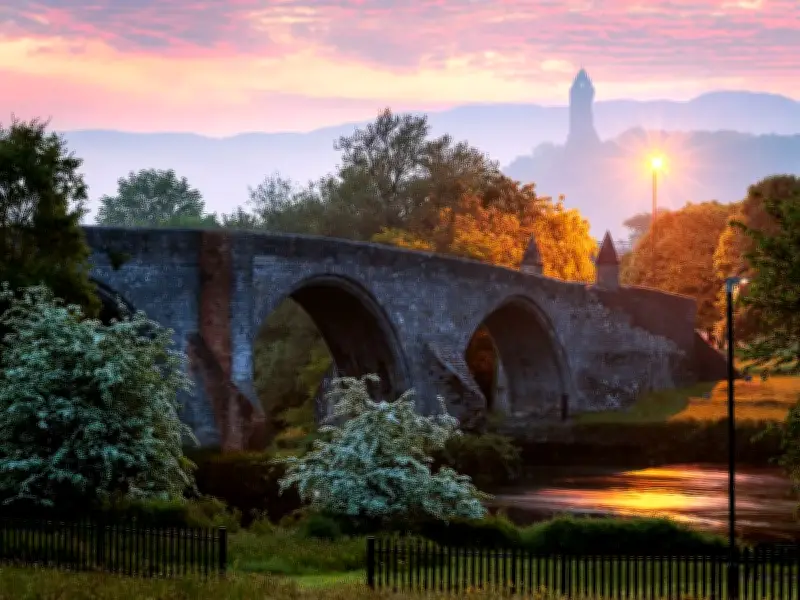
It wouldn't be a Scottish city if it didn't have a William Wallace reference. And so to with Stirling, where the National Wallace Monument, a striking tower on Abbey Craig, rises up above the city. It sits on fields where Wallace led his troops to victory at the Battle of Stirling Bridge and tells the story of the patriot and martyr who became Scotland's National Hero.

Another Scottish hero is commemorated at the Battle of Bannockburn site, where Robert the Bruce defeated the English in 1314. For £9.50 for adults and £8 for kids, you can experience an immersive digital recreation of the battle. The last major historical monument to visit in Stirling is the Church of the Holy Rude, an iconic religious building with a rich and fascinating history spanning six centuries. The Church has played an integral role in many significant events in Scottish history, from the Battle of Stirling Bridge to the coronation of King James VI. It has stunning stained-glass windows, intricate stonework and a peaceful atmosphere.