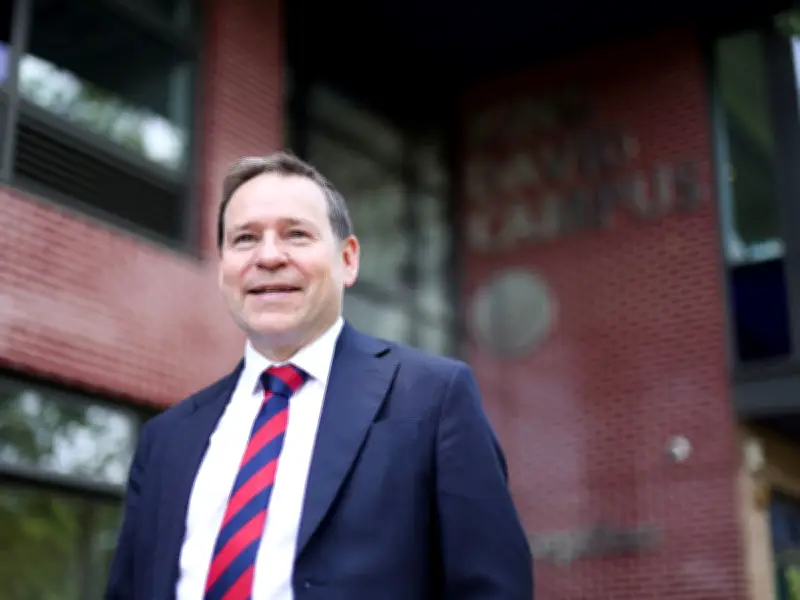
Michael Sutton, headteacher of King David Secondary School in Liverpool, has spoken candidly about the realities of leading a Jewish school during a global surge in anti-Semitic hate crimes. A former science teacher at Liverpool College in the 1990s, Sutton took a brief career break before joining King David, where he has served as headteacher for the past nine years. With decades in education, he acknowledged the stark differences between King David and other schools he has worked at.
Heightened security measures
“We’ve got a different level of security from other schools, but that’s been a fact since the day I arrived. It is a bigger factor here than in any school I’ve ever experienced,” Sutton told the ECHO. The 54-year-old described his role as multifaceted: “I’ve become used to dealing with so many different things that if you wrote the job description, you wouldn’t necessarily expect it. You get into a frame of mind that you are just going to do what you need to do. But it all comes down to ‘have you got your guiding principles and ethics?’”
Jewish values at the core
Although only about 12% of secondary school students are Jewish, Sutton emphasised that core Jewish values are central to the school’s ethos. “We are proudly a Jewish Orthodox school, and that means that we teach a lot of good things to everybody about the importance of considering each other. The phrase we use is Kehila. There are apparently three words for community in Hebrew,” he said. “The best type of community is Kehila, where every single member of the community is integral to that community, is a living part of it, is respected and that respect also means that you take responsibility too. That’s what we teach as a whole school, and we have pushed that since I became head.”
Impact of October 7 attacks
The last 12 months have been particularly challenging for the Jewish community worldwide. Recent months have seen a sharp rise in reported hate crimes against the UK’s Jewish community, with the aftermath of the October 7, 2023 attacks bringing fear to the school. On that day, the Palestinian terrorist group Hamas led a coordinated attack on Israel, killing 1,195 people, including an estimated 364 attendees of the Nova Music Festival.
Sutton recalled: “It took place on the Saturday and on the Monday we had this whole school assembly which was very much about trying to reassure [everyone]. At the time, we had students who had lost relatives, we had members of staff and students who were worried about relatives or relations over in Israel.” He added: “So we sent out messages reassuring people about safety and security, but also gave them pieces of advice about not congregating outside the school gates. It’s a balancing act about making sure that people feel safe and secure here without turning it into always having to be extra vigilant.”
Parental concerns and security
“At that time some people were suggesting we should get a lot more security, and asking where it was and why we weren’t getting it. And we’re like ‘No, we are secure. Don’t worry.’ But, for example, we were getting messages from parents saying ‘someone wasn’t where they should have been at whatever time’, or ‘I’m really worried’ – any of those little things sometimes get amplified.”
According to the Community Security Trust (CST), 2023 was the highest year on record for anti-Semitic incidents. In 2025, the UK recorded 3,700 examples of anti-Semitism, a 4% increase from the previous year, with 200 cases reported monthly.
Educational initiatives
Despite concerns from parents and students, Sutton said the school is actively educating pupils about global events. “It is more difficult with the young ones, but with the older students, we do workshops and there’s an organisation called Solutions Not Sides,” he explained. “Last year, it was a Palestinian lady and a Jewish lady from Israel who came in together, talked about the problems, talked about the history, but also the current reality, and what the possible solutions could be, to bring about an end to the conflict. They did a workshop with students, and the students do a lot of the work too but the whole point is, look, we can work together. I think that’s been very constructive.”
Student unity and hope
Amid the difficult times, Sutton finds hope in the unity of his students. “When they [the students] are playing at lunch, sometimes they turn it into a weekly football cup competition. One week it became the Kosher Cup, but then when it was closer to Eid, it became the Eid Cup. Now, that’s the kids who did that. We didn’t tell them to do that. It’s Muslims, Jews, Christians all playing together.”