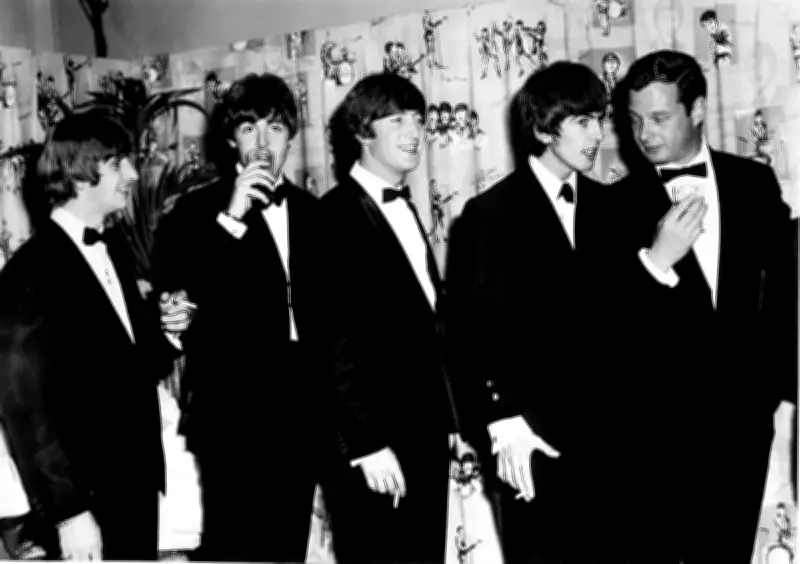
Spandau Ballet's Gary Kemp paid £10,710 at auction for an address book that once belonged to Beatles manager Brian Epstein. The 160x100mm black Twinlock binder, containing 57 pages with 404 entries, many handwritten by Epstein himself, catalogued his social and business network in 1967, the year of his death.
Kemp, who was bidding by phone from a recording studio, said he felt he had to have it: “I just thought, ‘I’ve got to have this. I’ve got to hold it. It’s got DNA on it.’” As the price soared, he kept pressing the yes button, thinking, “My wife’s going to kill me for this!”
From auction to book
The book, 1967: The World of Brian Epstein and the Beatles, co-authored with film-maker Simon Halfon, is not a traditional biography. Instead, it presents an alphabetical list of fragments that, read in sequence, reveal an intimate picture of Epstein in the last months of his life. Kemp and Halfon spent months scouring books, newspapers, magazines and online archives to identify each contact and why they crossed paths with Epstein.
Halfon, who had previously worked on a biopic of Epstein with Jude Law attached to star, saw the address book as a different story. “An address book in many ways is a very personal thing. It’s not a diary, but it tells you who your friends are, your family, your business acquaintances, the places you hang out,” he said.
A tormented final year
The book captures Epstein juggling the Beatles' increasingly elaborate business affairs while wrestling with personal torment. His contract with the Beatles was up, and the group had stopped playing live, leaving him with less purpose. In January 1967, he merged NEMS Enterprises with Robert Stigwood's agency, causing friction with the Beatles. “He’s terrified. He finds these boys who he transforms into the biggest phenomenon the world has seen, but then it starts to run away from him. And we’re at this stage now where he is panicked. He can’t sleep. He’s taking uppers and downers,” said Kemp.
Epstein's drug use, his Jewishness, and his homosexuality—still a criminal offence at the time—contributed to his isolation. “There’s such a strong sense of the gay community within the book,” said Kemp, noting figures like his lawyer David Jacobs and Robin Maugham. Despite the breadth of his orbit, Epstein emerges as lonely. “He couldn’t find a relationship,” Kemp said.
A tragic end
One of the most disturbing contacts is John “Dizz” Gillespie, an aspiring American actor with whom Epstein had a volatile affair. In August 1966, Gillespie stole Epstein's attache case from his Los Angeles hotel room, making off with $20,000, contracts, incriminating photographs, and possibly his previous address book. Epstein died alone on 27 August, aged 32, of an accidental overdose of sleeping pills. Kemp imagines Epstein reaching for the address book in his final hours: “It was almost certainly on his bed when he was found dead, because he was calling people, and he would have been calling people using that book.”
Kemp said he came out of the project knowing Epstein more: “I felt I’d walked with him down different streets.” Halfon added, “It’d just be nice to push Brian slightly to the foreground. It’s very hard to stand in front of the Beatles in a way, as a character, because they’re so larger than life. But people can say, ‘Well, this was the guy who made their dream come true.’” The book is published by HarperCollins at £25 on 13 October.