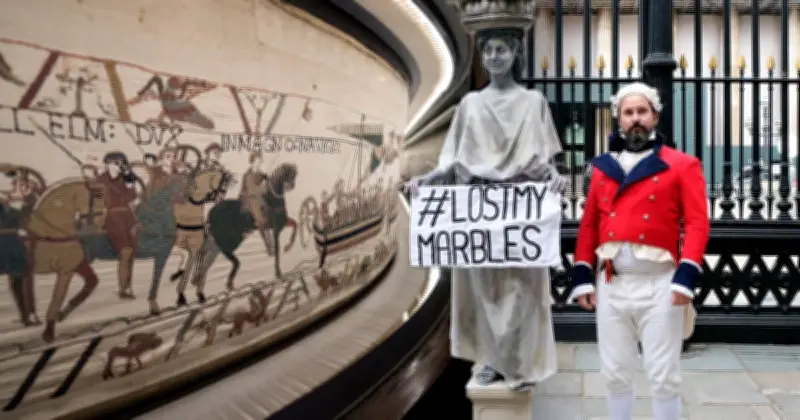
Thousands are visiting the Bayeux Tapestry at the British Museum after France loaned it to the UK, sparking debate over whether it should be returned or kept permanently. The 230-ft work, detailing events around the Norman Conquest in 1066, was almost certainly woven in Kent by Anglo-Saxon women, not in France. Probably commissioned by Bishop Odo, half-brother of William the Conqueror, to commemorate victory over King Harold’s forces at the Battle of Hastings, it was designed for Bayeux Cathedral in Normandy. The Normans relied on English needleworkers to produce the masterpiece, which is technically an embroidery, not a tapestry.
Calls for Repatriation of 'Canterbury Embroidery'
The relic’s real origin has led to calls for repatriation of what some say should be re-titled The Canterbury Embroidery. A current parliamentary petition urges the government “to seek to negotiate with France to permanently keep the Bayeux Tapestry in the UK. As a masterpiece which many historians believe was created by Anglo-Saxons, depicting Norman England's birth, we think this foundation monument of our monarchy and state belongs in the UK”. It continues: “While it will be loaned to the British Museum, we think it should remain here permanently”, describing it as a “vital piece of our national identity.”
This comes amid years of calls for UK institutions to repatriate historic items from foreign lands, most famously the Elgin Marbles, sculptures legally removed from the Parthenon in Athens by Lord Elgin in the early 1800s and sold to the British Museum. Greece wants them back. Campaigns also exist for the Rosetta Stone to go to Egypt, the Benin Bronzes to Nigeria, and the Koh-i-Noor diamond to India.
British Artefacts Abroad
Strangely, there is little outrage over artefacts originating in Britain that ended up abroad, including Royal letters, ancient manuscripts, and historic buildings. Some were bought, others given away, and some pinched. Among the most intriguing examples are 17 love letters written by Henry VIII to Anne Boleyn during their courtship in the late 1520s, when Henry was still married to Catherine of Aragon. In one, the Tudor monarch expresses his desire to kiss Anne’s “pritty duckys” – slang for her breasts.
The missives mysteriously went missing – probably stolen from Anne for political purposes – and ended up in the Vatican Library in Italy, where they reside today. No-one knows how they got there, an ironic resting place given Henry’s break with Rome over his bid to marry Anne. The Italians also have The Codex Amiatinus, the oldest complete Latin Bible, created by monks in Jarrow Abbey, Northumbria, then given to Pope Gregory II in 716AD. The 75lb, 1,040-page vellum manuscript is in the Laurentian Library in Florence; Jarrow has only a replica.
Historic Ships and Buildings
The Rijksmuseum in Amsterdam holds what remains of the 17th century English flagship HMS Royal Charles, seized by the Dutch navy during a raid on the River Medway in 1667 and towed to the Netherlands. Its 12ft x 9ft stern carving of the Royal coat of arms survived and has been loaned to the National Maritime Museum. Calls have also been made to repatriate the Pennal Letter from Welsh hero Owain Glyndŵr, written in 1406 to Charles VI of France, kept in the French National Library in Paris. Motions in the House of Commons to return it to Wales have fallen on deaf ears.
Even historic buildings have been exported. In the 1920s, US publisher William Randolph Hearst bought interiors of Gwydir Castle in North Wales; a panelled dining room from the 1640s was brought back in the 1990s, but panelling and fireplace from the Tudor oak parlour are still missing. Hearst also purchased Georgian rooms from Sutton Scarsdale Hall in Derbyshire, some later used as film sets, now in California’s Huntington Library and Philadelphia Museum of Art. Entire stately homes have gone too, such as Agecroft Hall, a Tudor mansion from Lancashire, transported and reconstructed in Richmond, Virginia.
Captain Cook’s Cottage is now in a park in Melbourne, Australia. The 18th century property, built by the parents of James Cook, stood in Great Ayton, North Yorkshire, until 1933 when the owner put it up for sale insisting it stay in England. Aussie businessman Russell Grimwade persuaded the seller to change the listing to “Empire”, bought it for £800, and gave it to the state of Victoria. It was shipped over in 253 cases and 40 barrels, then rebuilt. St Mary Aldermanbury, designed by Sir Christopher Wren, was gutted in the Blitz and went to an American college in Fulton, Missouri; its 7,000 stones were dismantled and rebuilt there. London Bridge, designed by John Rennie in 1831, was sold to US oil tycoon Robert Paxton McCulloch in 1967 for £1million when found to be sinking, and now sits in Lake Havasu City, Arizona.
Export Bans and Negotiations
The government can impose temporary export bans on cultural works to allow time for funds to be raised, which has helped save items like Jane Austen’s ring, but not stopped others like JMW Turner’s painting Campo Vaccino departing for a US museum. It might not be feasible or desirable to have all exiled national treasures back, but enquiries could start about the Bayeux Tapestry’s proper place. Perhaps a negotiation could hand over Marie Antoinette’s writing desk, currently in The Wallace Collection, London, to the French in return – and maybe throw in one or two impressionist paintings from the National Gallery. The serious point is that those who seek a wholesale, woke clear out of museums of foreign-origin artefacts would do well to remember that it has not been entirely one-way traffic down the centuries; the rest of the world benefits from some of Britain’s historic treasures too.