Tate Britain presents a luscious, seductive blockbuster dedicated to James McNeill Whistler, the American painter who delighted and scandalised late Victorian Britain. This insightful show celebrates his pioneering spirit, torn between painting beauty for beauty's sake and cutting through the glitz of his era.
The Iconic Portrait
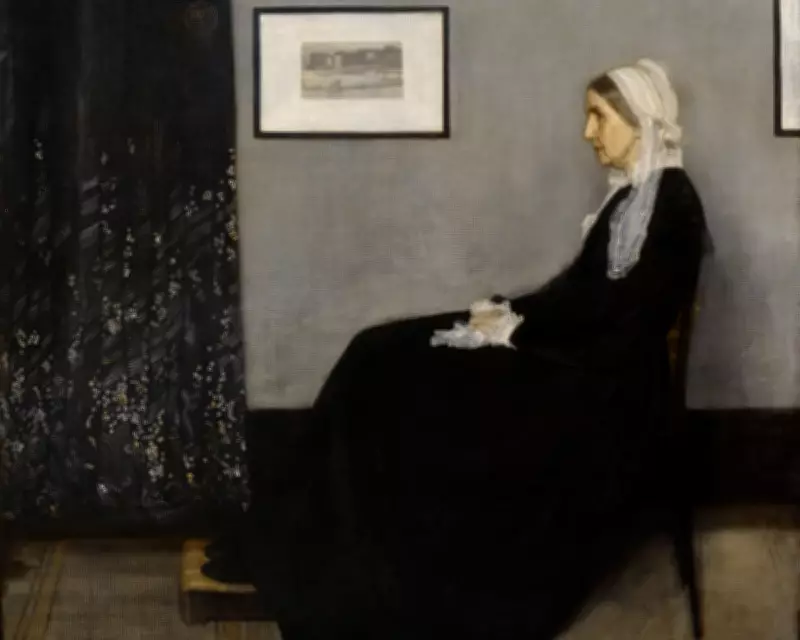
At the heart of the exhibition is Arrangement in Grey and Black No 1, better known as Whistler's Mother, lent by the Musee d'Orsay. Anna McNeill Whistler's face is rigid and cold, yet the starbursts of silver on the curtain and her silhouette transform her into a symbol of art for art's sake. Whistler competed with Walter Pater and Oscar Wilde for leadership of the Aesthetic Movement, which argued that art has no responsibility to depict real life or serve a moral purpose. The cosmic curtain and carefully composed pattern serve as the movement's earliest manifesto.
Two Sides of Whistler
The show reveals that Whistler himself is partly his mother. The abstract vision of beauty and Anna's bony reality are two sides of the artist. One part wants to paint beauty for its own sake, while the other is a hard-bitten observer, suspicious of the very glitz he creates. At the far end of the gallery hangs his raw 1860s masterpiece Wapping. The Thames glistens with lurid colours, likely caused by pollution, while his model and lover Joanna Hiffernan leans back sensually on a dockside terrace. This louche, honest evocation of modern city life rivals the work of French avant-garde artists like Courbet and Manet.

Artistic Independence
In 1865, Whistler suddenly paints the sea as if it were silk decorated with white lace. Green and Grey, Channel is a stunning declaration of artistic independence, treating the sea as a painterly plaything. The exhibition follows Whistler's subjective quest to arrange the world, including a reconstruction of The Peacock Room, an extravagant installation for patron Frederick Leyland. At its heart hangs the original cartoon of Whistler and Leyland as fighting peacocks.
Modernist Pioneer
Whistler's free celebrations of colour and pattern anticipate Klimt and Pollock. His nocturnes, like Nocturne: Blue and Gold – Old Battersea Bridge, capture haunting views of London with tiny gold fireworks in twilight. Japanese prints and porcelain reveal his ideal of art that is both abstract and accurate. Yet in Symphony in White, No 2: The Little White Girl, Hiffernan's face in the mirror is tired and melancholic, showing that all this beauty is a bore. James McNeill Whistler is at Tate Britain from 21 May to 27 September.