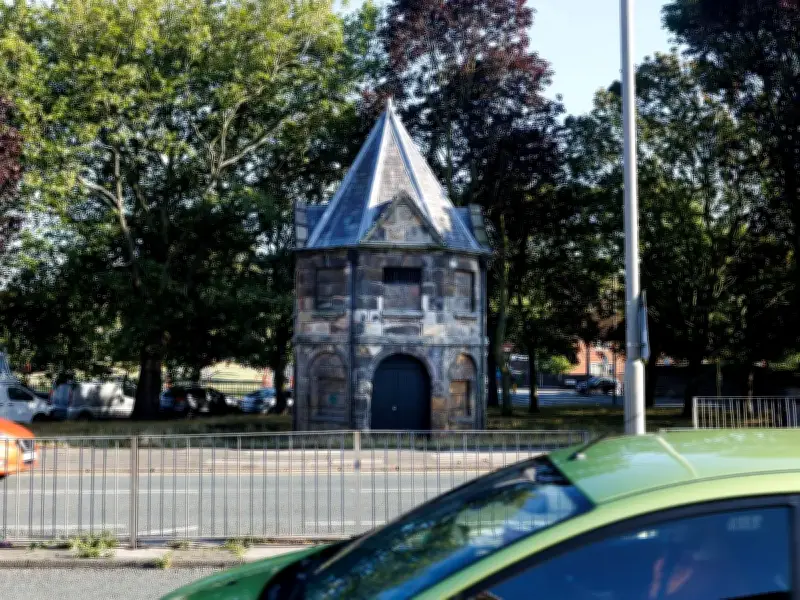
Wavertree Lock-Up, an unassuming building beside a busy road, was once a feared village jail where drunks were packed in overnight. Built in 1796, it played a prominent role in tackling a wave of drunkenness and petty crime that plagued the area in the late 1700s.
Crime Wave Leads to Village Jail
In the late-1700s, Wavertree attracted visitors to its attractions, including a large meadow with a lake free for swimming. However, as night fell, the area's taverns filled up, and rowdiness became a serious issue.
Local historian Ken Pye told the ECHO: "People came to Wavertree to sample all the local attractions in a clean setting with fresh air and friendly people. However, far too many of these visitors were soon overstaying their welcome and also drinking far too much in the taverns. Drunkenness, rowdiness, noise, altercations, and petty crime were now becoming such an issue that in 1796, the villagers paid for the building of a two-story village jail, known locally as the Lock-up. This stood on the village green, close to the lake."

Sheriff's Incentive and Escapes
To handle the crime wave, villagers employed a local sheriff equipped with a truncheon and handcuffs. He patrolled taverns with a large handcart, collecting drunks ejected by landlords and locking them up overnight. He was paid for each arrest, giving him a strong incentive to be thorough.
However, at night, friends of prisoners would climb onto the flat straw-and-lath roof, break holes, and lower ladders and ropes for escapes. Ken explained: "But as he was paid for each arrest, this suited the sheriff very well because he simply re-arrested them and locked them up again. He was also paid to make necessary repairs to the jail, so he was on a nice, regular little earner for every hole the mates of these drunks had knocked in the roof."
Harsh Conditions and Later Uses
Conditions inside were harsh, with no heating, no light, and no lavatories. Ken said: "The sheriff would pack them in, because the more he locked up overnight, the more money he was making. So, you could get a couple of dozen in, because it's big enough. And of course, there were two floors to it."
He added: "Once you're locked in there, in the summer, baking hot, you'd find it really uncomfortable. In the winter, freezing cold, because there's no heating in there at all. No light, and you wouldn't be allowed candles anyway, so you couldn't see, it would be pitch black. Although there were little tiny windows with iron grills in them, so there was some light. But you'd be crowded, so it would stink. The drunks would be throwing up, and no lavatories anywhere, so you'd find a corner, or not bother finding a corner."
Towards the end of the 1800s, it stopped being used as a prison and was later repurposed to isolate people suffering from cholera and dysentery during epidemics. Ken noted: "In time of plague, in times of the great epidemics of dysentery and cholera, lock-ups were used for isolating people who had got these dreadful illnesses. Today, fortunately, we don't have to use it for any of those purposes, but we just keep it as a piece of living history."
Grade-II Listing Protects Landmark
Despite no longer having an active use, its Grade-II listing makes demolition unlikely. Ken said: "I for one would lie down in front of the bulldozer if they came to try and knock it down, and I'm not alone in that. All the village would come out."
He concluded: "It's part of Wavertree's history, there's the lake itself, there's the Monk's Well, there's the tunnels under Wavertree, there's the Coffee House pub. You couldn't demolish any of these things, certainly not the Lock-up, because they make Wavertree what it is, a glorious piece of history captured in time, even though it's a modern place to live."