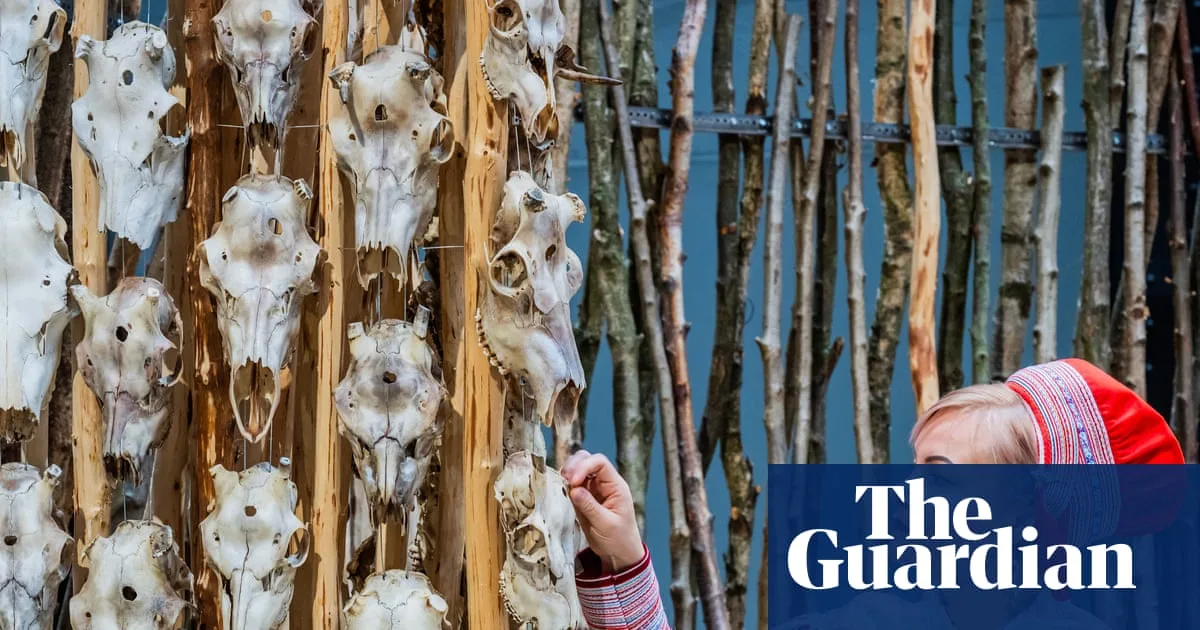
Visitors to Tate Modern are used to unusual encounters in its vast Turbine Hall, but this is the first time they will be taking a deep dive into a reindeer’s nose. The latest commission, by Indigenous Sámi artist Máret Ánne Sara, invites gallerygoers into a labyrinthine structure based on the scaled-up interior of a reindeer’s nasal passages. Once inside, they can meander round or relax on reindeer hides, listening on headphones to Sámi elders telling stories and imparting knowledge.
The installation pays tribute to a natural marvel: scientists have discovered that in under a second, the reindeer’s nose can heat the surrounding air it inhales by 80 degrees Celsius, enabling the animal to survive in inhospitable Arctic temperatures. Scaling the nose up to larger than human size, Sara says, “creates a sense of inferiority that you as a human being are not dominant over nature”. The artist, a former journalist, children’s author and land defender, comes from a reindeer-herding family in northern Norway.
The maze-like structure is one of several components in Sara’s immersive commission celebrating the culture, science and philosophy of the Sámi, Europe’s only Indigenous people. Semi-nomadic, the Sámi number roughly 100,000 people across northern Norway, Finland, Sweden and Russia’s Kola Peninsula. They have faced persecution, forced assimilation and suppression of their language by all four nations. By focusing on the reindeer, an animal at the heart of the Sámi cosmology, the work draws attention to the community’s struggles relating to the climate crisis, land dispossession and colonialism.
On the long entrance ramp, a towering 26-metre structure of reindeer hides trapped by power and light cables can be read as a metaphor for the political and economic systems constraining the Sámi. Part of the installation, titled Goavve-, refers to an extreme weather phenomenon where dense layers of ice form as fluctuating temperatures melt and refreeze snow, locking in the reindeers’ main winter food, lichen. Goavvi is a consequence of global heating, which is happening up to four times faster in the Arctic than elsewhere.
The sculpture also underscores the divergence between the western understanding of power as a resource to be harnessed for profit and the Sámi worldview of energy as an innate life force in animals, people and land. Tate Modern’s history as a coal and oil power station is tied up in this, as is what the Sámi view as green colonialism by Scandinavian states. Nordic nations have locked horns with the Sámi over windfarms, hydroelectric dams and mines on their ancestral land; the Sámi argue their human rights and way of life are threatened.